.webp&w=384&q=75)

Loading, please wait...
Loading, please wait...

In the management of adult congenital heart disease, cardiovascular biomarkers play a critical role. Specifically, recent research highlights the significance of NT-proBNP in ccTGA (congenitally corrected transposition of the great arteries) for predicting heart failure and other adverse outcomes. While clinicians frequently use these markers for acquired heart disease, this study provides much-needed data on their utility in patients with a systemic right ventricle.
Researchers conducted a study involving 152 adults with ccTGA over a longitudinal period from 2003 to 2024. They observed that nearly 30% of these patients experienced significant cardiovascular events, including heart failure hospitalization and heart transplantation. Interestingly, the study found that higher baseline levels and relative temporal changes in NT-proBNP levels directly correlated with increased event risk. Consequently, clinicians should prioritize serial measurements to identify patients needing more intensive monitoring.
Moreover, several modifiable factors were associated with elevated levels of NT-proBNP in ccTGA. These correlates include atrial fibrillation, hypertension, and right ventricular dysfunction. Interestingly, the administration of renin-angiotensin-aldosterone system (RAAS) antagonists was linked to lower biomarker levels and a reduced risk of cardiovascular events. This suggests that targeting these modifiable factors could significantly improve patient outcomes.
The study concludes that serial testing is a highly effective, noninvasive tool for long-term surveillance. Because NT-proBNP is widely available and inexpensive, it serves as an ideal marker for managing adults with congenital heart disease. Furthermore, the incremental prognostic value of serial measurements over a single baseline reading allows for more precise risk stratification.
An elevated level typically indicates a higher risk for cardiovascular events, such as heart failure, the need for a ventricular assist device, or heart transplantation.
Yes, research suggests that RAAS antagonists are associated with lower NT-proBNP levels and a decreased risk of adverse cardiovascular events in this population.
Disclaimer: This content is for informational and educational purposes only. It does not constitute medical advice or substitute for professional consultation with a healthcare provider. Refer to the latest local and national guidelines for clinical practice.
References
1. Bahnasy A et al. Correlates and Prognostic Value of Serial N-Terminal Pro-B-Type Natriuretic Peptide Assay in Congenitally Corrected Transposition of the Great Arteries. J Am Heart Assoc. 2026 Apr 09. doi: 10.1161/JAHA.125.046544. PMID: 41954066.
2. Baggen VJM, et al. Prognostic Value of N-Terminal Pro-B-Type Natriuretic Peptide, Troponin-T, and Growth-Differentiation Factor 15 in Adult Congenital Heart Disease. Circulation. 2017;135(3):264-279.
3. Hendriks AC, et al. Prognostic Value of Serial N‐Terminal Pro‐B‐Type Natriuretic Peptide Measurements in Adults With Congenital Heart Disease. J Am Heart Assoc. 2018;7(7):e007817.

Read summarized clinical updates, watch expert medical content, and earn CME certifications right from your smartphone.
Open your smartphone camera to scan and install.





A new study reveals that serial NT-proBNP measurements significantly improve risk stratification for cardiovascular events in adults with ccTGA....
6 months ago
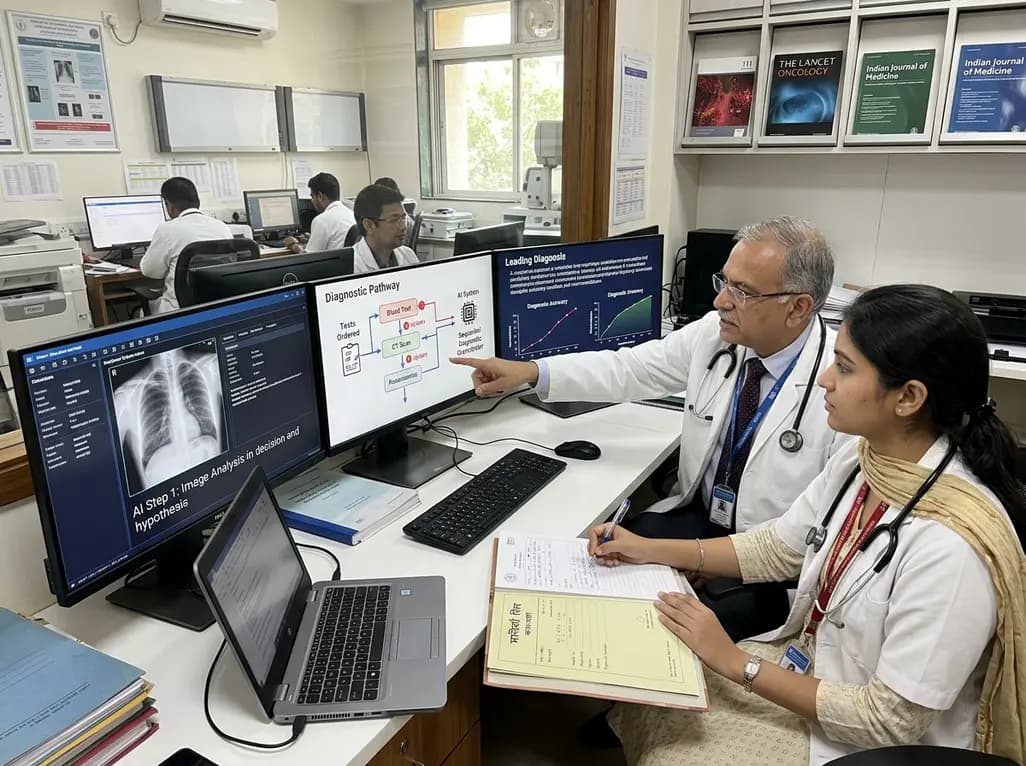
A breakthrough peer-reviewed study demonstrates that a sequential AI diagnosis system can mirror real-world clinical reasoning. By ordering stepwise tests and updating hypotheses dynamically, this multi-agent orchestrator achieved superior diagnostic accuracy while reducing investigative costs.
Today

A prenatal case highlights severe glutaric acidemia type II presenting as bilateral hyperechoic cystic kidneys at 18 weeks. Whole-exome sequencing revealed a novel homozygous ETFDH frameshift variant, demonstrating the power of rapid genetic testing in fetal renal anomalies.
Today

Review how tailored exercise programs benefit frail older patients with heart failure. Explore pathophysiological mechanisms, individualized training prescriptions, and strategies to overcome adherence barriers in clinical practice.
Yesterday

This comparative study evaluates posterior labral tears with and without glenohumeral instability, highlighting distinct demographic patterns, MRI underestimation in stable shoulders, and successful arthroscopic repair outcomes.
Yesterday

A clinical study demonstrates that early intervention with tocilizumab, either as monotherapy or bridged with corticosteroids, achieves significant proptosis reduction and resolves active inflammation in treatment-naive thyroid eye disease.
Yesterday
