.webp&w=384&q=75)

Loading, please wait...
Loading, please wait...

Scrotal ultrasound imaging serves as the primary diagnostic tool for evaluating various testicular and extratesticular conditions. Because clinical examinations can often be inconclusive, this modality provides essential clarity for effective patient management. Consequently, the review explores a wide spectrum of findings, ranging from anatomical variants to acute surgical emergencies. Furthermore, it highlights the importance of distinguishing between inflammatory processes and life-threatening vascular events. Therefore, clinicians must understand these sonographic characteristics to ensure timely intervention and better outcomes.
In addition, ultrasound is highly sensitive for detecting infectious conditions such as acute epididymo-orchitis. Similarly, color Doppler plays a vital role in identifying vascular anomalies like testicular torsion or varicoceles. Moreover, when patients present with scrotal trauma, imaging helps determine if the tunica albuginea remains intact. However, identifying small neoplasms requires a systematic approach to differentiate solid masses from benign cystic lesions. Specifically, seminomas often appear as hypoechoic, well-defined masses that necessitate immediate urological consultation. Finally, a thorough assessment of both testes allows for comparison and increases the accuracy of the final diagnosis. Thus, clinicians can achieve high diagnostic precision across various patient presentations.
Doppler imaging is essential for assessing blood flow to the testes. It specifically helps clinicians differentiate between inflammatory conditions like epididymitis, which shows increased flow, and surgical emergencies like testicular torsion, which shows a lack of flow.
In cases of blunt or penetrating trauma, ultrasound determines the integrity of the tunica albuginea. This information is critical because a ruptured testis requires urgent surgical repair to prevent organ loss and preserve fertility.
Disclaimer: This content is for informational and educational purposes only. It does not constitute medical advice or establish a doctor-patient relationship. Clinicians should use their professional judgment and cross-reference multiple sources when making diagnostic or treatment decisions. Refer to the latest local and national guidelines for clinical practice.
References
Lam Shin Cheung J et al. A Sound Approach to Stay on the Ball - A Review of Scrotal Pathologies on Ultrasound Imaging. Br J Radiol. 2026 Mar 17. doi: undefined. PMID: 41844526.
Revzin MV et al. US of the Scrotum: Benign and Malignant Masses. Radiographics. 2018;38(5):1426-1443.
Avery LL et al. Imaging of Scrotal Emergencies. RadioGraphics. 2013;33(3):721-740.

Read summarized clinical updates, watch expert medical content, and earn CME certifications right from your smartphone.
Open your smartphone camera to scan and install.





A comprehensive review of scrotal ultrasound imaging findings for clinicians, covering infections, vascular anomalies, trauma, and testicular neoplasms....
7 months ago
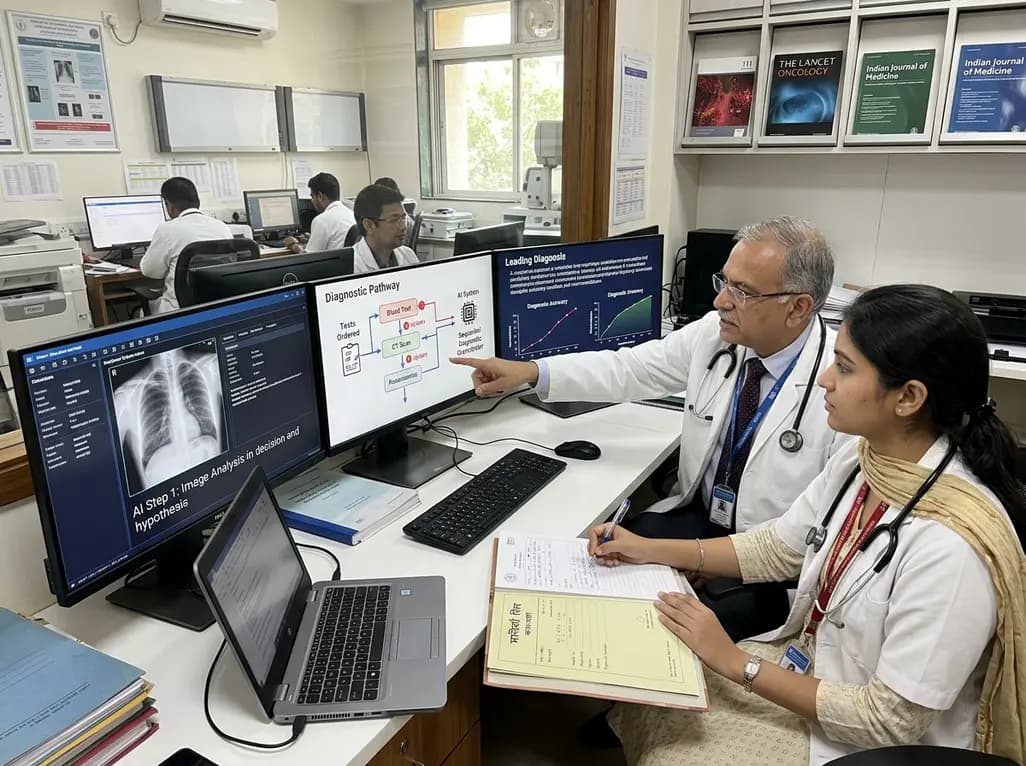
A breakthrough peer-reviewed study demonstrates that a sequential AI diagnosis system can mirror real-world clinical reasoning. By ordering stepwise tests and updating hypotheses dynamically, this multi-agent orchestrator achieved superior diagnostic accuracy while reducing investigative costs.
Today

A prenatal case highlights severe glutaric acidemia type II presenting as bilateral hyperechoic cystic kidneys at 18 weeks. Whole-exome sequencing revealed a novel homozygous ETFDH frameshift variant, demonstrating the power of rapid genetic testing in fetal renal anomalies.
Today

Review how tailored exercise programs benefit frail older patients with heart failure. Explore pathophysiological mechanisms, individualized training prescriptions, and strategies to overcome adherence barriers in clinical practice.
Yesterday

This comparative study evaluates posterior labral tears with and without glenohumeral instability, highlighting distinct demographic patterns, MRI underestimation in stable shoulders, and successful arthroscopic repair outcomes.
Yesterday

A clinical study demonstrates that early intervention with tocilizumab, either as monotherapy or bridged with corticosteroids, achieves significant proptosis reduction and resolves active inflammation in treatment-naive thyroid eye disease.
Yesterday
