.webp&w=384&q=75)

Loading, please wait...
Loading, please wait...

The Supreme Court of India recently took a strict stand on public health. Specifically, the apex court questioned the Centre regarding weak food safety regulations. Justices Vikram Nath and Sandeep Mehta issued critical notices to multiple central ministries. Consequently, the government must now explain why a nationwide performance audit should not occur.
The legal petition highlights several critical failures in the current oversight system. First, India faces a severe shortage of qualified food safety officers. Furthermore, many food testing laboratories lack advanced infrastructure to detect dangerous contaminants. In addition, existing laws permit inadequate monetary penalties for large food operators. Specifically, statutory provisions cap the maximum fine for sub-standard food at five lakh rupees. Thus, major corporations easily treat these small fines as routine business expenses. Doctors across the nation have raised alarms because adulterated products cause chronic health conditions.
To address these issues, the public interest litigation proposes a turnover-linked penalty model. Therefore, penalties would scale proportionally to a company's total revenue. Additionally, the petitioner urges the creation of a dedicated digital platform. This portal would allow citizens to easily report local safety violations. Historically, a 2017 report by the Comptroller and Auditor General highlighted similar administrative deficiencies. Unfortunately, authorities failed to recover nearly half of the imposed fines. Medical practitioners argue that stricter enforcement is vital to secure public health. Finally, robust surveillance will ensure that patients consume wholesome and safe foods.
Q1: Why did the Supreme Court issue notices regarding food safety?
The court responded to a petition highlighting weak enforcement and poor lab infrastructure. Consequently, the court wants the government to justify the lack of a nationwide audit.
Q2: Who filed the petition seeking food safety reforms?
Public health advocate Dr. Aniruddha Narayan Malpani filed the petition. Specifically, he argued that current fixed penalties fail to deter major corporate violators.
Q3: What reforms does the petition propose for food operators?
The petition proposes linking penalties to a company's turnover instead of capped fines. Additionally, it demands a digital reporting platform for citizens.
Disclaimer: This content is for informational and educational purposes only. It does not constitute medical advice or replace professional judgment. Refer to the latest local and national guidelines for clinical practice.
References

Read summarized clinical updates, watch expert medical content, and earn CME certifications right from your smartphone.
Open your smartphone camera to scan and install.





The Supreme Court of India has demanded a nationwide audit of FSSAI to address rising food adulteration, poor lab testing, and weak enforcement policies....
4 months ago
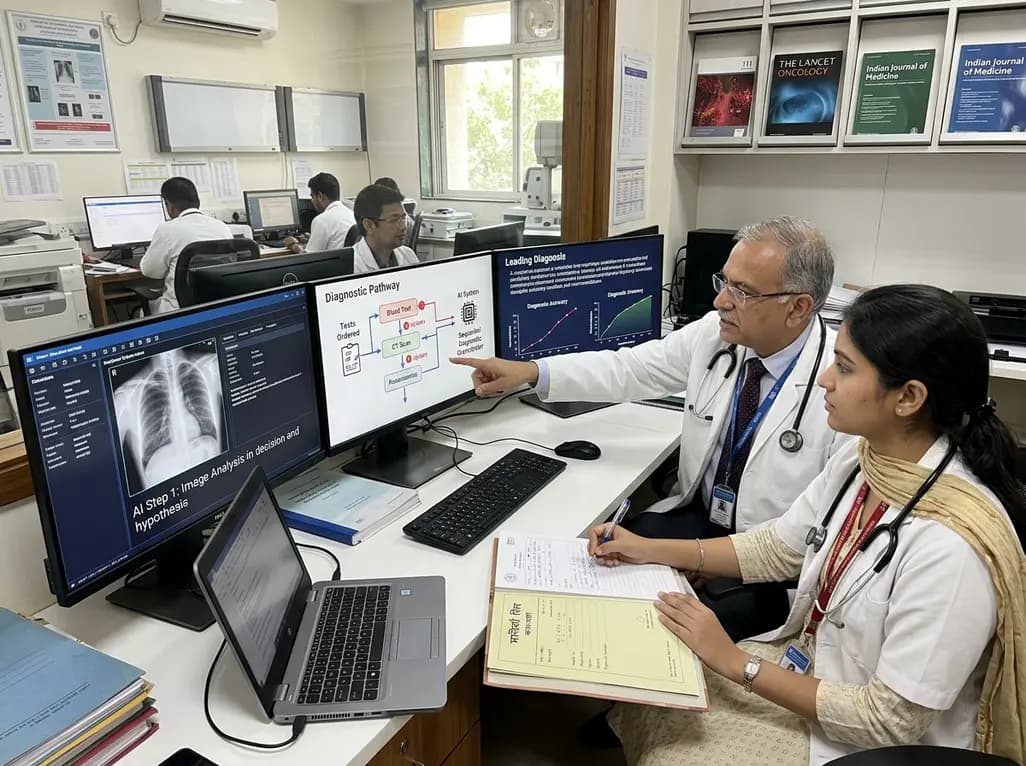
A breakthrough peer-reviewed study demonstrates that a sequential AI diagnosis system can mirror real-world clinical reasoning. By ordering stepwise tests and updating hypotheses dynamically, this multi-agent orchestrator achieved superior diagnostic accuracy while reducing investigative costs.
Today

A prenatal case highlights severe glutaric acidemia type II presenting as bilateral hyperechoic cystic kidneys at 18 weeks. Whole-exome sequencing revealed a novel homozygous ETFDH frameshift variant, demonstrating the power of rapid genetic testing in fetal renal anomalies.
Today

Review how tailored exercise programs benefit frail older patients with heart failure. Explore pathophysiological mechanisms, individualized training prescriptions, and strategies to overcome adherence barriers in clinical practice.
Yesterday

This comparative study evaluates posterior labral tears with and without glenohumeral instability, highlighting distinct demographic patterns, MRI underestimation in stable shoulders, and successful arthroscopic repair outcomes.
Yesterday

A clinical study demonstrates that early intervention with tocilizumab, either as monotherapy or bridged with corticosteroids, achieves significant proptosis reduction and resolves active inflammation in treatment-naive thyroid eye disease.
Yesterday
