.webp&w=384&q=75)

Loading, please wait...
Loading, please wait...

Invasive mechanical ventilation frequently induces severe physical discomfort and psychomotor anxiety among critically ill adults. Consequently, intensive care clinicians rely on continuous analgo-sedation to facilitate patient-ventilator synchrony and improve bedside comfort. When evaluating pharmacotherapeutic options, comparing remifentanil versus fentanyl represents a crucial clinical and economic consideration. Although remifentanil offers distinct pharmacokinetic properties that assist weaning, health systems must evaluate its comprehensive financial impact. Understanding this delicate balance enables clinicians to optimize intensive care delivery while stewarding limited institutional resources.
Clinicians routinely manage critically ill patients who require invasive mechanical ventilation through tailored analgo-sedation regimens. Historically, traditional protocols utilized standard opioids such as fentanyl alongside hypnotic agents. However, fentanyl exhibits high lipid solubility and accumulates extensively in peripheral tissues during continuous infusion. Consequently, prolonged fentanyl administration prolongs the context-sensitive half-time, which often delays spontaneous breathing trials.
In contrast, remifentanil provides an ultrashort elimination profile due to rapid hydrolysis by non-specific blood and tissue esterases. Therefore, its context-sensitive half-time remains stable at approximately three to five minutes, regardless of infusion duration. This organ-independent metabolism prevents drug accumulation even in patients with hepatic or renal impairment. Furthermore, intensivists can titrate remifentanil rapidly to match fluctuating pain levels during invasive procedures. As a result, bedside teams can interrupt infusions to assess neurological function without waiting hours for clearance. Because analgo-sedation prioritizes analgesia over hypnotic sedation, remifentanil allows clinicians to reduce propofol requirements. Ultimately, these unique pharmacological advantages provide a compelling rationale for adopting remifentanil in modern critical care pathways.
To evaluate remifentanil, researchers conducted a systematic review of published health economic evaluations. The investigators searched major medical databases, including Ovid MEDLINE, Ovid Embase, and the Cochrane Library, spanning 1997 through 2023. Initially, the comprehensive search yielded 169 citations. After removing duplicates, investigators screened 103 abstracts and selected eight candidates for detailed full-text appraisal.
However, only two single-centre studies met all inclusion criteria for complete health economic evaluation. Together, these two investigations examined 285 adult patients undergoing invasive mechanical ventilation. Furthermore, the authors evaluated study quality using the 24-item Consolidated Health Economic Evaluation Reporting Standards checklist. Notably, the methodological reporting quality varied between the two trials. The evaluation by Muellejans and colleagues achieved a good rating of 59 percent. In contrast, the analysis by Al and coworkers demonstrated very good reporting adherence, scoring 81 percent. Nevertheless, both studies exhibited marked heterogeneity regarding analytical perspectives, cost components, and time horizons. Consequently, these differences complicate direct comparisons between the datasets.
Both identified clinical trials revealed consistent improvements in patient-centered recovery metrics when teams utilized remifentanil. Specifically, patients receiving remifentanil experienced significantly shorter durations of invasive mechanical ventilation compared to those receiving fentanyl. Because remifentanil clears rapidly without tissue sequestration, bedside teams initiated spontaneous breathing protocols much earlier. Consequently, clinicians extubated patients faster, avoiding prolonged airway instrumentation.
Moreover, both clinical investigations demonstrated a corresponding reduction in overall intensive care unit length of stay. Shorter ICU stays reduce the incidence of ventilator-associated pneumonia and delirium. In addition, prompt extubation facilitates early physical rehabilitation and decreases physical deconditioning in critically ill individuals. Patients also required fewer supplemental sedative infusions because remifentanil provided robust analgesia that controlled distress effectively. Therefore, remifentanil analgo-sedation achieved predictable clinical control while accelerating emergence from mechanical support. Although these clinical outcomes consistently favored remifentanil across both trials, clinical efficacy alone does not determine institutional adoption. Hospital decision-makers must also weigh these clinical benefits against intensive care budgeting realities.
While clinical recovery metrics aligned between the two studies, their economic conclusions diverged markedly. On one hand, Al and colleagues demonstrated that remifentanil-based sedation generated meaningful net financial savings for the hospital. Their economic model revealed that substantial reductions in intensive care bed-days offset the initial medication price. Because mechanical ventilation and intensive care beds carry massive hourly overhead costs, shortening hospital stays produced favorable cost-effectiveness ratios.
On the other hand, Muellejans and associates reported neutral overall expenditure between the two treatment groups. In their trial, the higher acquisition price of remifentanil neutralized financial benefits gained from faster extubation. Thus, total inpatient expenses remained essentially identical between remifentanil and fentanyl cohorts. This divergence highlights how differing costing methodologies and hospital accounting structures impact pharmacoeconomic outcomes. Furthermore, generic fentanyl remains inexpensive, making acquisition cost differentials immediately apparent to procurement committees. However, evaluations that capture only drug acquisition prices ignore the profound economic value of freed ICU capacity. Ultimately, whether remifentanil reduces net hospital costs depends on how institutions quantify ICU bed-day valuation.
The findings of this systematic review emphasize the urgent need for comprehensive, contemporary health economic evaluations. Critical care medicine has evolved substantially over the past two decades, introducing light-sedation protocols and daily awakening trials. Therefore, historic costing models may not reflect modern intensive care realities or current generic pricing structures. Clinicians practicing in resource-constrained environments must carefully assess whether clinical benefits justify pharmacy acquisition budgets.
Additionally, future economic trials must incorporate societal perspectives, long-term functional recovery, and post-intensive care syndrome metrics. Researchers should also evaluate whether remifentanil reduces secondary complications, such as intensive care delirium and secondary infections. When healthcare organizations evaluate new analgesia regimens, administrators should implement micro-costing frameworks that monitor ventilator hours directly. Furthermore, multi-centre randomized clinical trials should evaluate patient subgroups that derive the greatest benefit from rapid-offset opioids. For example, elderly patients may exhibit pronounced clinical gains from organ-independent clearance. In conclusion, while remifentanil clearly accelerates liberation from mechanical ventilation, robust economic evidence must guide sustainable hospital formulary policies.
Remifentanil possesses a unique esterase-based metabolism that enables rapid and predictable plasma clearance. Consequently, the drug does not accumulate within peripheral adipose tissues during prolonged continuous infusions. In contrast, fentanyl exhibits substantial lipophilicity and prolonged context-sensitive half-times in critical illness. Therefore, clinicians can perform spontaneous breathing trials promptly after stopping remifentanil. This pharmacokinetic advantage shortens ventilator weaning intervals and accelerates extubation across intensive care settings without causing unexpected lingering sedation.
The initial acquisition cost of remifentanil remains higher than generic fentanyl formulations in many hospital pharmacies. However, overall ICU expenditure depends heavily on daily bed-day costs and complication rates. When faster extubation reduces total mechanical ventilation time, hospitals can offset drug expenses through shorter ICU stays. Nevertheless, institutions with lower baseline bed costs or extended recovery pathways may observe equivalent financial expenditures. Therefore, pharmacoeconomic value depends directly on unit-level operational efficiency.
Critical care units must adopt structured, nurse-driven analgo-sedation algorithms that prioritize patient comfort through scheduled pain scores. First, clinicians should treat acute discomfort with calibrated opioid infusions before introducing hypnotic agents like propofol. Furthermore, teams should conduct daily spontaneous awakening and breathing trials to minimize drug exposure. Incorporating objective sedation scales ensures rapid titration and prevents inadvertent deep sedation. Consequently, this systematic clinical strategy optimizes patient recovery while controlling overall hospital resource utilization.
Disclaimer: This content is for informational and educational purposes only and should not be considered medical advice. Always consult a qualified healthcare professional regarding clinical decisions and treatments. Refer to the latest local and national guidelines for clinical practice.
References

Read summarized clinical updates, watch expert medical content, and earn CME certifications right from your smartphone.
Open your smartphone camera to scan and install.





A systematic review evaluated remifentanil versus fentanyl for analgo-sedation in mechanically ventilated ICU patients. Remifentanil shortened ventilation and ICU stay, but total cost savings remain equivocal due to acquisition expenses, highlighting the need for robust economic evaluations.
Today

A quaternary centre study of 143 patients undergoing TIPS revealed high 90-day rates of hepatic encephalopathy (43.8%) and mortality (18.6%). Type 2 diabetes independently doubled encephalopathy risk, while advancing age and higher baseline MELD scores strongly predicted short-term mortality.
Today

Meghalaya recorded a historic 55% reduction in maternal deaths, dropping from 244 to 107 over five years. Through the MOTHER app, dedicated transit homes, and expanded infrastructure like the 150-bed Tura Maternity Hospital with its first public NICU, the state demonstrates an effective public health model.
Today

Explore modern perioperative management protocols for clinical xenotransplantation. Learn how costimulation blockade, anti-inflammatory perfusion, and coagulopathy rescue overcome interspecies hurdles.
Today
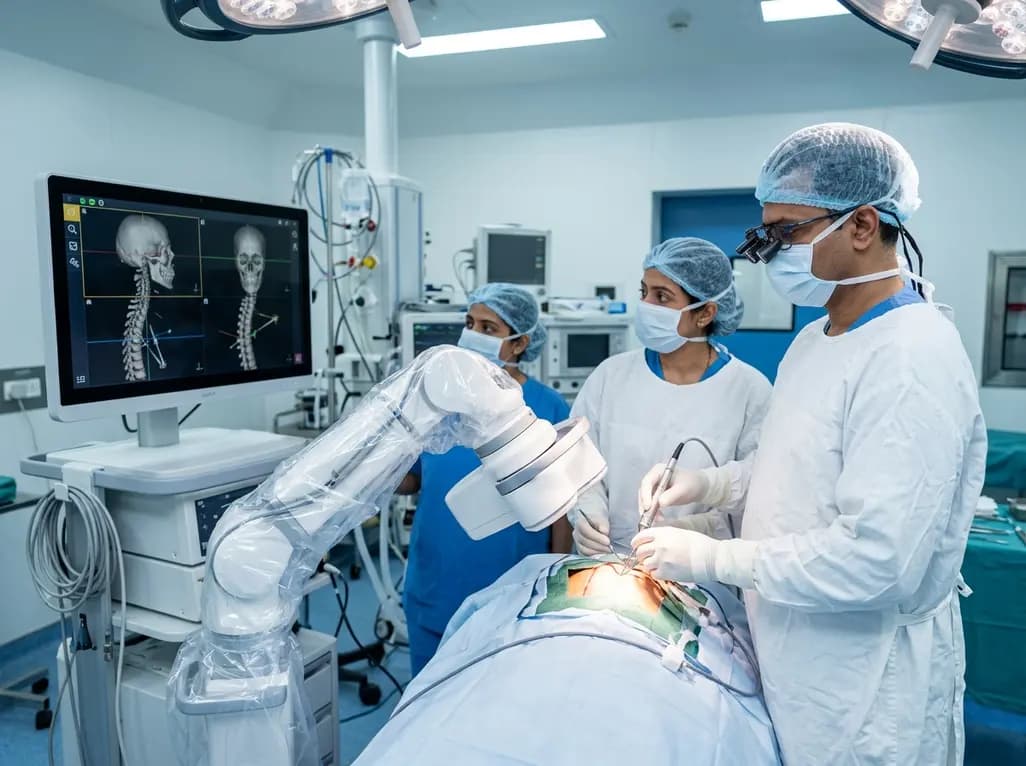
North India's first Centre of Excellence for Brain and Spine at Amrita Hospital Faridabad integrates Brainlab's Loop-X mobile robot. This landmark facility combines cone-beam computed tomography with surgical navigation to elevate precision, optimize operative workflows, and enhance specialized clinician training.
Today

At Homa CME 2026 at Hyderabad's T-Hub, healthcare leaders emphasized moving beyond routine metrics through digital calculators and precision stratification. Discover why characterizing individual insulin secretion, resistance patterns, and vascular risks transforms chronic metabolic care in India.
Today
