.webp&w=384&q=75)

Loading, please wait...
Loading, please wait...

Early and reliable detection of brain tumors from magnetic resonance imaging (MRI) is essential for timely clinical diagnosis and treatment planning. However, traditional automated methods often struggle with tumor heterogeneity and the complex anatomy of the brain. Consequently, researchers are turning toward Quantum Brain Tumor Detection frameworks to bridge the gap between computational limits and clinical precision. A recent study introduces a scalable quantum non-local neural network (QNL-Net) that leverages quantum entanglement to capture fine-grained tumor features more effectively than classical models.
Automated detection continues to be challenging due to noise in MRI images and the limitations of existing deep learning models in capturing global contextual information. Furthermore, many current approaches suffer from high computational complexity. To solve these issues, the proposed framework integrates advanced preprocessing with a precise tumor region segmentation process. The researchers utilized the Tyrannosaurus Algorithm, a bio-inspired optimization meta-heuristic, to fine-tune the network parameters. This optimization ensures that the Quantum Brain Tumor Detection model maintains high performance while reducing computational errors.
The framework underwent evaluation using two benchmark datasets: BRATS 2018 and Figshare. These datasets contain multi-class MRI images representing diverse tumor types and grades. The experimental results were remarkable, showing a classification accuracy of up to 99.8%. This performance significantly outperforms several state-of-the-art deep learning models. In addition, comparative analysis confirms improved precision, recall, and F1-scores across different tumor categories. Therefore, this method provides a robust tool for clinicians to identify complex tumor structures that might otherwise be overlooked.
The success of this quantum-classical hybrid model suggests a paradigm shift in computer-aided diagnostics. Because the system improves feature representation for complex structures, it supports more accurate clinical assessments. Clinicians can use these insights for earlier intervention and more personalized treatment planning. As quantum hardware becomes more accessible, these algorithms will likely become standard components of diagnostic workflows in neurology and oncology centers across India and globally.
The Tyrannosaurus Algorithm is used as an optimization tool to find the best possible weights and parameters for the neural network. This reduces the error rate and improves the model's ability to generalize across different MRI datasets.
Quantum computing allows for the simultaneous processing of vast amounts of data through parallelism and entanglement. This helps the AI capture "non-local" relationships between distant pixels in an image, leading to better detection of subtle tumor margins.
Yes, the framework was tested on diverse tumor types and grades in the BRATS 2018 and Figshare datasets, demonstrating high precision and recall across various categories, including gliomas and meningiomas.
Disclaimer: This content is for informational and educational purposes only and does not constitute medical advice or a professional relationship. The information provided regarding AI and quantum technologies in medicine is based on current research and may evolve. Clinicians should not rely solely on automated tools for diagnosis. Refer to the latest local and national guidelines for clinical practice.
References

Read summarized clinical updates, watch expert medical content, and earn CME certifications right from your smartphone.
Open your smartphone camera to scan and install.





A new study introduces a Scalable Quantum Non-Local Neural Network optimized by the Tyrannosaurus Algorithm, achieving 99.8% accuracy in brain tumor detecti...
6 months ago
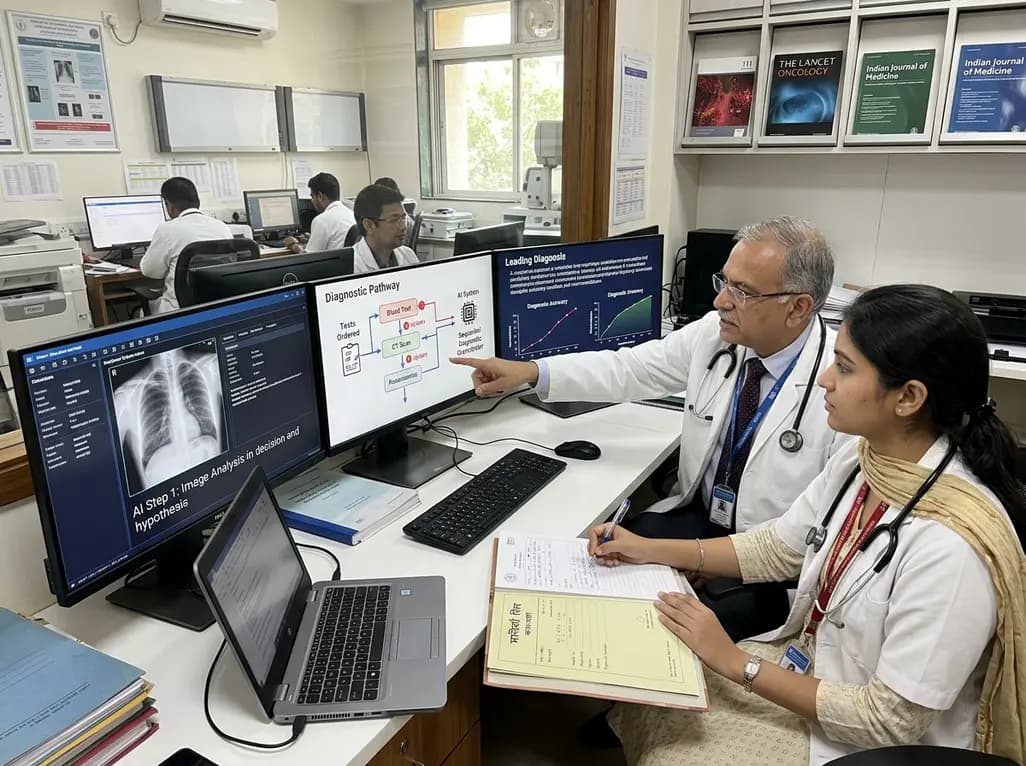
A breakthrough peer-reviewed study demonstrates that a sequential AI diagnosis system can mirror real-world clinical reasoning. By ordering stepwise tests and updating hypotheses dynamically, this multi-agent orchestrator achieved superior diagnostic accuracy while reducing investigative costs.
Today

A prenatal case highlights severe glutaric acidemia type II presenting as bilateral hyperechoic cystic kidneys at 18 weeks. Whole-exome sequencing revealed a novel homozygous ETFDH frameshift variant, demonstrating the power of rapid genetic testing in fetal renal anomalies.
Today

Review how tailored exercise programs benefit frail older patients with heart failure. Explore pathophysiological mechanisms, individualized training prescriptions, and strategies to overcome adherence barriers in clinical practice.
Yesterday

This comparative study evaluates posterior labral tears with and without glenohumeral instability, highlighting distinct demographic patterns, MRI underestimation in stable shoulders, and successful arthroscopic repair outcomes.
Yesterday

A clinical study demonstrates that early intervention with tocilizumab, either as monotherapy or bridged with corticosteroids, achieves significant proptosis reduction and resolves active inflammation in treatment-naive thyroid eye disease.
Yesterday
