

Loading, please wait...
Loading, please wait...

Exposure therapy remains the clinical cornerstone for treating social anxiety disorder. However, widespread patient avoidance and high dropout rates frequently undermine treatment efficacy. Patients often anticipate social interactions with intense dread, expecting catastrophic judgment and embarrassment. To overcome this hurdle, researchers are investigating prospective mental imagery as an innovative intervention. Prospective mental imagery enables patients to visualize future events in rich sensory detail, engaging emotional circuits before confronting real-world triggers. Consequently, clinicians hope that prospective simulation can rekindle approach motivation and help anxious individuals engage in therapy.
Cognitive behavioral therapy with in-vivo exposure offers robust evidence for managing social anxiety disorder. In clinical practice, however, many patients refuse exposure tasks or drop out early. This reluctance stems from potent anticipatory anxiety. Socially anxious individuals consistently expect social humiliation, prompting immediate avoidance behavior. Avoidance provides transient relief through negative reinforcement, which unfortunately maintains debilitating anxiety over time.
Furthermore, conventional psychiatric protocols concentrate heavily on reducing fear and distress. Traditional approaches often overlook the critical role of appetitive drive and reward processing. In addition, people with social anxiety exhibit marked anticipatory anhedonia, meaning they struggle to anticipate pleasure from interpersonal connection. Because they foresee zero emotional reward from socializing, exposure tasks appear purely punitive. Thus, therapeutic interventions must do more than extinguish conditioned fear. Clinicians must actively cultivate approach motivation by enhancing positive anticipatory expectations. Addressing both reward deficits and threat processing creates a more balanced therapeutic foundation for sustained patient engagement.
Mental simulation acts as an emotional amplifier across multiple psychological domains. When individuals picture an experience vividly, the human brain recruits perceptual, neural, and autonomic circuits identical to actual perception. For this reason, mental imagery elicits stronger emotional reactions than verbal thoughts alone. In depression, prospective imagery interventions have successfully elevated positive affect and goal-directed pursuits.
Researchers have now extended this framework to social phobia. Socially anxious individuals routinely suffer from involuntary, catastrophic mental images depicting social failure. Replacing these distressing visions with guided prospective mental imagery can recalibrate anticipatory reward processing. Specifically, when patients imagine engaging warmly with others, experiencing shared laughter, and receiving social validation, their anticipated pleasure climbs. This sensory simulation activates mesolimbic reward pathways that govern approach behavior. As a result, patients experience a cognitive shift from defensive threat anticipation toward appetitive reward pursuit. Prospective simulation thereby prepares the mind for forthcoming social challenges.
A landmark randomized controlled trial recently evaluated prospective mental imagery in 136 socially anxious adults. Investigators assigned participants to either a prospective mental imagery intervention or a psychoeducation-only control group. Researchers assessed anticipatory reward processing and approach motivation before and immediately following the experimental session. In addition, the team tracked self-reported behavioral engagement with feared social scenarios one week later.
The results demonstrated clear psychological gains in the imagery group. Participants practicing imagery reported significantly greater increases in anticipated pleasure and anticipatory enjoyment regarding feared social tasks. Moreover, they exhibited substantial increases in subjective approach motivation compared to control subjects. Statistical mediation analyses confirmed that heightened anticipatory pleasure directly mediated the enhancement in approach motivation.
However, the trial also revealed notable boundaries. The researchers found no significant differences between groups regarding general reward anticipation or actual behavioral engagement at the one-week follow-up. While participants felt more willing to confront feared events immediately after imagery, this motivation did not automatically produce independent behavioral action.
Exploratory analyses from the trial highlighted an essential clinical factor: imagery vividness. Specifically, participants who generated highly vivid, sensory-rich simulations derived the greatest therapeutic benefit. Higher vividness significantly predicted larger increases in anticipatory pleasure and approach motivation. When individuals pictured vibrant environments with distinct facial expressions and tone of voice, their neural emotional circuitry activated strongly.
Conversely, participants who struggled to visualize scenarios experienced negligible psychological shifts. Vague or fragmented images failed to evoke the emotional warmth needed to overwrite negative social expectations. Therefore, clinicians must recognize that the qualitative depth of imagery determines its clinical potency. In psychiatric practice, doctors cannot simply ask anxious patients to visualize success without structured guidance. Therapists should actively assist patients in building detailed multisensory scenes. For example, therapists can prompt patients to imagine auditory cues, posture, and internal somatic sensations. Furthermore, clinicians must help patients identify and correct intrusive negative thoughts that interrupt the simulation. Cultivating vividness ensures that prospective imagery serves as a powerful motivational catalyst.
The trial demonstrated that heightened approach motivation did not immediately increase real-world behavioral engagement. In psychiatric practice, the leap from intention to action faces substantial real-world friction. When patients face social encounters alone, ingrained avoidance triggers quickly re-emerge. Consequently, clinicians must recognize that brief standalone imagery cannot replace comprehensive exposure protocols.
Instead, psychiatrists should use prospective mental imagery as an active primer before scheduled exposures. By scheduling behavioral experiments immediately after imagery sessions, clinicians can capitalize on the transient surge in approach motivation. Furthermore, doctors in outpatient settings should actively guide patients through vivid visualization of upcoming social tasks, such as family gatherings or professional interviews. In addition, providing structured accountability through follow-up visits or digital monitoring reinforces real-world follow-through. When paired with clinician-guided exposure, prospective simulation bridges the implementation gap, converting initial motivational readiness into enduring behavioral change. Ultimately, integrating motivational imagery into clinical practice empowers patients to confront feared situations with confidence.
Prospective mental imagery is an evidence-based cognitive technique where individuals mentally simulate future events in sensory-rich detail. Instead of focusing on catastrophic possibilities, patients intentionally envision positive social scenarios and constructive outcomes. This process stimulates emotional and reward networks, effectively amplifying anticipatory pleasure and motivating individuals to approach previously feared social encounters.
Although mental imagery successfully enhanced approach motivation, confronting feared situations in daily life involves complex environmental barriers and ingrained avoidance habits. A single brief cognitive session may generate positive intentions without providing adequate scaffolding. Therefore, clinicians must pair motivational imagery with structured clinical accountability and real-time behavioral guidance to achieve sustained behavioral change.
Clinicians can enhance imagery vividness by systematically coaching patients to recruit multiple sensory modalities during visualization exercises. Practitioners should prompt patients to imagine auditory cues, visual details, bodily sensations, and facial expressions. Furthermore, clinicians must identify and defuse negative automatic intrusions, ensuring the mental simulation remains vividly rewarding, realistic, and emotionally compelling for the patient.
Disclaimer: This content is for informational and educational purposes only. It is not intended to be a substitute for professional medical advice, diagnosis, or treatment. Refer to the latest local and national guidelines for clinical practice.
References

Read summarized clinical updates, watch expert medical content, and earn CME certifications right from your smartphone.
Open your smartphone camera to scan and install.





A recent randomized controlled trial highlights prospective mental imagery as an intervention to enhance reward processing and approach motivation in social anxiety. While the technique primes patients for exposure therapy, clinical guidance is vital to translate motivation into behavioral action.
Today

A breakthrough ultrathin multimodal sensor decouples physical hemodynamic monitoring from disposable electrochemical calibration, achieving long-term wearable glucose prediction with 81.36% accuracy and a 9.12% MARD. This offers a robust, drift-free solution for outpatient metabolic surveillance.
Today

A clinical review of menopause and neurology highlights the neurobiological impacts of midlife hormonal shifts on cognition, epilepsy, migraine, multiple sclerosis, and stroke, emphasizing safe hormone therapy prescribing.
Today

Co-administering antiseizure medications and DOACs frequently causes pharmacokinetic interactions, subtherapeutic drug levels, and thromboembolic failures. This review highlights enzyme induction risks, unpredictable outcomes with levetiracetam, and the vital role of therapeutic drug monitoring.
Today

A comparative review of tension band wiring and intramedullary screw fixation in thumb metacarpophalangeal arthrodesis, evaluating union rates, hardware complications, and clinical outcomes.
Today
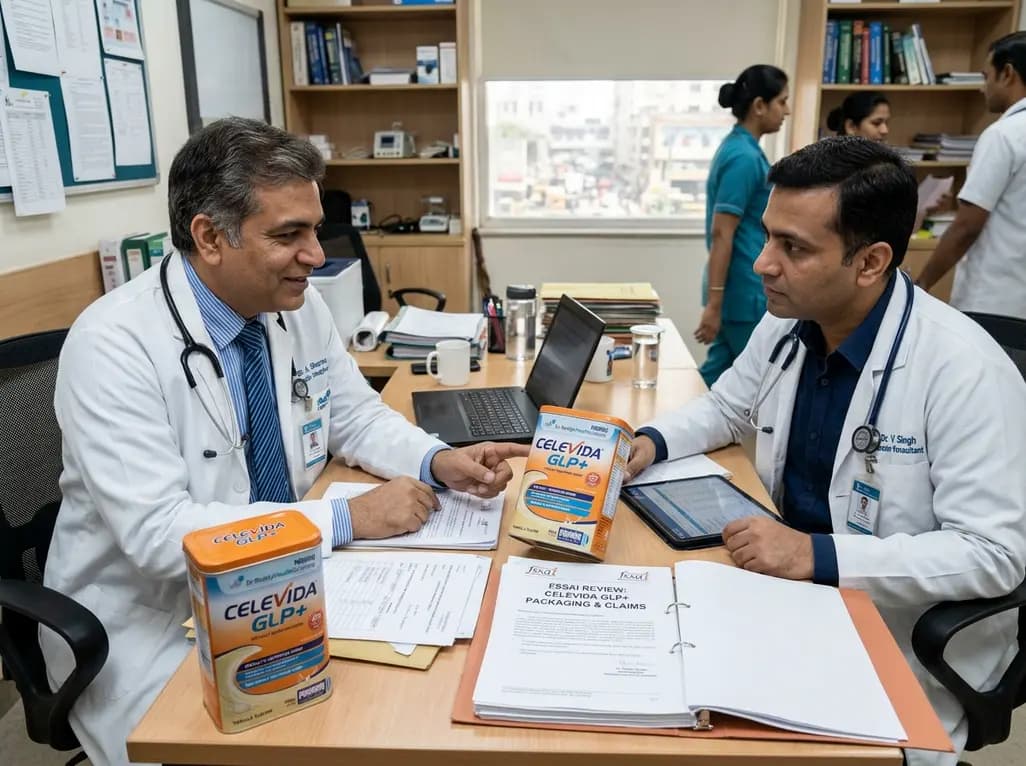
Following regulatory scrutiny from FSSAI regarding promotional representations and lean muscle preservation claims, Dr. Reddy's Laboratories and Nestlé Health Science are currently reviewing the branding and marketing strategy for their joint nutritional supplement Celevida GLP+.
Today
