.webp&w=384&q=75)

Loading, please wait...
Loading, please wait...

Researchers from BITS Pilani Hyderabad and Purdue University have created a revolutionary technology to advance portable liver diagnostics. Consequently, clinicians can now detect liver-related issues in under three minutes using a pocket-sized, handheld electrochemical sensor. Therefore, this innovation could dramatically improve healthcare access, especially in resource-limited rural clinics.
This novel point-of-care system utilizes a compact electrochemical sensor to measure bilirubin. Specifically, bilirubin serves as a crucial clinical marker for evaluating general liver function. Because elevated bilirubin levels often indicate serious conditions like jaundice or liver disease, rapid detection is extremely critical. Additionally, the device is roughly twice the size of a smartphone. In contrast to conventional testing that requires offline laboratory processing, this system delivers instant results using a tiny serum sample. Furthermore, the onboard system wirelessly transmits the readings directly to a smartphone.
To achieve high accuracy, the researchers coated the disposable sensor with gold nanoparticles. Moreover, they integrated a specialized nafion-chitosan membrane into the sensor architecture. Simultaneously, this layer actively attracts bilirubin while blocking interfering substances like proteins and uric acid. As a result, the sensor maintains high selectivity even at a physiological pH. Currently, the prototype has reached Technology Readiness Level 4, meaning laboratory validation is complete. However, clinical trials are still necessary before commercial release. Fortunately, the platform can easily adapt to identify other disease biomarkers in the future.
Q1: How long does it take for the new device to detect liver issues?
The pocket-sized device can analyze a small serum sample and provide accurate readings in under three minutes.
Q2: What biomarker does this portable liver diagnostics system measure?
The electrochemical sensor specifically measures bilirubin, which is a key biological marker used to evaluate liver function.
Q3: How does the device prevent interfering substances from corrupting the signal?
It utilizes a unique nafion-chitosan membrane that actively attracts bilirubin while blocking proteins, uric acid, and ascorbic acid.
Disclaimer: This content is for informational and educational purposes only. It does not constitute medical advice or replace professional judgment. Refer to the latest local and national guidelines for clinical practice.
References

Read summarized clinical updates, watch expert medical content, and earn CME certifications right from your smartphone.
Open your smartphone camera to scan and install.





Researchers have developed a pocket-sized point-of-care device that accurately measures bilirubin levels to detect liver health issues in under three minute...
4 months ago
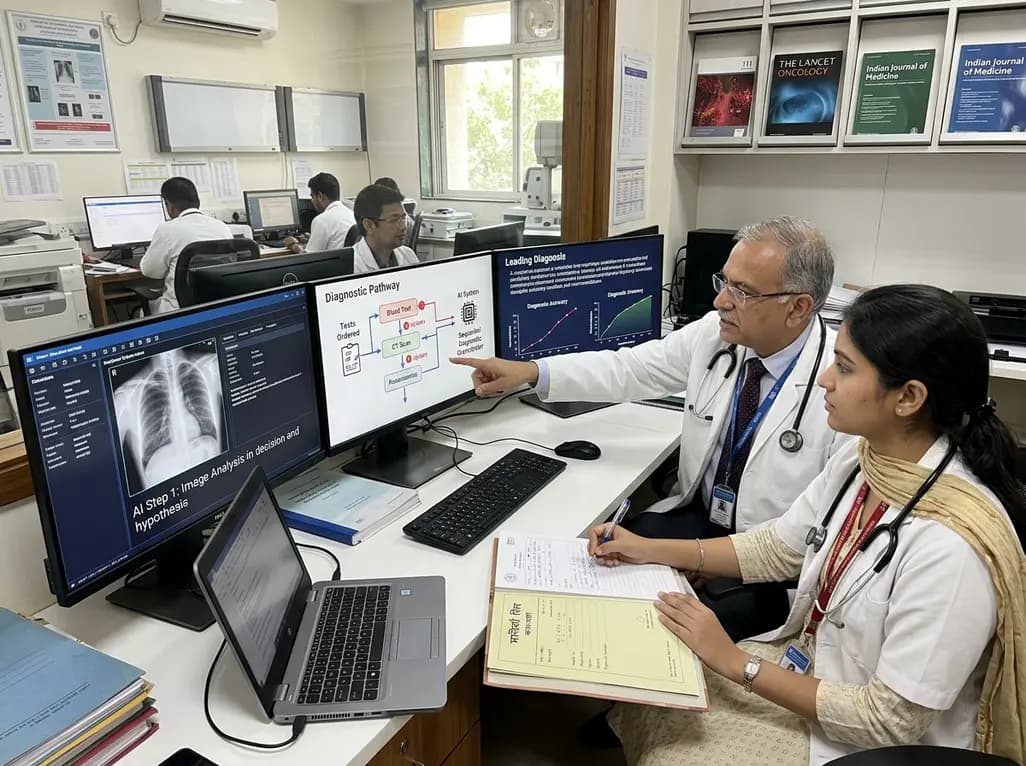
A breakthrough peer-reviewed study demonstrates that a sequential AI diagnosis system can mirror real-world clinical reasoning. By ordering stepwise tests and updating hypotheses dynamically, this multi-agent orchestrator achieved superior diagnostic accuracy while reducing investigative costs.
Today

A prenatal case highlights severe glutaric acidemia type II presenting as bilateral hyperechoic cystic kidneys at 18 weeks. Whole-exome sequencing revealed a novel homozygous ETFDH frameshift variant, demonstrating the power of rapid genetic testing in fetal renal anomalies.
Today

Review how tailored exercise programs benefit frail older patients with heart failure. Explore pathophysiological mechanisms, individualized training prescriptions, and strategies to overcome adherence barriers in clinical practice.
Yesterday

This comparative study evaluates posterior labral tears with and without glenohumeral instability, highlighting distinct demographic patterns, MRI underestimation in stable shoulders, and successful arthroscopic repair outcomes.
Yesterday

A clinical study demonstrates that early intervention with tocilizumab, either as monotherapy or bridged with corticosteroids, achieves significant proptosis reduction and resolves active inflammation in treatment-naive thyroid eye disease.
Yesterday
