.webp&w=384&q=75)

Loading, please wait...
Loading, please wait...

Heavy metal pollution represents a significant public health threat in many regions of India. Consequently, researchers are developing innovative platforms for heavy metal ion sensing to ensure water safety and patient health. Carbon Dots (CDs) have emerged as a distinctive class of carbon-based nanomaterials. These materials offer unique optoelectronic and fluorescence characteristics. Furthermore, they exhibit exceptional chemical stability, superior water solubility, and low toxicity.
However, researchers often face challenges with the dispersion and handling of raw CDs in practical applications. Therefore, they have begun embedding CDs within polymer matrices to overcome these limitations. This strategy significantly enhances their stability and sensitivity towards various toxic ions like lead and mercury. Additionally, the fluorescence properties of these composites change immediately upon interaction with metal ions. This mechanism allows for the creation of simple and cost-effective sensing platforms for clinical use.
Moreover, the use of polymer-carbon dot nanocomposites provides several functional advantages over traditional methods. For instance, these materials enable convenient handling and reusability in both laboratory and field settings. Practitioners can now monitor heavy metal levels in biological or environmental samples with much higher precision. Ultimately, these advancements support broader applications in environmental monitoring, industrial safety, and healthcare diagnostics.
CDs are preferred because they possess unique fluorescence properties, superior water solubility, and low toxicity. These characteristics make them ideal for biocompatible sensing applications where safety and precision are paramount.
The polymer matrix enhances the stability and dispersion of CDs. Consequently, it improves the sensitivity of the composite towards heavy metal ions while allowing for easier handling and repeated use in diagnostic platforms.
Disclaimer: This content is for informational and educational purposes only. It does not constitute medical advice, diagnosis, or treatment. Always seek the advice of a qualified healthcare provider with any questions you may have regarding a medical condition. Refer to the latest local and national guidelines for clinical practice.
References
Mathew AJ et al. Polymer-carbon dot nanocomposites for heavy metal ion sensing. Nanotechnology. 2026 Feb 26. doi: 10.1088/1361-6528/ae4ab1. PMID: 41747294.
World Health Organization. Lead poisoning and health. 2023.
Bhatt M et al. Recent advances in green synthesis of carbon dots for heavy metal ion sensing. E3S Web of Conferences. 2024.

Read summarized clinical updates, watch expert medical content, and earn CME certifications right from your smartphone.
Open your smartphone camera to scan and install.





Explore how embedding carbon dots in polymer matrices creates highly sensitive, cost-effective platforms for detecting toxic heavy metal ions in medical sam...
7 months ago
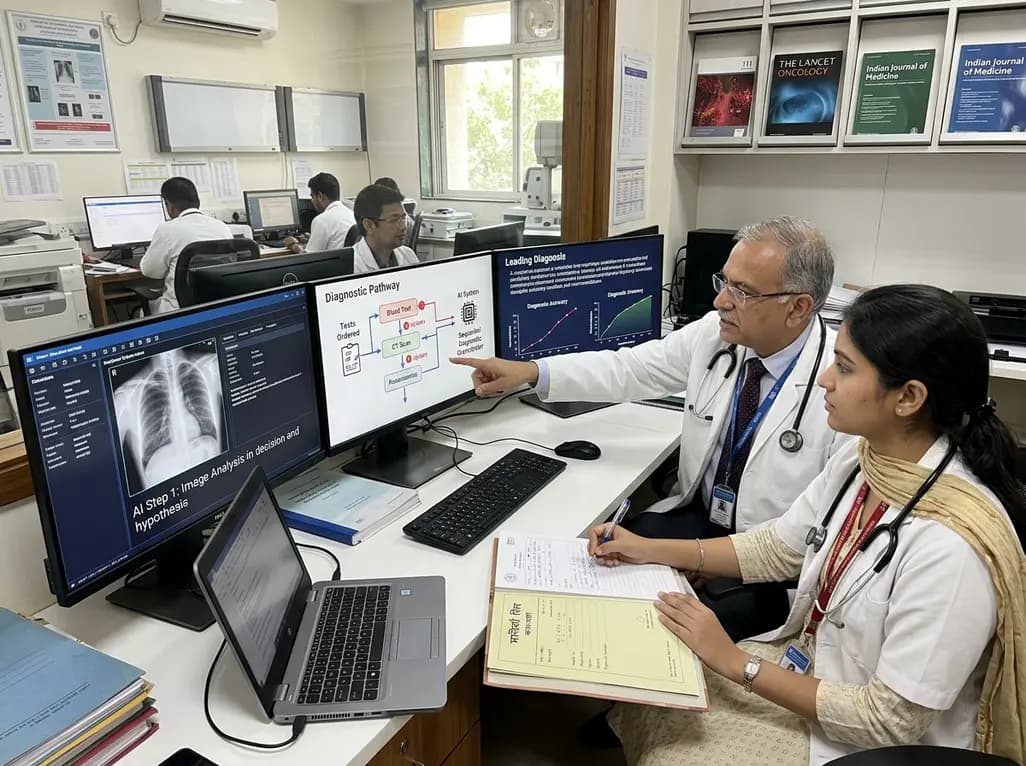
A breakthrough peer-reviewed study demonstrates that a sequential AI diagnosis system can mirror real-world clinical reasoning. By ordering stepwise tests and updating hypotheses dynamically, this multi-agent orchestrator achieved superior diagnostic accuracy while reducing investigative costs.
Today

A prenatal case highlights severe glutaric acidemia type II presenting as bilateral hyperechoic cystic kidneys at 18 weeks. Whole-exome sequencing revealed a novel homozygous ETFDH frameshift variant, demonstrating the power of rapid genetic testing in fetal renal anomalies.
Today

Review how tailored exercise programs benefit frail older patients with heart failure. Explore pathophysiological mechanisms, individualized training prescriptions, and strategies to overcome adherence barriers in clinical practice.
Yesterday

This comparative study evaluates posterior labral tears with and without glenohumeral instability, highlighting distinct demographic patterns, MRI underestimation in stable shoulders, and successful arthroscopic repair outcomes.
Yesterday

A clinical study demonstrates that early intervention with tocilizumab, either as monotherapy or bridged with corticosteroids, achieves significant proptosis reduction and resolves active inflammation in treatment-naive thyroid eye disease.
Yesterday
