.webp&w=384&q=75)

Loading, please wait...
Loading, please wait...

Researchers have introduced a novel method using Physics-Informed Neural Networks (PINNs) to model elastoviscoplastic (EVP) materials. These materials, which include biological tissues and various pharmaceutical gels, typically present significant challenges for predictive modeling. Specifically, their nonlinear behavior under large amplitude oscillatory shear (LAOS) conditions often results in complex datasets. Traditional models frequently struggle with computational intensity and noisy experimental measurements. Consequently, this new PINN-based approach offers a robust alternative by embedding physical laws directly into the machine learning framework.
The study re-evaluates EVP modeling by integrating a modified Saramito model into the training process. By doing so, the Physics-Informed Neural Networks can fit time-dependent stress data without requiring manual gradient estimation. This differentiable framework significantly enhances data efficiency and generalizability. Furthermore, the researchers introduced a shear-thinning formulation to better reflect decreasing viscosity at high strain amplitudes. As a result, the model provides a more accurate representation of how materials yield and transition between viscoelastic states.
Understanding the rheology of soft matter is essential for several medical applications. For instance, magnetic resonance elastography (MRE) relies on precise modeling of tissue stiffness to diagnose conditions like liver fibrosis or identify malignant tumors. This framework bridges microstructural deformation modes with macro-level rheological modeling. Therefore, it provides a powerful tool for predicting nonlinear viscoelastic behavior in biological systems. Stable recovery of physical parameters suggests that PINNs could soon enhance the interpretability of diagnostic imaging and personalized tissue characterization.
Physics-Informed Neural Networks are a class of deep learning models that incorporate physical laws, such as partial differential equations, into their loss functions to ensure physically consistent predictions.
Unlike conventional methods, PINNs are differentiable and highly resistant to noise. They eliminate the need for complex gradient estimations, making them more efficient for fitting experimental data from soft matter.
Yes. By accurately modeling the elastoviscoplastic properties of tissues, these models can improve the accuracy of elastography and other biomechanical assessments used in oncology and hepatology.
Disclaimer: This content is for informational and educational purposes only. It does not constitute medical advice or a professional relationship. Refer to the latest local and national guidelines for clinical practice.
References
Valipour Goodarzi B et al. Modeling elastoviscoplastic materials using physics-informed neural networks. Soft Matter. 2026 May 26. doi: 10.1039/d6sm00198j. PMID: 42189592.
Ragoza M, Batmanghelich K. Physics-Informed Neural Networks for Tissue Elasticity Reconstruction in Magnetic Resonance Elastography. Med Image Comput Comput Assist Interv. 2023 Oct. doi: 10.1007/978-3-031-43999-5_32.
Michaloglou A et al. Physics-Informed Neural Networks in Materials Modeling and Design: A Review. ResearchGate. 2025 Sep.
"
Read summarized clinical updates, watch expert medical content, and earn CME certifications right from your smartphone.
Open your smartphone camera to scan and install.





Researchers use Physics-Informed Neural Networks (PINNs) to model elastoviscoplastic materials, offering a new tool for predicting nonlinear soft matter beh...
4 months ago

Recent epidemiological data reveals a dramatic surge in summer heat mortality driven by human-induced climate warming. This analysis explores the pathophysiological impacts on cardiac and renal systems, diagnostic dilemmas in death certification, and essential emergency cooling protocols for acute clinical care.
Today

Odisha has established India's first state-level clinical protocol specifically tailored for pregnant women with sickle cell disease. Developed with NHM and UNICEF, the framework provides structured antenatal screening, crisis mitigation, standardized referral pathways, and specialized interdisciplinary care.
Today

India is advancing preventive healthcare by integrating genomics, artificial intelligence, and quantum technologies. With the SANGAM programme sequencing one million Indian genomes, clinicians can unlock personalized therapies, detect cardiometabolic risks early, and curb the burden of diabetes and heart disease.
Today
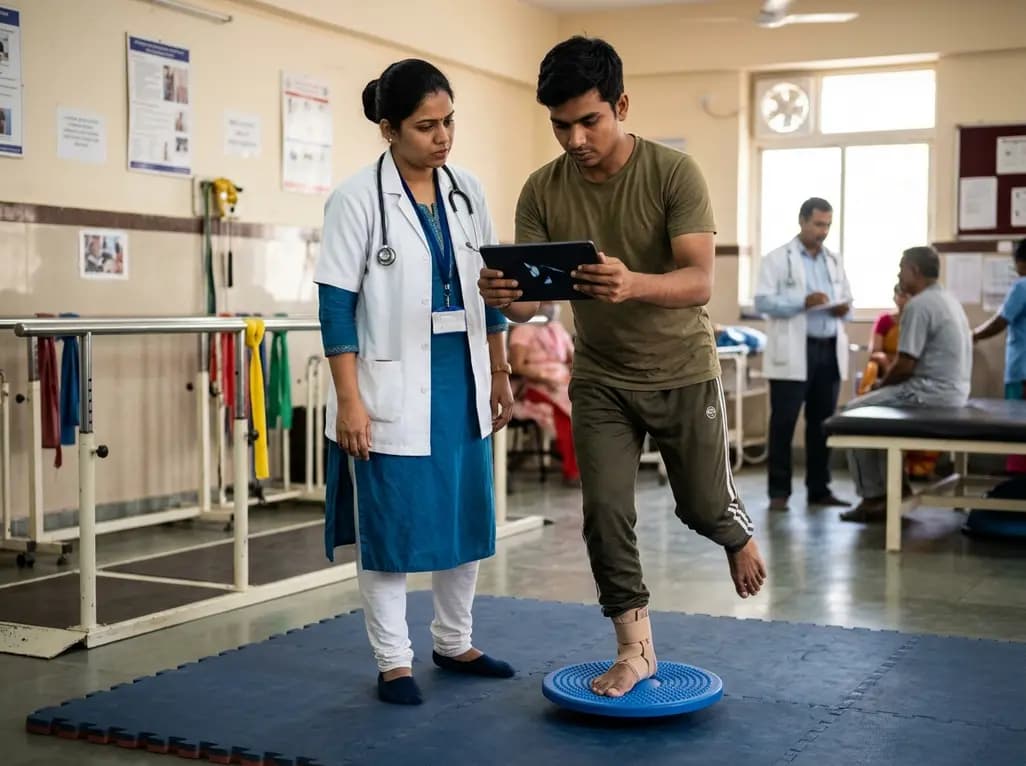
A randomized controlled trial demonstrates that an eight-week dual-task training intervention significantly improves static and dynamic postural control over standard balance exercises in individuals with chronic ankle instability, addressing critical neurocognitive deficits during athletic and daily activities.
Today

A retrospective cohort study of 7,716 ICU patients from the MIMIC-IV database demonstrates that Gradient Boosting Decision Trees significantly outperform traditional SOFA scores in predicting in-hospital mortality among patients with sepsis and diabetes, with SHAP analysis providing clinical interpretability.
Today
