

Loading, please wait...
Loading, please wait...

Contemporary clinical encounters frequently involve discussions surrounding nicotine dependency and harm reduction. Electronic nicotine delivery systems have rapidly transformed the global tobacco control landscape. Consequently, clinicians must understand the complex evidence surrounding electronic cigarette smoking cessation. A cross-sectional investigation from Türkiye evaluated how healthcare practitioners understand and counsel patients regarding vaping devices. The findings highlight significant knowledge gaps and demonstrate an unexpected disconnect between theoretical understanding and bedside cessation counseling.
Researchers conducted a comprehensive cross-sectional investigation among 525 physicians across academic and public health institutions in Adana, Türkiye. The investigators administered a validated 12-item knowledge questionnaire alongside a 5-item counseling practice scale. Overall, participating physicians achieved a mean knowledge score of 9.40 out of 12. Concurrently, their mean clinical counseling practice score reached 20.71 out of a possible 25. Therefore, clinicians demonstrated satisfactory baseline awareness regarding vaping delivery systems. However, statistical evaluation revealed no significant correlation between physician knowledge and their actual clinical counseling behaviors. The Spearman correlation coefficient remained markedly low at 0.063. This critical finding indicates that factual awareness alone does not reliably predict proactive smoking cessation interventions. Instead, multivariate analyses confirmed that clinical specialty, academic title, institutional setting, physician age, and personal chronic disease history independently predicted cessation practice scores. Pulmonologists and primary care physicians consistently reported more structured counseling routines compared to surgical and laboratory specialists.
Why does adequate factual knowledge fail to translate into structured counseling behavior? Clinical workflows and institutional constraints often hinder proactive interventions. Many medical practitioners encounter severe time constraints during outpatient consultations. Consequently, routine behavioral counseling frequently yields priority to acute symptom management. Furthermore, informal information channels frequently dilute scientific knowledge. In the Adana study, many doctors acquired vaping information through social media or popular press rather than peer-reviewed medical journals. When physicians rely on fragmented sources, their clinical confidence diminishes. Therefore, practitioners often hesitate to initiate direct dialogues regarding vaping risks and cessation pathways. In addition, medical curricula have historically marginalized formal training in addiction medicine. Medical students and residents rarely receive practical coaching in motivational interviewing or structured tobacco cessation frameworks. Consequently, even highly informed clinicians struggle to convert their scientific understanding into impactful bedside communication.
The regulatory and clinical framework in India differs fundamentally from Western settings. The Indian Parliament enacted the Prohibition of Electronic Cigarettes Act in 2019. This legislation comprehensively bans the production, manufacture, import, export, transport, sale, distribution, storage, and advertisement of electronic cigarettes nationwide. The Indian Council of Medical Research supported this statutory ban following extensive toxicological reviews. ICMR highlighted that electronic nicotine delivery systems carry substantial risks of heavy metal exposure, respiratory irritation, and cardiovascular toxicity. Furthermore, public health authorities recognized that flavored vaping products act as gateway devices that recruit adolescents into lifelong nicotine addiction. Therefore, Indian doctors cannot legally recommend or endorse vaping as a harm-reduction tool. Nevertheless, illegal gray-market channels and online vendors continue to distribute unregulated devices across metropolitan centers. As a result, Indian clinicians regularly encounter patients who vape under the mistaken belief that aerosol inhalation is harmless. Physicians must understand statutory prohibitions while actively identifying concealed vaping practices among adolescents and young adults.
Because statutory regulations prohibit electronic devices in India, healthcare professionals must champion approved therapeutic alternatives. Clinicians should systematically implement the 5 A's framework during every clinical encounter: Ask, Advise, Assess, Assist, and Arrange. This structured behavioral paradigm empowers clinicians to guide patients through practical quit plans. In addition, first-line pharmacotherapies demonstrate robust efficacy without introducing untested aerosol pollutants. Nicotine replacement therapy remains the cornerstone of ambulatory tobacco cessation. Over-the-counter nicotine gums and lozenges reduce acute withdrawal cravings safely. Clinicians can also combine transdermal nicotine patches with short-acting oral preparations for heavy tobacco consumers. Furthermore, non-nicotine prescription medications provide powerful support. Sustained-release bupropion hydrochlorid alters central dopaminergic pathways, thereby diminishing nicotine withdrawal symptoms. Similarly, varenicline acts as a partial agonist at alpha-4 beta-2 nicotinic acetylcholine receptors, blunting tobacco reinforcement. Combining dedicated behavioral counseling with approved pharmacotherapy yields significantly higher long-term abstinence rates than unguided quit attempts.
When patients inquire about electronic cigarette smoking cessation, clinicians must deliver clear, non-judgmental, and evidence-informed counseling. Many individuals mistakenly view vaping as an officially approved medical intervention. Therefore, healthcare providers must clarify that major health bodies, including the World Health Organization and the ICMR, do not endorse electronic cigarettes as cessation aids. Clinicians should acknowledge the patient's genuine desire to quit tobacco while explaining the genuine risks of vaping, such as persistent dual use and severe endothelial inflammation. Next, doctors should pivot the consultation toward proven, lawful cessation strategies. Practitioners can introduce structured tapering schedules using nicotine replacement therapies while actively addressing social triggers and behavioral dependencies. Providing written quit plans and scheduling close follow-up visits within two weeks significantly boosts patient compliance. By establishing an empathetic, evidence-based dialogue, clinicians can successfully steer patients away from unregulated devices and toward lasting tobacco abstinence.
Bridging the gap between physician knowledge and clinical practice demands structured institutional reform. Healthcare organizations must integrate standardized addiction medicine modules into postgraduate residency programs and continuing medical education. Medical councils should sponsor targeted workshops focused on practical motivational interviewing techniques. When healthcare institutions supply dedicated cessation counseling toolkits, clinical delivery improves dramatically. Furthermore, hospital administrators should incorporate tobacco and vaping screening prompts directly into electronic medical record systems. Standardized prompts ensure that physicians routinely document nicotine use and provide appropriate cessation referrals. Public health agencies must also launch physician-directed awareness campaigns detailing the medical and legal hazards of illegal vaping hardware. By combining academic education, institutional support, and rigorous policy compliance, the medical community can deliver comprehensive tobacco control that protects vulnerable patient populations.
No, electronic cigarettes are entirely illegal in India. Under the Prohibition of Electronic Cigarettes Act of 2019, manufacturing, importing, selling, transporting, storing, and advertising electronic nicotine delivery systems are criminal offenses. Healthcare professionals in India must not prescribe or recommend vaping devices as cessation tools under any clinical circumstances.
Clinicians should adopt an empathetic yet firm approach. Acknowledge the patient's goal to eliminate combustible tobacco, but explain the significant cardiovascular and toxicological risks of vaping. Inform them of the legal prohibitions in India and transition them toward proven therapies, such as behavioral therapy combined with approved nicotine replacement products or oral bupropion.
The cross-sectional study revealed that theoretical knowledge alone cannot overcome practical consultation barriers. Severe clinical time constraints, lack of formal communication training, reliance on non-academic information sources, and the absence of institutional screening protocols frequently prevent doctors from executing structured smoking cessation interventions, regardless of their factual awareness.
Disclaimer: This content is for informational and educational purposes only and does not constitute medical advice or replace independent clinical judgment. Healthcare professionals must use their own clinical discretion, review complete prescribing information, and verify compatibility with prevailing medical standards before initiating any intervention. Treatment decisions should be individualized, taking into account the patient's condition, relevant contraindications, and potential drug interactions. The authors and publishers assume no liability for any injury, damage, or adverse outcomes resulting from the application of this information. Refer to the latest local and national guidelines for clinical practice.
References
Erhan Ç et al. Physicians' Knowledge Level, Sources of Information, and Clinical Smoking Cessation Practices Regarding Electronic Cigarettes: A Cross-sectional Study in Adana, Türkiye. Thorac Res Pract. 2026 Oct 26. doi: 10.4274/ThoracResPract.2026.2026-7-16. PMID: 42929077.
Ministry of Law and Justice, Government of India. The Prohibition of Electronic Cigarettes (Production, Manufacture, Import, Export, Transport, Sale, Distribution, Storage and Advertisement) Act, 2019. Gazette of India. Published December 5, 2019.
Indian Council of Medical Research. White Paper on Electronic Nicotine Delivery Systems (ENDS). New Delhi: ICMR; 2019.
Hartmann-Boyce J, Lindson N, Butler AR, et al. Electronic cigarettes for smoking cessation. Cochrane Database Syst Rev. 2024;1(1):CD010216.

Read summarized clinical updates, watch expert medical content, and earn CME certifications right from your smartphone.
Open your smartphone camera to scan and install.





A cross-sectional study evaluates physician knowledge and counseling practices regarding e-cigarettes. Discover how these clinical insights align with India's prohibition framework under PECA 2019 and evidence-based tobacco cessation strategies.
Today

A KGMU study reveals over half of women with breast abnormalities fail to undergo diagnostic confirmation, leading to advanced-stage detection. Discover the socio-cultural barriers, clinical risks of incomplete resection, and community-level solutions needed to bridge the critical screening-to-diagnosis gap in India.
Today
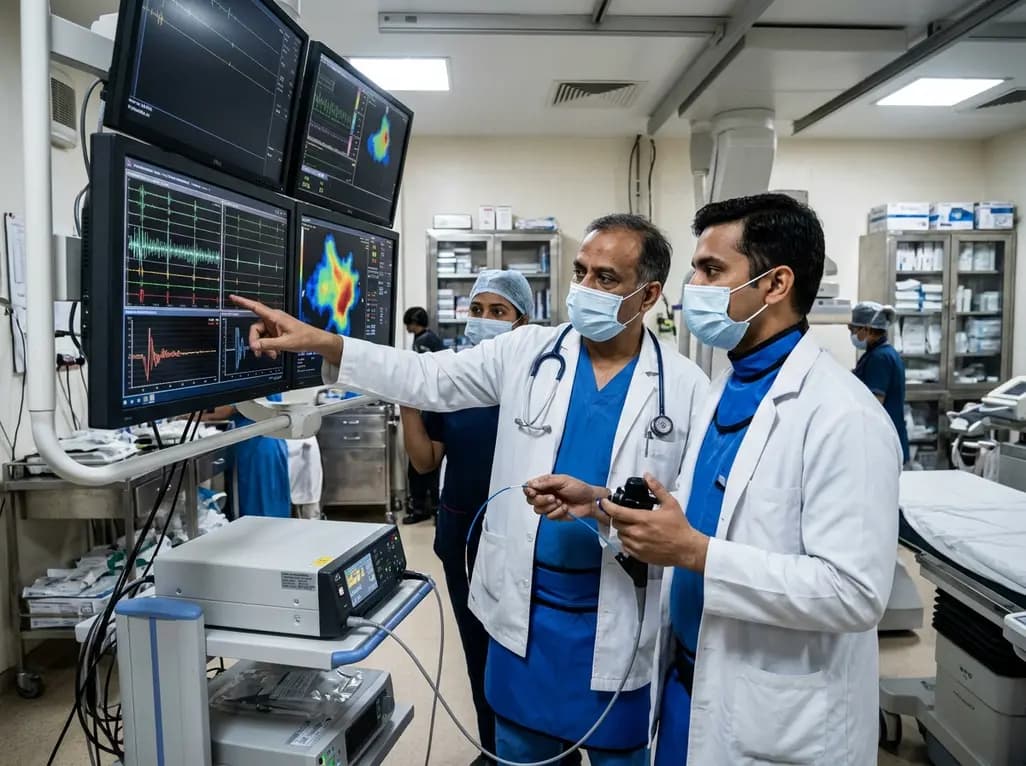
A comparative non-contact study reveals that high-power radiofrequency delivery with the QDOT MICRO catheter induces an artifactual contact force rise. Electrophysiologists must understand this power-dependent thermal and electrical phenomenon to avoid inadvertent catheter withdrawal and ineffective ablation.
Today

Healthium Medtech has transitioned its arthroscopy vertical into SIRONIX Orthopedics, aiming to capture key segments of the global joint care market. The strategic shift introduces dedicated portfolios in sports medicine, joint regeneration, surgical reconstruction, and digital operating technologies.
Today

Preclinical research demonstrates that BMI1 overexpression alleviates metabolic syndrome-related liver injury. By triggering ubiquitin-mediated METTL3 degradation, BMI1 prevents AHNAK m6A methylation and suppresses fibrogenic TGF-β/SMAD signaling, significantly improving hepatic steatosis and insulin resistance.
Today
