

Loading, please wait...
Loading, please wait...

Contact force sensing transformed cardiac catheter ablation by providing operators with objective mechanical feedback during lesion delivery. Clinicians rely on real-time force readouts to achieve transmural myocardial tissue destruction while avoiding fatal cardiac perforations. However, electrophysiologists now encounter an unexpected artifactual contact force rise during energetic radiofrequency bursts. This technical phenomenon describes an apparent increase in recorded contact force without physical myocardial contact. When generators deliver alternating current, catheter sensors occasionally display false force increases despite stable manual positioning. Consequently, operators face confusing feedback regarding actual catheter-tissue contact. The QDOT MICRO catheter recently popularized very high-power short-duration ablation protocols worldwide, delivering 90 watts across four seconds. These ultra-short applications improve procedural workflow and streamline pulmonary vein isolation. Nevertheless, extreme electrical power introduces intense thermal and electromagnetic gradients near internal force sensors. Therefore, clinicians must investigate whether real-time force elevations represent true mechanical tissue tension or measurement distortion. Electrophysiologists in Indian catheterization laboratories and global cardiac centers need robust awareness of this phenomenon. By recognizing these technical discrepancies, proceduralists can prevent inappropriate catheter manipulation during complex rhythm interventions.
To isolate true mechanical interaction from electronic artifact, researchers developed an inventive clinical protocol. The investigation retrospectively analyzed 135 arrhythmia patients who underwent non-contact radiofrequency delivery tests in the right atrial blood pool. Clinicians specifically stratified patients according to the ablation catheter utilized during their electrophysiological study. Overall, the cohort comprised 93 patients treated with the QDOT MICRO catheter and 42 with the Thermocool SmartTouch platform. During each test, operators positioned the catheter tip entirely free within the blood cavity, guaranteeing zero myocardial contact. The team tested the QDOT MICRO system across three distinct settings: 90 watts, 50 watts, and 40 watts. In contrast, they tested the Thermocool SmartTouch catheter at standard power outputs of 50 watts and 40 watts. Because the tip never engaged cardiac tissue, any detected force rise represented a purely artifactual measurement. The investigators documented peak force increments and calculated the incidence of false spikes exceeding 5 grams and 10 grams. Furthermore, this rigorous non-contact framework eliminated anatomical motion and respiratory excursions as confounding variables. Consequently, the experimental setup isolated catheter-specific electrical dynamics from active human tissue feedback. The resulting methodology provided an objective environment to compare sensor resilience under different electrical outputs.
The non-contact experiments uncovered stark discrepancies in force stability between the two catheter technologies. In the QDOT MICRO group, the investigators discovered a pronounced, power-dependent surge in measured contact force. Delivering 90 watts produced a median artifactual force rise of 9 grams, spanning an interquartile range of 5 to 12 grams. Reducing generator power to 50 watts lowered the median elevation to 3 grams. At 40 watts, the median increase dropped to 2 grams. Consequently, higher energy outputs triggered significantly larger measurement errors during ablation bursts. Moreover, the frequency of clinically concerning shifts peaked at 90 watts, where the vast majority of pulses exceeded 5 grams. Approximately half of the 90-watt applications even exceeded 10 grams without touching cardiac tissue. In sharp contrast, the Thermocool SmartTouch SF catheter demonstrated remarkable signal stability across all evaluations. At both 50 watts and 40 watts, the Thermocool device exhibited minimal force variance, maintaining medians near zero grams. Additionally, false elevations above 5 grams almost never occurred in the Thermocool cohort. These robust comparative findings prove that artifactual force rise is predominantly an issue for the newer high-power platform.
Multiple engineering and biophysical factors explain why intense radiofrequency delivery distorts contact force measurements. The QDOT MICRO catheter tip incorporates sophisticated microelectrodes and embedded thermocouples to regulate rapid temperature adjustments. However, releasing 90 watts of energy into circulating blood creates extreme thermal fluxes across microscopic tip components. This localized thermal surge induces rapid expansion of internal metallic structures and protective composite materials. Because optical force sensors detect microscopic deflections of an internal spring, thermal expansion can physically compress the sensing assembly. As a result, the processing console interprets thermal deformation as genuine mechanical force against myocardial tissue. Furthermore, high-frequency electromagnetic noise emitted during 90-watt transmission may perturb delicate optical-electrical signal conversion. Dynamic changes in saline irrigation flow also occur simultaneously, potentially generating transient mechanical thrust against the tip. In comparison, the Thermocool SmartTouch SF employs a different internal geometry, broader surround-flow irrigation, and lower peak power ceilings. Thus, its optical sensing array avoids excessive localized heating and subsequent structural distortion. Moreover, these temporary mechanical artifacts resolve completely once energy transmission terminates. Recognizing these physical principles assures electrophysiologists that internal material thermodynamics, rather than permanent equipment damage, drive these temporary reading spikes.
These discoveries provide crucial clinical lessons for electrophysiologists performing complex catheter ablation procedures. During very high-power short-duration ablation, operators typically aim for an initial contact force between 10 and 15 grams. If an application suddenly registers an artifactual increase of 10 grams, the monitor falsely indicates excessive pressure. Inexperienced operators might instinctively retract the catheter to avoid steam pops or cardiac perforation. Consequently, withdrawing the catheter creates complete loss of tissue contact during energy delivery. This unintended detachment results in shallow, ineffective lesions that promote late arrhythmia recurrence and pulmonary vein reconnection. Alternatively, an operator who initiates energy with inadequate contact might falsely assume stability based on the artifactual surge. Therefore, electrophysiologists must confirm firm, stable tissue contact before stepping on the ablation pedal. Clinicians should rely on pre-ablation impedance and tactile feedback to maintain consistent contact. Once energy delivery commences, operators should resist making rapid steering adjustments based solely on transient four-second force changes. Meanwhile, electrophysiology teams must advocate for software algorithms that automatically compensate for power-induced thermal drift. Adopting these disciplined habits preserves procedural safety without sacrificing the clinical efficiency of very high-power short-duration ablation protocols.
Artifactual contact force rise occurs primarily due to acute thermal expansion and electromagnetic interference within the catheter tip. When the generator delivers 90 watts of radiofrequency energy, intense localized heating rapidly warms internal metallic elements and composite polymers. This thermal expansion mechanically compresses internal optical force sensors, mimicking actual myocardial contact. Additionally, high alternating currents generate electromagnetic noise that transiently alters optical signal transmission, leading the recording console to display false force elevations.
Electrophysiologists identify artifactual elevations by closely observing the precise timing of force changes relative to energy delivery. Real mechanical force changes typically correlate with cardiac motion, respiratory cycles, or manual catheter manipulation. In contrast, artifactual spikes appear instantaneously when the radiofrequency generator activates and vanish the moment energy delivery stops. Operators should confirm stable baseline force and electrogram attenuation before activation, avoiding mid-pulse steering adjustments.
Yes, artifactual force elevation can compromise lesion durability if operators respond inappropriately to distorted monitor displays. When clinicians see an abrupt force surge to 25 grams, they may instinctively ease catheter pressure. Consequently, the catheter moves away from the myocardium, delivering energy into circulating blood instead of atrial tissue. This premature separation causes shallow, non-transmural lesions, leading to early pulmonary vein reconnection. Maintaining steady manual stability throughout the burn prevents this procedural complication.
Disclaimer: This content is for informational and educational purposes only and does not constitute medical advice, diagnosis, or treatment. Healthcare professionals should exercise independent clinical judgment. Refer to the latest local and national guidelines for clinical practice.
References

Read summarized clinical updates, watch expert medical content, and earn CME certifications right from your smartphone.
Open your smartphone camera to scan and install.





A comparative non-contact study reveals that high-power radiofrequency delivery with the QDOT MICRO catheter induces an artifactual contact force rise. Electrophysiologists must understand this power-dependent thermal and electrical phenomenon to avoid inadvertent catheter withdrawal and ineffective ablation.
Today
A retrospective comparative cohort study evaluated genitourinary safety in HFpEF between dapagliflozin and empagliflozin over six months. Rates of symptomatic UTI and asymptomatic bacteriuria showed no statistically significant differences, supporting comparable safety profiles across both SGLT2 inhibitors.
Today
A novel folate-conjugated tecto-dendrimer nanoplatform successfully delivers siRNA to achieve targeted HK2 silencing, disrupting ovarian cancer glycolysis and suppressing lactate output.
Today
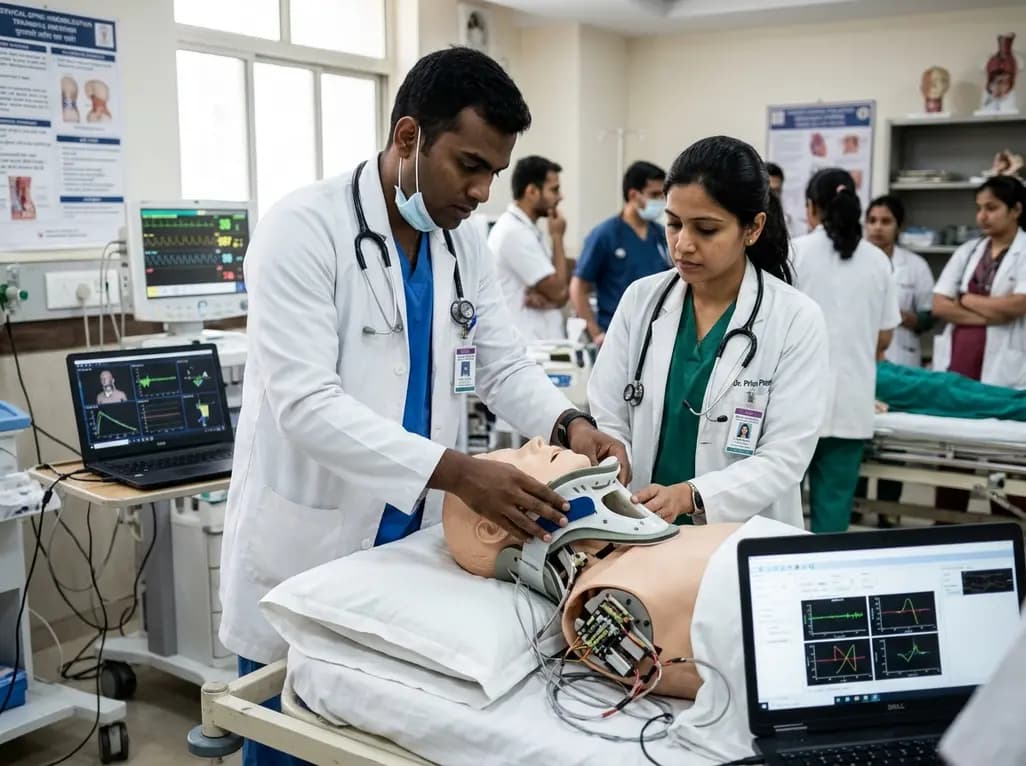
A novel proof-of-concept study presents a six-degree-of-freedom articulated manikin neck equipped with linear potentiometers. The system provides real-time kinematic motion feedback during cervical immobilisation, delivering sub-degree tracking accuracy to improve pre-hospital trauma training and patient safety.
Today

Protein O-GlcNAcylation couples cellular nutrient status to vital neuronal functions. This review explores how disrupted O-GlcNAc cycling drives both neurodevelopmental delays and neurodegenerative cascades, positioning metabolic post-translational modifications as therapeutic targets in clinical neurology.
Today
