.webp&w=384&q=75)

Loading, please wait...
Loading, please wait...
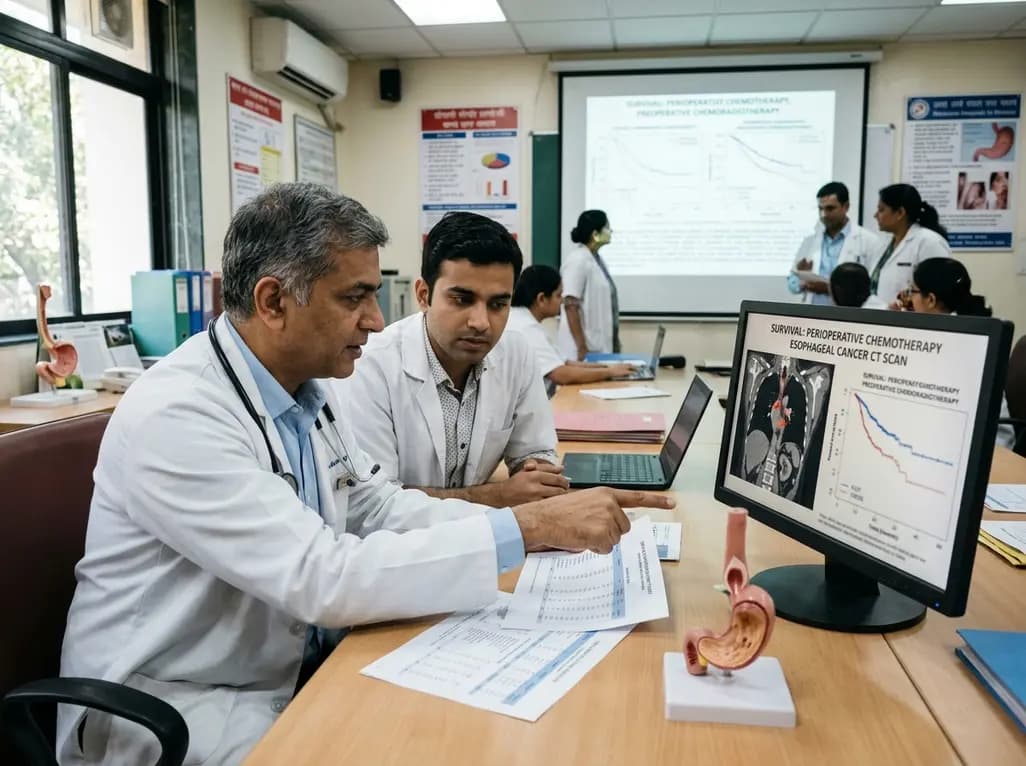
Optimal multimodal management remains essential for improving long-term survival in nonmetastatic gastroesophageal malignancies. Choosing the most effective esophagogastric adenocarcinoma treatment strategy continues to challenge oncologists, surgeons, and multidisciplinary tumor boards globally. Although landmark clinical trials such as CROSS and FLOT4 established standard regimens, direct comparisons in broad patient populations have remained scarce. Clinicians frequently deliberate between perioperative triplet chemotherapy and neoadjuvant chemoradiation, especially when treating locally advanced disease. Consequently, comprehensive real-world registry investigations provide critical evidence to guide clinical practice across diverse healthcare settings.
Historically, multimodal management of locally advanced gastroesophageal junction and gastric malignancies evolved along two distinct therapeutic pathways. The standard trimodality approach utilizes preoperative concurrent chemoradiotherapy followed by definitive surgical resection, effectively achieving substantial local tumor regression. Conversely, the perioperative chemotherapy approach delivers systemic cytotoxic therapy both before and after surgery to eradicate micro-metastatic disease early. While chemoradiation provides high rates of pathological complete response, perioperative regimens focus intensely on distant failure reduction. Therefore, evaluating these strategies in broad real-world cohorts clarifies whether systemic optimization or local intensification delivers superior overall survival benefits.
To evaluate these therapeutic modalities outside highly selected clinical trials, researchers analyzed a large cohort of 4,715 patients from the National Cancer Database. The investigative team stratified patients into four distinct treatment pathways to assess long-term overall survival outcomes accurately. These therapeutic pathways included preoperative chemotherapy alone, perioperative chemotherapy, preoperative chemotherapy followed by chemoradiotherapy, and preoperative chemoradiotherapy alone. Furthermore, the researchers utilized inverse probability of treatment weighting based on propensity scores to control for baseline demographic and oncologic differences. Consequently, this rigorous methodology minimized selection bias, allowing for a reliable comparison of systemic and locoregional treatment effectiveness.
The study demonstrated that patients receiving perioperative chemotherapy experienced significantly improved median overall survival compared to those undergoing preoperative chemoradiotherapy. Specifically, individuals in the perioperative chemotherapy cohort attained a median overall survival of 79.1 months, whereas those receiving chemoradiation achieved 74.6 months. Multivariable Cox proportional hazard regression confirmed that systemic perioperative treatment significantly reduced the hazard of mortality. Moreover, this survival benefit persisted even after comprehensive adjustment for clinical stage, nodal involvement, and performance metrics. Hence, these findings indicate that aggressive systemic control offers durable survival advantages in resectable esophagogastric junction and gastric adenocarcinoma.
These registry findings carry substantial practical implications for multidisciplinary cancer care teams treating esophagogastric adenocarcinoma. While chemoradiotherapy remains valuable for achieving high rates of negative surgical margins, distant systemic recurrence represents the primary driver of mortality. Therefore, completing both preoperative and postoperative systemic therapy cycles ensures maximal suppression of circulating tumor cells and micrometastases. Nevertheless, clinicians must carefully evaluate patient performance status, nutritional reserves, and organ function before prescribing aggressive triplet systemic regimens. Multidisciplinary tumor boards should individualize therapy, prioritizing systemic perioperative regimens for fit patients with high systemic recurrence risks.
Integrating systemic chemotherapy with timely, high-quality surgical resection forms the foundation of curative management. Although radiation therapy enhances local downstaging, perioperative systemic regimens deliver comparable R0 resection rates while treating occult systemic disease simultaneously. Surgeons and medical oncologists must collaborate closely to monitor treatment tolerance, manage toxicities proactively, and avoid unnecessary delays before definitive gastrectomy or esophagectomy. Furthermore, assessing postoperative recovery promptly enables eligible patients to complete adjuvant chemotherapy cycles without prolonged interruptions. As therapeutic standards continue to evolve, these comprehensive real-world findings reinforce perioperative systemic therapy as an optimal standard of care.
Perioperative chemotherapy treats micrometastatic disease early before surgery and provides additional systemic consolidation afterward. While chemoradiotherapy offers robust local tumor downstaging, distant metastatic progression remains the leading cause of treatment failure in esophagogastric adenocarcinoma. Therefore, delivering comprehensive pre- and postoperative systemic chemotherapy minimizes distant recurrence risks, which ultimately translates into improved long-term overall survival across large patient populations.
Aggressive perioperative chemotherapy regimens require adequate baseline organ function, nutritional stability, and good overall performance status to tolerate systemic toxicities. For frail patients or individuals with significant cardiopulmonary comorbidities who cannot complete intensive systemic cycles, preoperative chemoradiotherapy or tailored dual-agent regimens may offer manageable alternatives with meaningful local disease control and favorable surgical outcomes.
Completing the postoperative component of perioperative chemotherapy ensures maximal eradication of residual micrometastatic tumor cells that may persist after surgical resection. Studies consistently demonstrate that patients who successfully receive their full planned adjuvant systemic cycles achieve better progression-free and overall survival rates compared to individuals who discontinue therapy prematurely due to surgical complications or toxicities.
Disclaimer: This content is for informational and educational purposes only. It is not intended to provide medical advice or to be a substitute for professional medical advice, diagnosis, or treatment. Always seek the advice of your physician or other qualified health provider with any questions you may have regarding a medical condition or treatment. Refer to the latest local and national guidelines for clinical practice.
References
1. Oyenuga M et al. Analysis of real-world clinical outcomes of perioperative chemotherapy compared to preoperative chemoradiotherapy in esophagogastric adenocarcinoma. Cancer. 2026 Aug 15. doi: 10.1002/cncr.70571. PMID: 42603143.
2. Al-Batran SE, Homann N, Pauligk C, et al. Perioperative chemotherapy with fluorouracil plus leucovorin, oxaliplatin, and docetaxel versus fluorouracil or capecitabine plus cisplatin and epirubicin or doxorubicin for locally advanced, resectable gastric or gastro-oesophageal junction adenocarcinoma (FLOT4): a randomised, phase 2/3 trial. Lancet. 2019;393(10184):1948-1957.
3. Shapiro J, van Lanschot JJB, Hulshof MCCM, et al. Neoadjuvant chemoradiotherapy plus surgery versus surgery alone for oesophageal or junctional cancer (CROSS): long-term results of a randomised controlled trial. Lancet Oncol. 2015;16(9):1090-1098.

Read summarized clinical updates, watch expert medical content, and earn CME certifications right from your smartphone.
Open your smartphone camera to scan and install.





A real-world National Cancer Database analysis reveals superior overall survival with perioperative chemotherapy compared to preoperative chemoradiotherapy in patients with nonmetastatic esophagogastric adenocarcinoma, highlighting key insights for multimodal clinical decision-making.
last month

Researchers developed a novel bezafibrate-L-proline cocrystal inclusion compound using ball milling, boosting saturation solubility by 3.9-fold and oral bioavailability twofold. This supramolecular strategy holds promising potential to enhance drug efficacy and consistency in atherogenic dyslipidemia management.
Today

A multiparametric MRI approach combining quantitative T2 shading, apparent diffusion coefficient (ADC) measurements, and morphological signs provides superior diagnostic accuracy over subjective evaluation to differentiate ovarian endometriomas from benign hemorrhagic cysts.
Yesterday
A landmark case report reveals a donor heart beating for a century in a 63-year-old recipient, challenging conventional age limits in cardiac transplantation and offering critical lessons on organ longevity, donor selection, and long-term graft survival.
Today

Fatty infiltration after rotator cuff tears impairs shoulder repair outcomes. A new study reveals that targeting MST1 kinase suppresses fibro/adipogenic progenitor adipogenesis via WNT/β-catenin signaling, reducing muscle fat accumulation and mitigating muscle atrophy.
Today

A randomized crossover study reveals that exercise-induced glycogen depletion combined with a low-carbohydrate diet significantly enhances peak fat oxidation without impairing skeletal muscle mitochondrial coupling control or efficiency in healthy trained men.
Today
