

Loading, please wait...
Loading, please wait...
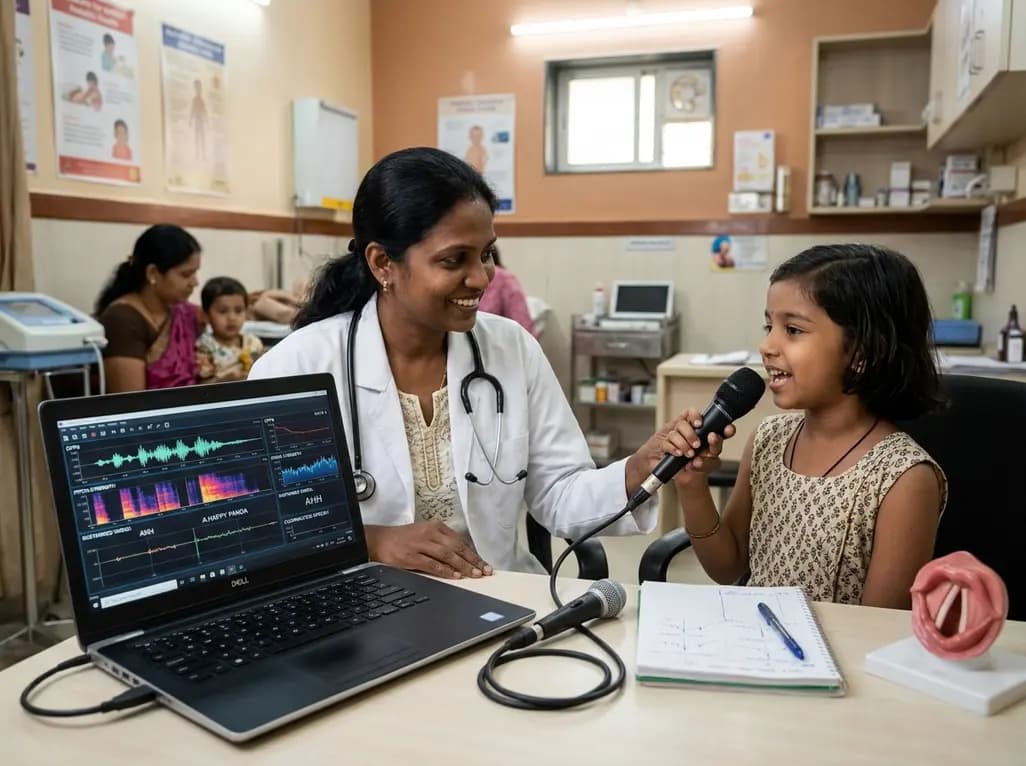
Pediatric dysphonia represents a frequent yet challenging clinical presentation in pediatric healthcare and otolaryngology practices. Vocal fold lesions, especially benign vocal fold nodules, frequently cause hoarseness and vocal fatigue among young children. Traditional clinical voice assessment relies heavily on subjective perceptual ratings and invasive flexible nasopharyngolaryngoscopy. However, pediatric patients often struggle during flexible endoscopic examinations because the procedure causes notable anxiety and physical discomfort. Furthermore, perceptual voice evaluation introduces subjective listener bias across clinicians. Consequently, objective acoustic assessment provides an indispensable, non-invasive diagnostic pathway. Historically, traditional perturbation measures like jitter and shimmer required strictly periodic phonation. Because dysphonic children cannot consistently sustain steady vocal vibration, traditional algorithms frequently generate unreliable results. Therefore, clinicians urgently need robust acoustic metrics that function across irregular acoustic signals. Recent advancements in cepstral processing offer superior diagnostic alternatives. In particular, cepstral peak prominence smoothed and pitch strength have emerged as promising non-invasive tools. These sophisticated metrics quantify harmonic regularity without requiring fundamental frequency tracking. Ultimately, objective acoustic indicators streamline clinical evaluations while preserving patient comfort.
Specifically, a recent investigation evaluated the clinical utility of Cepstral Peak Prominence Smoothed (CPPS) in one hundred children aged four to twelve years. The study compared forty-two pediatric patients with confirmed benign vocal fold lesions against fifty-eight vocally healthy control participants. Researchers analyzed sustained vowel phonations and connected speech samples to evaluate how voice context influences metric precision. Notably, children with voice disorders demonstrated significantly lower CPPS values compared to healthy peers across both tasks. In this analysis, CPPS calculated during sustained vowel phonation served as the strongest statistical predictor of vocal pathology status. Furthermore, CPPS derived from connected speech also separated dysphonic children from healthy controls with notable statistical significance. Benign vocal fold masses disrupt glottal closure and induce turbulent airflow, which generates spectral noise and diminishes cepstral peak prominence. In contrast, healthy pediatric vocal folds produce clear harmonic energy that generates pronounced cepstral peaks. Consequently, CPPS accurately quantifies the disruption of harmonic regularity caused by mucosal pathology. Thus, clinicians can reliably leverage smoothed cepstral metrics to identify pediatric dysphonia during standard voice screenings.
In addition to cepstral analysis, researchers examined pitch strength as an innovative acoustic indicator of pediatric voice quality. Pitch strength quantifies the perceptual prominence of tonal sensation relative to background noise. When vocal folds develop nodules or fibrous thickening, irregular mucosal dynamics corrupt acoustic periodicity. Consequently, the listener perceives a raspy or strained sound rather than a clear musical pitch. In the clinical trial, children presenting with vocal fold lesions displayed significantly decreased pitch strength values across sustained vowels and connected speech. Furthermore, pitch strength calculations exhibited strong statistical associations with disease status in univariable logistic regression modeling. Although pitch strength did not outperform CPPS on sustained vowels, it provided substantial complementary discriminatory power. Moreover, computing pitch strength requires minimal computational overhead and works effectively on brief acoustic recordings. This non-invasive assessment reduces patient fatigue during testing, which remains crucial when evaluating young children. Therefore, pitch strength represents a highly promising adjunctive metric for vocal profiling. When clinicians combine pitch strength with smoothed cepstral metrics, they gain an enriched multidimensional profile of vocal function.
To translate these acoustic metrics into practical clinical tools, the study established optimal diagnostic cutoff thresholds using receiver operating characteristic curves. Specifically, the optimal threshold for CPPS on sustained vowel phonation reached 11.19 dB, with a ninety-five percent confidence interval spanning 10.58 to 12.29 dB. Meanwhile, connected speech demonstrated an optimal CPPS threshold of 9.48 dB, with a confidence interval between 8.98 and 10.06 dB. For pitch strength, the optimal cutoff on sustained vowels was 0.30, whereas connected speech yielded a threshold of 0.28. However, the study identified substantial within-group variability among both dysphonic patients and healthy controls. Because individual vocal behaviors and phonatory effort vary widely during childhood, acoustic scores exhibited significant overlap across cohorts. Consequently, clinicians must exercise caution when applying rigid universal cutoffs to individual pediatric patients. A single acoustic measurement below the threshold does not replace direct visualization or comprehensive clinical history. Instead, these quantitative cutoffs serve as reliable benchmarks for tracking longitudinal rehabilitation progress. Therefore, practitioners should interpret these cutoffs within a holistic diagnostic framework rather than relying on them as standalone diagnostic determinants.
These findings carry direct clinical implications for pediatricians, speech-language pathologists, and otolaryngologists managing pediatric voice disorders. Traditionally, objective voice assessment required extensive recording batteries that overwhelmed younger children, causing reduced compliance and distorted data. In contrast, incorporating brief recordings of sustained vowels alongside short connected speech passages takes less than two minutes. Furthermore, modern speech processing software can automatically calculate CPPS and pitch strength in real time during outpatient office consultations. This rapid assessment protocol enables clinicians to identify mucosal pathology early without inducing procedural distress. Additionally, objective acoustic metrics provide invaluable baseline documentation before initiating behavioural voice therapy or surgical intervention. Clinicians can present visual acoustic feedback to parents, illustrating voice improvements as treatment progresses over time. Similarly, serial CPPS tracking helps therapists confirm mucosal healing and vocal habit normalization. However, clinicians must remember that acoustic screening complements rather than supplants pediatric laryngeal endoscopy. When acoustic values persistently fall below established thresholds, physicians should promptly schedule direct laryngoscopy to rule out structural lesions. Thus, integrating cepstral analysis modernizes pediatric voice care by combining objective precision with child-friendly convenience.
Cepstral Peak Prominence Smoothed improves assessment because it operates reliably on irregular acoustic waveforms. Traditional perturbation metrics fail when severe hoarseness disrupts fundamental frequency tracking. In contrast, CPPS transforms the acoustic spectrum into a cepstrum to measure harmonic energy prominence relative to background noise. Consequently, clinicians obtain reproducible, objective measurements from sustained vowels and connected speech without requiring periodic phonation or subjecting young children to uncomfortable invasive procedures.
Sustained vowel phonation provides a steady aerodynamic environment free from articulatory movements and consonant transitions. During connected speech, dynamic vocal tract shaping, rapid coarticulation, and natural phonetic pauses introduce extensive acoustic variability into cepstral calculations. Therefore, sustained vowels isolate the true vibratory stability of the vocal fold mucosa with superior statistical precision. Consequently, acoustic algorithms detect subtle glottal closure defects more distinctly during sustained phonation, making it the strongest predictor of voice status.
Within-group variability stems primarily from ongoing anatomical development, fluctuating vocal effort, and variable behavioral compliance across pediatric age groups. Laryngeal framework dimensions and vocal fold histology shift dramatically between ages four and twelve. Furthermore, children exhibit wide variations in speaking volume and momentary fatigue during clinic visits. Because these physiological and behavioral factors influence acoustic energy distribution, clinicians cannot rely exclusively on rigid cutoffs. Instead, they should combine acoustic data with comprehensive clinical examination.
Disclaimer: This content is for informational and educational purposes only and is not medical advice. Diagnostic thresholds must be integrated into comprehensive clinical protocols. Refer to the latest local and national guidelines for clinical practice.
References

Read summarized clinical updates, watch expert medical content, and earn CME certifications right from your smartphone.
Open your smartphone camera to scan and install.





New research demonstrates that Cepstral Peak Prominence Smoothed (CPPS) and pitch strength serve as objective acoustic markers of pediatric dysphonia, differentiating children with benign vocal fold lesions from healthy controls across sustained vowels and connected speech.
Today

A novel adherence-driven sparsity framework demonstrates that missingness in patient-generated telemedicine data reflects human behavior rather than mere technical error, guiding safer clinical interpretations.
Today

This study examines how sexual victimization leads to alcohol misuse via PTSD symptoms among college females. While general rape myths show no moderating effect, intoxication-related myths exert a selective buffering role, highlighting the need for comprehensive trauma-informed dual-diagnosis interventions.
Today

A major World Health Organization study reveals that one in four teenagers globally records zero active days per week. Discover the epidemiological data, cardiometabolic consequences of adolescent sedentary behavior, and practical guidance for clinicians to promote healthy lifestyle habits among youth.
Today

Arthrogryposis multiplex congenita affects fetal joint mobility, yet fewer than half of cases are detected prenatally. This review highlights dynamic fetal motor assessment, phenotypic subtyping, rapid exome sequencing, and multidisciplinary perinatal care to optimize diagnosis and parental counseling.
Today

A multicenter study evaluates an XGBoost machine learning model to predict miscarriage risk in PCOS after fresh embryo transfer. While discrimination was strong internally, cross-cohort calibration drift emphasizes its role as a risk-ranking tool rather than a standalone diagnostic instrument.
Today
