.webp&w=384&q=75)

Loading, please wait...
Loading, please wait...
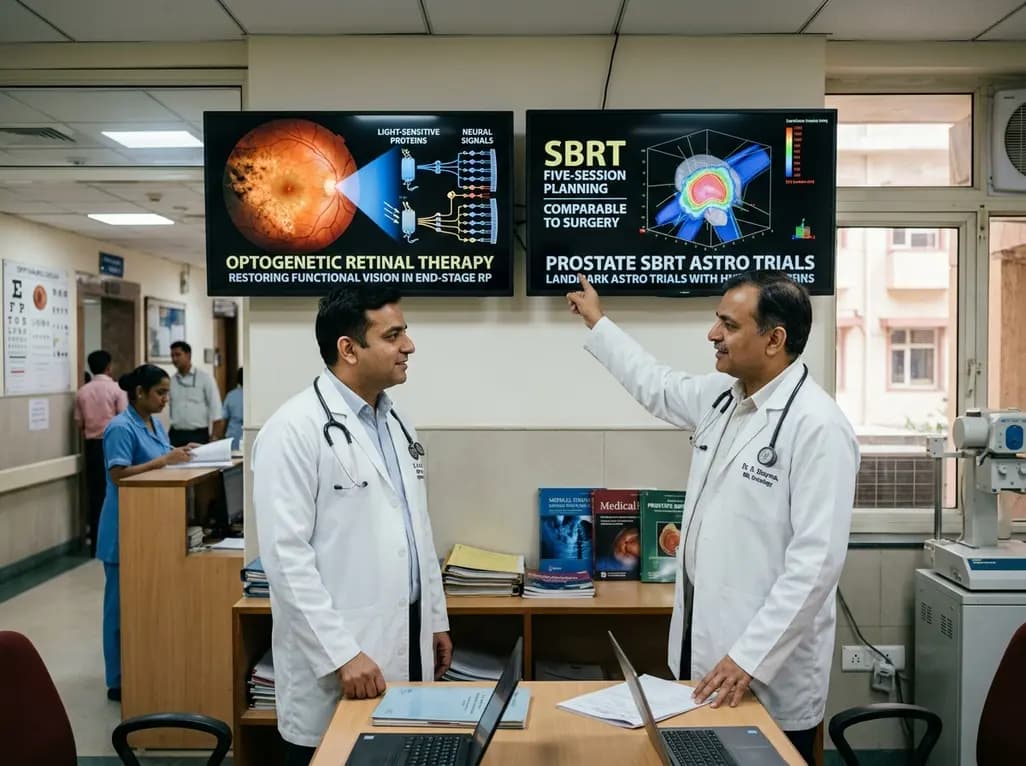
Modern translational medicine continues to deliver remarkable breakthroughs that reshape standard clinical care. Specifically, optogenetic therapy has emerged as a revolutionary therapeutic approach capable of restoring functional perception in severe degenerative blindness. At the same time, newly published oncology trials from the American Society for Radiation Oncology demonstrate substantial survival and quality of life benefits for localized and metastatic malignancies. For healthcare practitioners in India and worldwide, these rapid innovations highlight an encouraging shift toward biologically targeted and minimally invasive interventions.
Retinitis pigmentosa encompasses a genetically heterogeneous group of inherited neurodegenerative disorders that progressively destroy retinal photoreceptors. Consequently, patients experience unremitting nyctalopia followed by peripheral visual field constriction and eventual profound blindness. Because more than one hundred distinct genetic mutations cause this condition, developing mutation-specific gene therapies remains economically and logistically challenging. Optogenetic therapy overcomes this significant hurdle through a mutation-independent restorative framework. Instead of repairing broken photoreceptor genes, this approach transforms surviving retinal ganglion cells into functional, light-sensitive artificial receptors.
In a recent phase 1/2 clinical study published in The New England Journal of Medicine, investigators evaluated this novel technology in ten participants with terminal vision loss. Researchers administered a single intravitreal injection carrying the ChrimsonR gene packaged inside an adeno-associated viral capsid. Furthermore, the viral vector transfects inner retinal ganglion cells, instructing them to produce amber-sensitive opsin proteins. Because ambient light alone cannot trigger these modified channels, patients wear specialized bioengineered goggles. These external headsets capture ambient visual scenes in real time and project targeted amber light pulses onto the retina. As a result, the optical signals stimulate ganglion cells directly, transmitting coherent visual data to the cerebral cortex.
The exploratory findings from this early cohort confirm meaningful visual gains among patients suffering from near-total blindness. Notably, seven of the ten treated participants demonstrated markedly heightened sensitivity to light after intervention. Furthermore, six individuals achieved clinically significant functional improvements during standardized psychophysical assessments. Patients successfully identified the presence of objects placed on tables, accurately discerned their spatial orientation, and reached toward them with reliable precision. Moreover, electroencephalographic recordings confirmed that optogenetic pulses evoked occipital cortical activity corresponding directly to visual stimuli.
Regarding safety, the biological intervention demonstrated an acceptable safety profile across the study group. Although one patient experienced a transient central retinal artery occlusion immediately following injection, the acute vascular event resolved spontaneously within minutes. Mild intraocular inflammation responded rapidly to routine topical corticosteroids without lasting ocular damage. While patients did not regain reading ability or facial recognition, the restored navigation capabilities provide immense autonomy. Therefore, this landmark investigation establishes that severely atrophic retinas maintain substantial neural plasticity. For ophthalmologists managing end-stage photoreceptor dystrophies, these findings validate optogenetics as an actionable platform for neurofunctional restoration. Consequently, clinicians anticipate that subsequent phase trials will refine stimulation algorithms and broaden clinical accessibility.
Beyond ophthalmology, recent radiation oncology presentations offer transformative clinical evidence for localized prostate carcinoma. For decades, urologists and radiation oncologists debated whether surgical prostatectomy or definitive radiotherapy provides superior disease control. However, mature eight-year outcomes from the randomized PACE-A trial presented at ASTRO demonstrate remarkable therapeutic equivalence between modalities. Specifically, the investigators tracked 123 men with low- and intermediate-risk disease assigned to either radical prostatectomy or stereotactic body radiation therapy.
After an eight-year median follow-up, 91% of patients receiving stereotactic radiotherapy remained entirely free from disease recurrence. In comparison, 84% of surgical patients achieved recurrence-free status, confirming statistically comparable oncological control. Furthermore, SBRT achieves these durable outcomes through only five outpatient fractions delivered over two weeks, utilizing sharp dose gradients that protect surrounding structures. Because clinicians do not administer androgen deprivation therapy in this protocol, the trial isolated the true therapeutic impact of focal radiation. Thus, urologists and oncologists in modern clinical practice can confidently present hypofractionated stereotactic radiotherapy as a robust alternative to invasive prostatectomy. This abbreviated radiation schedule substantially minimizes hospital visits, reduces overall healthcare costs, and preserves crucial medical resources.
While oncological equivalence remains paramount, functional outcomes heavily dictate patient satisfaction and emotional well-being following prostate cancer interventions. In this context, the PACE-A investigators reported strikingly favorable quality-of-life metrics among men treated with stereotactic body radiation. Specifically, urinary continence rates showed profound differences between the two therapeutic cohorts at five years. Only 8.3% of men receiving SBRT required absorbent pads for urinary leakage, whereas 48% of post-prostatectomy patients depended on daily pads. This forty percent absolute difference underscores the immense urinary morbidity frequently accompanying radical pelvic surgery.
Similarly, patient-reported sexual function favored stereotactic radiation over radical surgery across long-term follow-up intervals. Although sexual scores declined progressively in both arms due to natural aging, radiation patients retained considerably greater potency. On a validated 25-point erectile function assessment, SBRT recipients maintained a median score of 19, whereas surgically managed patients scored a median of 5. Consequently, radiation therapy avoids extensive neurovascular bundle disruption and preserves pelvic floor integrity far more reliably than surgical excision. For Indian clinicians counseling newly diagnosed men, these functional distinctions provide vital practical context. Clinicians can reassure patients that modern hypofractionation delivers definitive tumor eradication without severely compromising long-term dignity or physical comfort.
In parallel neuro-oncology advancements, a separate randomized study presented at ASTRO challenges traditional paradigms regarding small cell lung cancer brain metastases. Historically, radiation oncologists mandated whole-brain radiation therapy due to widespread microscopic seeding concerns. Unfortunately, whole-brain radiation frequently precipitates severe neurocognitive impairment, accelerated memory loss, and diminished functional independence. To counter these adverse effects, investigators evaluated focused stereotactic radiosurgery against modern hippocampal-avoidance whole-brain radiotherapy in 151 patients.
Surprisingly, patients receiving targeted stereotactic radiosurgery achieved a median overall survival of 17 months compared to only 9 months after whole-brain therapy. Although cognitive decline intervals remained statistically comparable between groups, radiosurgery demonstrated substantial survival advantages while limiting non-target tissue exposure. Furthermore, modern sub-millimeter stereotactic delivery ablates visible metastatic foci while sparing surrounding brain parenchyma. This focused strategy significantly decreases radiation-induced fatigue, somnolence, and executive dysfunction. Therefore, these randomized findings provide compelling clinical rationale for selecting stereotactic radiosurgery in oligometastatic small cell lung cancer presentations. As advanced linear accelerators become increasingly available across tertiary cancer centers in India, adopting targeted radiosurgery will expand personalized therapeutic options, reduce unnecessary neurocognitive toxicity, and improve survival for complex neuro-oncology patients.
Q1: How does optogenetic therapy restore light perception in retinitis pigmentosa?
The therapy utilizes an adeno-associated viral vector to deliver the ChrimsonR gene directly into dormant retinal ganglion cells. Consequently, these surviving neurons produce light-sensitive proteins that respond to amber light wavelengths. External camera goggles then capture the visual surroundings, transform images into targeted optical pulses, and project them onto the retina. Therefore, this mechanism bypasses damaged photoreceptors and enables patients to perceive shapes, locate boundaries, and detect surrounding objects effectively.
Q2: Why is five-session SBRT emerging as an alternative to prostatectomy?
Long-term data from the PACE-A clinical trial demonstrate that five-fraction stereotactic body radiation therapy matches radical surgery regarding eight-year disease-free survival. In addition, the targeted radiation technique delivers high therapeutic doses while sparing adjacent bladder and rectal tissues. Consequently, patients report significantly better preservation of erectile function and lower urinary incontinence rates. Specifically, fewer than ten percent of radiation patients required incontinence pads compared to nearly half of surgical patients.
Q3: What makes stereotactic radiosurgery beneficial for small cell lung cancer brain metastases?
Historically, clinicians prescribed whole-brain radiation for small cell lung cancer due to high intracranial recurrence risks. However, recent ASTRO trial findings indicate that stereotactic radiosurgery provides superior median survival of seventeen months compared to nine months with whole-brain irradiation. Furthermore, stereotactic delivery focuses high radiation beams directly on visible tumors while preserving normal brain tissue. Therefore, this strategy avoids broad neurotoxicity and offers oncologists an effective, patient-centered option for managing complex metastatic presentations.
Disclaimer: This content is for informational and educational purposes only. It does not constitute medical advice or replace professional judgment. Refer to the latest local and national guidelines for clinical practice.
References

Read summarized clinical updates, watch expert medical content, and earn CME certifications right from your smartphone.
Open your smartphone camera to scan and install.





Recent clinical breakthroughs reveal remarkable advances across medicine. An optogenetic approach restores functional vision in end-stage retinitis pigmentosa. Meanwhile, landmark ASTRO trials confirm five-session SBRT matches prostatectomy and focused radiosurgery prolongs survival in small cell lung cancer.
Today

A study demonstrates an explainable machine learning framework integrating clinical and echocardiographic metrics to predict left atrial appendage thrombus in non-valvular atrial fibrillation, utilizing SHAP analysis for clinical interpretability.
Today

Maternal anaemia contributes to nearly half of pregnancy-related fatalities across India. To prevent complications, Uttar Pradesh has added single-dose parenteral iron to its essential medicines list. This clinical transition aims to restore haemoglobin rapidly and protect high-risk mothers across rural facilities.
Today

A landmark systematic review and meta-analysis establishes age-specific normative reference values for pediatric pulse wave velocity, revealing a nonlinear trajectory of arterial stiffness from early childhood through adolescence.
Today
A new systematic review evaluates lumbar facet arthroplasty, predominantly the Total Posterior Spine System (TOPS). Evidence shows significant reductions in back and leg pain and preserved segmental mobility, though revision rates and outcome heterogeneity highlight the need for careful patient selection.
Today

A landmark cross-sectional study in Asian adults with type 2 diabetes identifies novel urinary metabolites linked to mild cognitive impairment. Elevated urinary sucrose and altered metabolites highlight non-invasive pathways for early cognitive risk stratification and targeted metabolic management.
Today
