.webp&w=384&q=75)

Loading, please wait...
Loading, please wait...
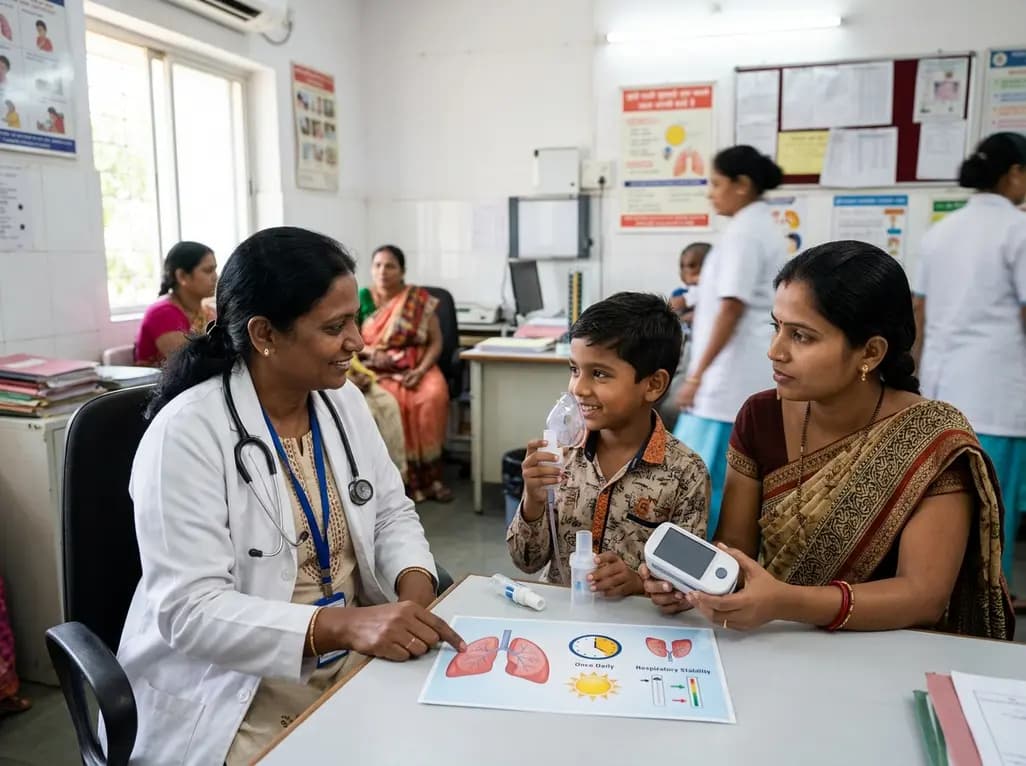
The emergence of highly effective cystic fibrosis transmembrane conductance regulator (CFTR) modulators has transformed pediatric cystic fibrosis management. Modern therapy combining elexacaftor, tezacaftor, and ivacaftor (ETI) addresses the root ion transport defect, significantly reducing chronic respiratory symptoms. Consequently, clinicians and families now question the continued necessity of burdensome twice-daily supportive regimens. Standard maintenance care demands significant time, often creating substantial treatment fatigue for young patients. Optimizing cystic fibrosis airway clearance routines represents a major clinical milestone in the modulator era. Recent prospective multicentre evidence indicates that reducing hypertonic saline inhalation and physiotherapy to once daily preserves respiratory stability in children on ETI.
For decades, standard pediatric cystic fibrosis care has mandated twice-daily nebulized hypertonic saline alongside physical chest physiotherapy. These interventions hydrate airway surfaces, loosen thick secretions, and stimulate productive coughing to prevent exacerbations. However, completing these burdensome therapies requires up to two hours every day. This heavy time commitment frequently impairs treatment adherence, school performance, and family quality of life. Highly effective modulator therapies have radically altered this clinical reality by restoring CFTR channel function.
Because ETI significantly enhances chloride and fluid transport across respiratory epithelia, many children achieve near-normal baseline lung health. Therefore, clinicians must determine whether intensive mucoactive regimens remain necessary. Safely de-escalating daily therapies could alleviate treatment fatigue without compromising patient outcomes. Researchers conducted a prospective multicentre study across two Swedish CF centres to evaluate this strategy. They systematically followed pediatric patients to confirm whether once-daily regimens maintain clinical stability over twelve months.
The prospective study enrolled forty-six children with cystic fibrosis aged 6 to 17 years. All participants had received stable ETI therapy for at least nine months prior to study entry. Under structured clinical supervision, investigators reduced both hypertonic saline nebulization and airway clearance techniques from twice daily to once daily over twelve months.
To detect subtle alterations in respiratory status, researchers designated the change in lung clearance index (LCI) as the primary outcome. Multiple-breath washout techniques calculate LCI to sensitively identify ventilation inhomogeneity and small airway dysfunction. Secondary endpoints included spirometry (FEV1 percent predicted), airway microbiology, antibiotic consumption, and validated respiratory symptom scores. Mixed-effects models facilitated comprehensive longitudinal analyses. At baseline, the pediatric cohort demonstrated preserved lung function, with a mean LCI of 6.6 and a mean FEV1 of 97.2 percent predicted. Consequently, these children represented an ideal population to evaluate safe maintenance de-escalation protocols.
Over the 12-month de-escalation period, primary and secondary physiological metrics demonstrated remarkable stability. Specifically, the lung clearance index showed a small, non-significant improvement of -0.32 units (95% CI -0.67 to 0.03; P = 0.075). Because LCI values below 7.0 represent normal ventilation distribution, participants maintained excellent peripheral airway health throughout the trial.
Similarly, spirometry measurements confirmed functional stability across all follow-up visits. The mean change in FEV1 percent predicted was 0.02 percentage points (95% CI -2.74 to 2.77; P = 0.99), demonstrating no functional deterioration. Furthermore, patient-reported respiratory symptom scores remained stable, showing an insignificant change of -2.9 points (95% CI -9.8 to 4.1; P = 0.41). These findings confirm that once-daily hypertonic saline and physical clearance sustain airway patency effectively. Restored endogenous mucociliary clearance appears sufficient to preserve lung function when supported by a simplified once-daily routine.
Evaluating infectious complications represents a critical safety priority during maintenance therapy de-escalation. Theoretical concerns suggest that reducing clearance frequency might encourage mucus stasis and opportunistic bacterial colonization. However, longitudinal microbiological surveillance revealed no detrimental microbial shifts during the 12 months of once-daily clearance.
Importantly, annual systemic antibiotic exposure decreased substantially among study participants. Total antibiotic use dropped from 47 days per person-year at baseline to 29 days per person-year during the intervention period. This change corresponds to a significant 39 percent reduction in antibiotic burden (95% CI 25% to 50%). Reduced antibiotic requirements verify that regimen simplification did not provoke subclinical pulmonary exacerbations. Instead, continuous CFTR modulation combined with once-daily clearance adequately protected children against respiratory infections. Thus, simplified regimens reduce clinical burdens while minimizing antimicrobial resistance risks.
The daily treatment burden in cystic fibrosis historically ranks among the highest across chronic pediatric diseases. Children and parents routinely navigate multiple nebulizers, oral medications, chest oscillation devices, and manual physiotherapy sessions daily. This demanding schedule frequently causes psychological stress, treatment resistance, and school absenteeism. Moreover, chronic treatment fatigue often leads to erratic adherence.
By safely reducing hypertonic saline and physiotherapy to once daily, families regain valuable time each morning or evening. Consequently, children experience greater daily autonomy, improved school attendance, and expanded opportunities for physical exercise. Physical activity itself serves as an effective natural clearance adjunct, further supporting airway hygiene. Therefore, reducing formal therapy regimens enhances overall quality of life and strengthens long-term treatment compliance. Healthcare teams can confidently support structured simplification when guided by regular clinical monitoring.
Although these trial results offer strong reassurance, clinicians must approach therapy de-escalation with careful clinical oversight. Regimen simplification is specifically suitable for pediatric patients demonstrating sustained stability on ETI therapy. Candidates must exhibit well-preserved baseline spirometry and minimal respiratory symptoms before initiating any treatment reduction.
Furthermore, multidisciplinary CF care teams must establish clear clinical safety nets before adjusting regimens. Providers should schedule routine monitoring visits with spirometry, multiple-breath washout assessments, and sputum cultures. If a child develops acute respiratory symptoms, viral infections, or pulmonary exacerbations, families must promptly resume twice-daily routines. Additionally, clinicians should evaluate individual adherence patterns and lifestyle factors before implementing changes. When applied thoughtfully, structured de-escalation delivers meaningful lifestyle benefits while preserving long-term pulmonary health.
No, therapy reduction is not universally appropriate for every pediatric patient. This approach is specifically supported for children aged 6 to 17 years who have received stable ETI therapy for at least nine months and maintain normal baseline lung function. Patients with significant structural airway damage, frequent exacerbations, or uncontrolled chronic infections require individualized evaluation by their cystic fibrosis care team before modifying therapy.
ETI directly addresses the underlying cystic fibrosis defect by improving CFTR channel function at the epithelial surface. This restoration increases mucosal hydration, enhances endogenous mucociliary transport, and decreases airway inflammation. Because the lungs naturally clear secretions more effectively, stable patients can maintain clear airways and optimal lung function without requiring intensive twice-daily nebulized hypertonic saline and manual chest physiotherapy.
Clinicians must implement structured longitudinal monitoring when stepping down therapy frequency. Routine follow-up visits should incorporate spirometry to assess FEV1, multiple-breath washout testing to track lung clearance index, and airway cultures to detect bacterial pathogens. Additionally, care teams must monitor patient-reported respiratory symptoms and instruct families to resume twice-daily clearance promptly during acute respiratory infections.
Disclaimer: This content is for informational and educational purposes only and should not be considered medical advice. Always consult a qualified healthcare professional regarding any medical condition or treatment. Refer to the latest local and national guidelines for clinical practice.
References
Svedberg M et al. Once-daily hypertonic saline inhalation and airway clearance techniques in children with cystic fibrosis treated with elexacaftor/tezacaftor/ivacaftor: a prospective multicentre study. J Cyst Fibros. 2026 Aug 22. doi: undefined. PMID: 42632792.
Mayer-Hamblett N, Nichols DP, Odem-Davis K, et al. Evaluating the impact of discontinuing hypertonic saline or dornase alfa in individuals with cystic fibrosis treated with elexacaftor/tezacaftor/ivacaftor: A randomized clinical trial (SIMPLIFY). Lancet Respir Med. 2023;11(4):329-340.
Donaldson SH, Corcoran TE, Laube BL, et al. The effect of discontinuing hypertonic saline or dornase alfa on mucociliary clearance in elexacaftor/tezacaftor/ivacaftor treated people with cystic fibrosis: The SIMPLIFY-MCC Study. J Cyst Fibros. 2024;23(3):474-480.

Read summarized clinical updates, watch expert medical content, and earn CME certifications right from your smartphone.
Open your smartphone camera to scan and install.





A prospective multicentre study reveals that children with cystic fibrosis treated with ETI can safely reduce hypertonic saline and airway clearance techniques from twice daily to once daily without compromising lung function, symptom stability, or exacerbation rates.
last month

A large UK cohort study of 1.4 million women shows that pregnancy complications, including gestational diabetes, hypertension, and preterm birth, substantially raise long-term risks for hypertension, chronic kidney disease, type 2 diabetes, and cardiovascular events, highlighting early postpartum intervention needs.
Today

A landmark single-cell study reveals that MEHP, a major phthalate metabolite, damages human ovarian tissue beyond follicles. By disrupting glial-stromal communication, cellular adhesion, and mitochondrial respiration, environmental plasticizers impair ovarian integrity at realistic exposure levels.
Today

Neuberg Diagnostics has consolidated its Maharashtra operations with NM Medical, creating a unified clinical platform. The strategic alliance integrates high-end radiology, cardiology, and wellness screening with advanced molecular diagnostics, digital pathology, and genomics to elevate patient care statewide.
Today

A scoping review reveals severe gaps in long-term assistive technology provision following humanitarian emergencies. Addressing post-disaster rehabilitation requires systematic follow-up, workforce training, and integration into national health systems to sustain mobility and recovery.
Yesterday

The World Health Organization has issued its first global guidelines for managing child and adolescent obesity. The recommendations strongly endorse family-based dietary interventions, regular physical activity, and behavioral support as frontline therapy, reserving GLP-1 therapies and surgery for select cases.
Today
