.webp&w=384&q=75)

Loading, please wait...
Loading, please wait...
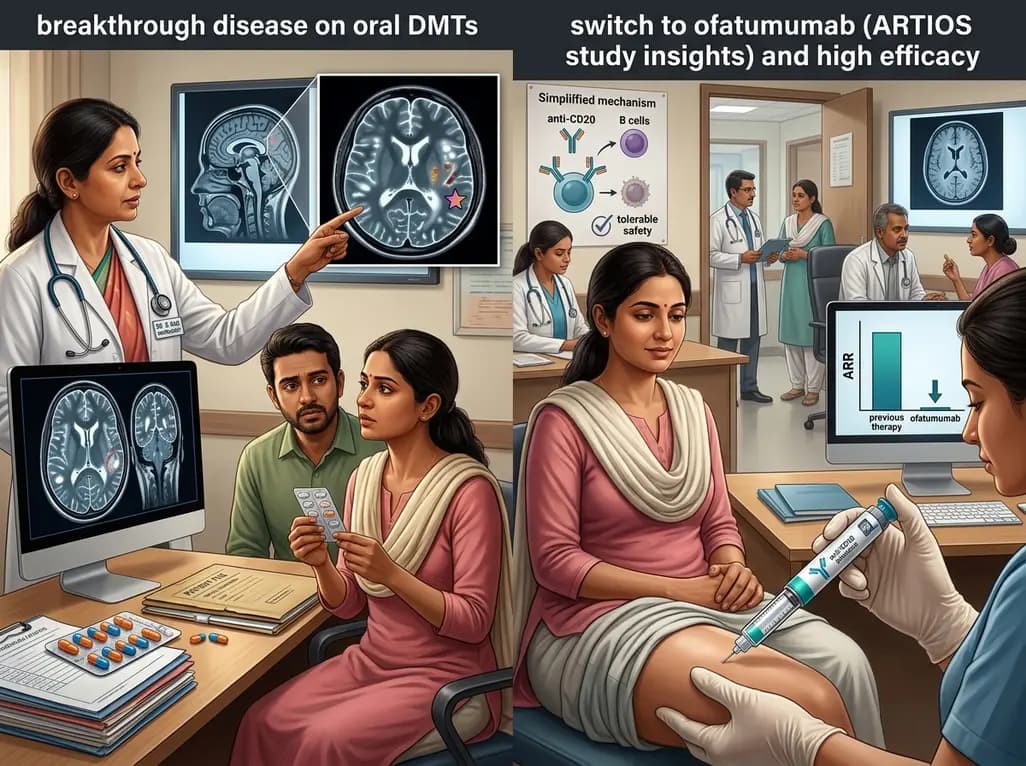
Managing relapsing multiple sclerosis (RMS) has evolved significantly with the introduction of diverse disease-modifying therapies (DMTs). Despite the availability of high-efficacy options, many clinicians still initiate treatment with moderate-efficacy oral agents like fingolimod or fumarates. While these drugs are effective for many, a subset of patients inevitably experiences breakthrough disease. This clinical scenario presents a significant challenge, as persistent inflammatory activity can lead to irreversible neurological damage and disability accumulation. Consequently, transitioning to a high-efficacy therapy becomes a priority for maintaining long-term neurological health. Ofatumumab in Relapsing MS has emerged as a potent subcutaneous B-cell depleting therapy, offering a convenient and effective alternative for these patients. However, until recently, data regarding the specific transition from moderate-efficacy oral DMTs to ofatumumab were limited.
The clinical community has long debated the timing of "stepping up" therapy. Early initiation of high-efficacy DMTs is increasingly supported by evidence showing better long-term outcomes. Furthermore, the psychological and physical burden of breakthrough relapses necessitates a swift and reliable change in strategy. Ofatumumab, a fully human anti-CD20 monoclonal antibody, targets the CD20 molecule on B cells with high precision. Its delivery via monthly subcutaneous injections allows for self-administration, bridging the gap between oral convenience and infusion-level efficacy. Therefore, understanding its performance in a real-world switch scenario is essential for refining MS treatment algorithms and improving patient care.
The ARTIOS study was a phase 3b, open-label, single-arm, multicenter trial designed to evaluate the real-world utility of switching to ofatumumab. It specifically focused on adults with RMS who were previously treated with either fingolimod or fumarate-based therapies. Participants had to demonstrate breakthrough disease activity to qualify for the study. This was strictly defined as having at least one relapse in the prior year or two relapses in the prior two years. Alternatively, patients could be enrolled if they showed magnetic resonance imaging (MRI) evidence of disease activity, such as new or enlarging lesions, while on their previous oral therapy. This design ensures that the study population reflects those most in need of a therapeutic escalation.
A total of 562 participants were enrolled across multiple global sites, including contributors from India. The majority of the cohort (67.8%) transitioned from fumarates, while the remainder (32.2%) switched from fingolimod. Baseline characteristics revealed that those switching from fingolimod often had more advanced disease. This was characterized by lower cognitive scores and a higher volume of pre-existing T2 lesions. Despite these differences, the study aimed to provide a comprehensive look at how ofatumumab performs across different levels of baseline disease severity. By focusing on this specific transition, ARTIOS provides clinicians with actionable data for managing patients who are no longer adequately controlled by first-line oral medications.
The primary endpoint of the ARTIOS study was the annualized relapse rate (ARR) over 96 weeks. The results were highly encouraging, showing a remarkably low overall ARR of 0.06. This figure indicates that, on average, patients experienced fewer than one relapse every sixteen years while on treatment. Statistical analysis confirmed that this was significantly lower than the predefined threshold of 0.18, which represented the expected rate if the switch were not highly effective. Furthermore, the ARR was consistently low across both subgroups. Those switching from fumarates achieved an ARR of 0.06, while the fingolimod group, despite having higher baseline severity, achieved an ARR of 0.09.
Interestingly, the efficacy appeared to improve even further during the second year of treatment. In year two, the ARR dropped to a mere 0.02, suggesting that the full inflammatory-suppressive effects of ofatumumab may consolidate over time. This trend is particularly important for Ofatumumab in Relapsing MS, as it reinforces the drug's role in providing sustained disease control. For patients who have recently suffered from the uncertainty of breakthrough relapses, these results offer significant reassurance. The ability of ofatumumab to virtually halt clinical relapses represents a major milestone in switching strategies. Consequently, clinicians can feel more confident when recommending this transition to patients experiencing suboptimal responses to their current oral DMTs.
MRI remains the most sensitive tool for monitoring subclinical disease activity in MS. In the ARTIOS trial, ofatumumab demonstrated near-complete suppression of new inflammatory lesions. Specifically, the rate of gadolinium-enhancing (Gd+) T1 lesions was reduced by 93.7% within the first 24 weeks of treatment. By week 96, this reduction reached 98.1%, indicating almost total abrogation of new focal inflammatory activity. This is a critical finding because subclinical lesions often precede clinical relapses and contribute to the overall burden of the disease. Moreover, the suppression was uniform across the different prior therapy subgroups, highlighting the drug's robust mechanism of action.
The suppression of new or enlarging T2 lesions (NeT2) was equally impressive. These lesions represent the accumulation of permanent tissue damage and are closely linked to long-term disability. By preventing the formation of new lesions, ofatumumab helps preserve brain volume and slow the progression of the disease. The high level of neuroimaging stability observed in ARTIOS complements the clinical relapse data. Together, they suggest that switching to Ofatumumab in Relapsing MS provides a comprehensive "mopping up" of residual inflammatory activity left by moderate-efficacy therapies. For the treating neurologist, these MRI results provide objective evidence of therapeutic success, allowing for a more proactive and precise management approach for their MS patients.
Beyond relapses and MRI scans, the ultimate goal of MS therapy is to prevent physical and cognitive disability. The ARTIOS study tracked 6-month confirmed disability worsening (CDW), a rigorous metric for assessing disease progression. Only 7.3% of participants experienced 6-month CDW during the 96-week study period. This low rate is particularly significant given that the participants had already shown signs of breakthrough disease before the switch. Effectively, ofatumumab was able to stabilize the disease course for the vast majority of these high-risk patients. This finding underscores the importance of not waiting too long to escalate therapy after the first signs of oral DMT failure.
Furthermore, the study evaluated the achievement of No Evidence of Disease Activity (NEDA-3). NEDA-3 is a composite measure requiring the absence of relapses, no new MRI lesions, and no confirmed disability progression. Remarkably, 90.9% of participants achieved NEDA-3 status over the course of the trial. Achieving NEDA-3 is increasingly viewed as the "gold standard" for MS treatment success. The fact that nine out of ten patients could reach this state after failing other therapies is a testament to the high efficacy of ofatumumab. It suggests that a successful switch can reset the disease trajectory, moving patients from a state of active inflammation to one of clinical and radiological stability. Therefore, ofatumumab represents a highly effective bridge to achieving better long-term outcomes in relapsing MS.
Safety is a paramount concern when switching between immunosuppressive or immunomodulatory therapies. The ARTIOS study reported a safety profile for ofatumumab that was entirely consistent with previous phase 3 trials like ASCLEPIOS. The most common treatment-emergent adverse events (TEAEs) were injection-related reactions and nasopharyngitis. Most of these events were mild to moderate in severity and typically occurred during the first few injections. Crucially, the incidence of serious adverse events was low, at approximately 5.9%. There were no new or unexpected safety signals, which is vital for clinicians who are managing a diverse and potentially vulnerable patient population.
Furthermore, the rates of treatment discontinuation due to adverse events were very low. This suggests that the subcutaneous delivery method is well-tolerated by patients who were previously used to taking oral medications. The transition process is also simplified by the drug's pharmacokinetic profile. Unlike some other high-efficacy therapies, ofatumumab does not require a prolonged washout period when switching from fumarates or fingolimod, although lymphocyte counts should be monitored. In the Indian context, where patient adherence and access to infusion centers can be barriers, the self-administration aspect of ofatumumab is a significant advantage. Consequently, Ofatumumab in Relapsing MS offers a balanced combination of high efficacy, manageable safety, and patient convenience, making it a viable first-line or switch option in modern neurology practice.
Breakthrough disease was defined as at least one clinically reported relapse in the previous year or two relapses in the prior two years while on oral DMTs. Alternatively, participants could qualify if they showed MRI evidence of activity, such as new or enlarging T2 lesions or gadolinium-enhancing T1 lesions, during the year preceding enrollment.
The switch was highly effective, resulting in an overall annualized relapse rate of 0.06. This represents a significant reduction compared to baseline activity. Specifically, during the second year of treatment, the ARR dropped further to 0.02, indicating near-total suppression of clinical relapses in patients who previously failed moderate-efficacy oral therapies.
The safety profile was consistent with earlier trials, with the most common adverse events being injection-related reactions and upper respiratory tract infections like nasopharyngitis. Most reactions were mild to moderate. Serious adverse events occurred in only 5.9% of patients, and the overall rate of treatment discontinuation due to side effects remained remarkably low.
Disclaimer: This content is for informational and educational purposes only and does not constitute medical advice, diagnosis, or treatment. Always seek the advice of a physician or other qualified health provider with any questions regarding a medical condition. The mention of specific products or trials does not imply endorsement. Refer to the latest local and national guidelines for clinical practice.
References
Bove R et al. Efficacy and safety of ofatumumab in participants with relapsing multiple sclerosis and breakthrough disease on oral fingolimod or fumarates: results from the ARTIOS study. J Neurol. 2026 Jun 29. doi: 10.1007/s00415-026-13960-5. PMID: 42371147.
Derfuss T et al. Ofatumumab vs Teriflunomide in Relapsing Multiple Sclerosis: Analysis of the Phase 3 ASCLEPIOS I and II Trials. N Engl J Med. 2020;383:546-558. doi: 10.1056/NEJMoa1917239.
Meca-Lallana V et al. Real-world effectiveness and safety of ofatumumab in relapsing-remitting multiple sclerosis: Insights from the Sicily multicenter experience. Mult Scler Relat Disord. 2025;91:105842. doi: 10.1016/j.msard.2025.105842.

Read summarized clinical updates, watch expert medical content, and earn CME certifications right from your smartphone.
Open your smartphone camera to scan and install.





The ARTIOS study highlights the high efficacy of ofatumumab in patients with relapsing multiple sclerosis who experience breakthrough disease while on oral fingolimod or fumarates. Results show significant reductions in relapses and MRI lesion activity with a tolerable safety profile.
3 months ago

Novel diimide and hydrazone scaffolds, particularly compound #C4, synergistically reactivate latent HIV-1 when combined with JQ1 or PKC activators. Demonstrating donor-matched proviral transcription ex vivo and non-canonical signaling, these findings advance shock and kill strategies toward reservoir eradication.
Today

A cross-sectional study reveals that maternal RSV vaccination coverage reached only 43.7% in Argentina, with maternal vaccine knowledge being the sole independent predictor of uptake. Clinicians play a crucial role in eliminating informational and structural barriers to optimize infant health.
Today

Review how tailored exercise programs benefit frail older patients with heart failure. Explore pathophysiological mechanisms, individualized training prescriptions, and strategies to overcome adherence barriers in clinical practice.
Yesterday

This comparative study evaluates posterior labral tears with and without glenohumeral instability, highlighting distinct demographic patterns, MRI underestimation in stable shoulders, and successful arthroscopic repair outcomes.
Yesterday

A clinical study demonstrates that early intervention with tocilizumab, either as monotherapy or bridged with corticosteroids, achieves significant proptosis reduction and resolves active inflammation in treatment-naive thyroid eye disease.
Yesterday
