.webp&w=384&q=75)

Loading, please wait...
Loading, please wait...

Maintaining occupational radiation safety is critical for Indian medical professionals performing fluoroscopy-guided interventional procedures. Although these procedures offer significant patient benefits, they expose interventionalists to substantial radiation risks. Currently, occupational exposure for these specialists remains among the highest in clinical practice. Therefore, adopting electronic personal dosimeters represents a necessary evolution in safety protocols. These devices measure doses during individual procedures. Consequently, they enable immediate optimization actions that traditional passive dosimeters cannot provide.
Researchers recently developed a novel information system that effectively aggregates these records. Specifically, they linked electronic dosimeters directly with X-ray systems to record occupational and patient doses simultaneously. The system stores this structured data in a central database for analysis. Moreover, the software uses this information to compute specific dose indicators. This integration allows hospitals to identify high-exposure events as they occur. Such transparency ensures that clinicians can adjust their techniques or shielding immediately to enhance protection.
A primary feature of this new approach involves the implementation of automated alerts. Experts configured these alerts based on regulatory dose limits and procedure-specific benchmarks. Specifically, the system monitors the third quartile of occupational dose per procedure. It also analyzes the ratio between the operator\'s dose and the patient\'s kerma area product. Furthermore, the system compares the clinician\'s exposure to the dose measured by the C-arm itself. These metrics provide a comprehensive view of how effectively the team uses radiation during a case.
Analysis of over 3,300 procedures across cardiology and radiology rooms shows the system\'s practical value. By providing detailed, structured data, the system empowers medical physics experts to implement targeted safety measures. In India, where the Atomic Energy Regulatory Board (AERB) mandates strict adherence to ALARA (As Low As Reasonably Achievable) principles, such technology is invaluable. It transforms radiation monitoring from a retrospective review into a proactive safety tool. Consequently, medical teams can significantly reduce their long-term health risks while maintaining high standards of patient care.
Unlike traditional badges that offer retrospective data after several weeks, electronic dosimeters provide immediate feedback. This allows interventionalists to correct their position or improve shielding during the procedure itself to maintain occupational radiation safety.
Alerts typically trigger when a dose exceeds the third-quartile benchmark for a specific procedure. The system also flags high ratios between the operator\'s dose and the total radiation delivered to the patient.
Disclaimer: This content is for informational and educational purposes only. It does not constitute professional medical or regulatory advice. Refer to the latest local and national guidelines for clinical practice.
References
Sanchez RM et al. Recording interventionalists' occupational dose by clinical procedure: a novel approach to radiation safety. CVIR Endovasc. 2026 Feb 28. doi: undefined. PMID: 41762425.
Atomic Energy Regulatory Board (AERB). Safety Code for Medical Diagnostic X-ray Equipment and Installations. Government of India.
International Commission on Radiological Protection (ICRP). Occupational Protection in Interventional Procedures. Publication 139.
"
Read summarized clinical updates, watch expert medical content, and earn CME certifications right from your smartphone.
Open your smartphone camera to scan and install.





A new system uses electronic personal dosimeters to track radiation doses per procedure, allowing interventionalists to optimize safety in real-time....
7 months ago
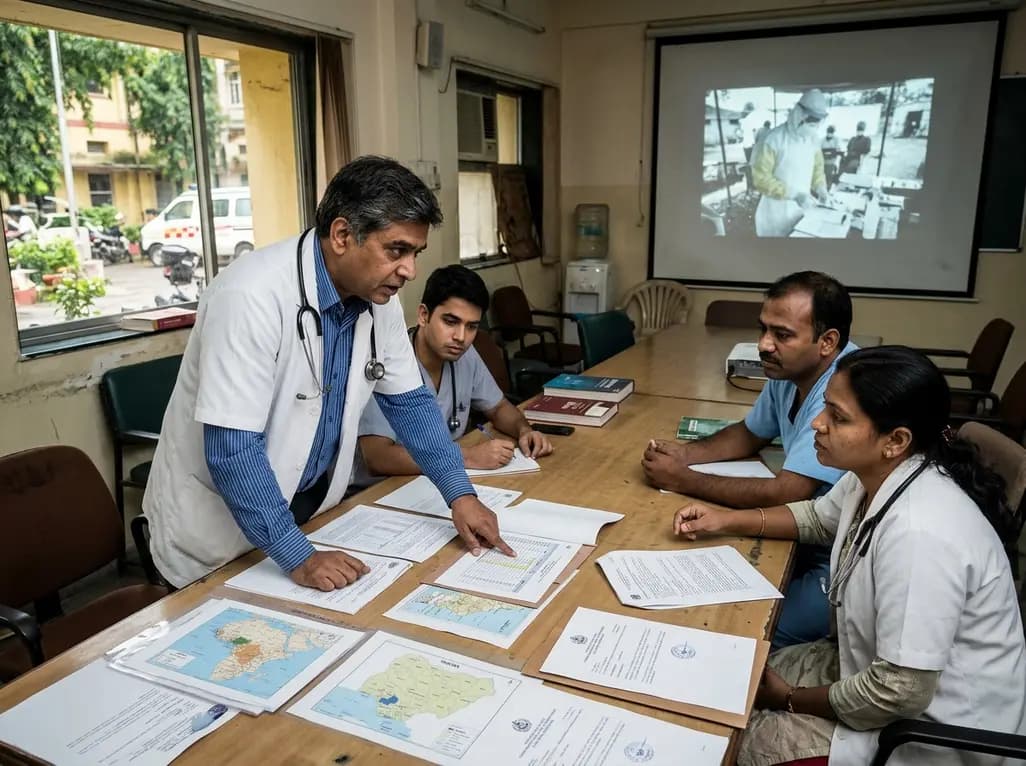
Following Nigeria's first recorded Ebola case linked to regional travel, the Africa CDC has convened an emergency ministerial summit. This alert underscores critical clinical priorities for healthcare professionals, including differentiating early viral infection from malaria, implementing barrier nursing, and triage.
Today

Leucine Rich Bio has introduced South Asia's first comprehensive vaginal microbiome test, BugSpeaks. By profiling microbial dysbiosis, pathogens, and antimicrobial resistance, this next-generation diagnostic platform provides clinicians with deeper insights into recurrent infections, fertility, and reproductive health.
Today

Review how tailored exercise programs benefit frail older patients with heart failure. Explore pathophysiological mechanisms, individualized training prescriptions, and strategies to overcome adherence barriers in clinical practice.
Today

This comparative study evaluates posterior labral tears with and without glenohumeral instability, highlighting distinct demographic patterns, MRI underestimation in stable shoulders, and successful arthroscopic repair outcomes.
Today

A clinical study demonstrates that early intervention with tocilizumab, either as monotherapy or bridged with corticosteroids, achieves significant proptosis reduction and resolves active inflammation in treatment-naive thyroid eye disease.
Today
