.webp&w=384&q=75)

Loading, please wait...
Loading, please wait...

Recent advancements in bioinorganic chemistry have paved the way for the development of cobalt-based anticancer agents as viable alternatives to traditional platinum-based therapies. A team of researchers recently synthesized a novel Cobalt(II) complex, [Co(L)(bipy)(H2O)], which demonstrates remarkable selectivity and cytotoxicity against multiple cancer cell lines. This study highlights a significant shift toward using essential trace metals to minimize systemic toxicity while maintaining high therapeutic efficacy.
The researchers utilized cobalt(II) acetate tetrahydrate, 2-((2'-carboxybenzyl)oxy)benzoic acid, and 2,2'-bipyridine ligands to construct the complex. Advanced analytical techniques, including single-crystal X-ray diffraction, revealed a distorted octahedral coordination sphere. Furthermore, the complex exhibits a stable 1D chain structure that extends into 2D layers through π-π interactions. Electrochemical investigations in acetonitrile showed a reversible Co(III)/Co(II) redox couple. This stability is crucial for the drug's performance in biological environments, where it must remain intact until reaching the target tissue.
During the biological evaluation, the complex underwent testing against PANC-1 (pancreatic cancer) and MCF7 (breast cancer) cell lines. The results showed significantly lower IC50 values compared to free CoCl2. This enhanced potency suggests that the specific ligand environment improves cellular uptake. Moreover, the complex did not stimulate cell proliferation at low concentrations, a common drawback of simple cobalt salts. Consequently, the researchers identified this complex as a high-potential candidate for further clinical development in oncology.
The primary mechanism driving the success of these cobalt-based anticancer agents involves ROS-mediated oxidative stress. By inducing the generation of reactive oxygen species within the tumor microenvironment, the complex triggers apoptosis. Density Functional Theory (DFT) calculations supported these findings, showing that the electronic distribution facilitates interaction with cellular macromolecules. Specifically, the regions of high electrostatic potential on the aromatic rings aid in targeting cancer cell membranes effectively.
Cobalt-based complexes utilize an essential trace metal that the human body can naturally process, potentially reducing the severe side effects associated with platinum-based drugs like cisplatin.
The complex induces the production of reactive oxygen species (ROS), which creates oxidative stress that specifically damages the DNA and mitochondria of cancer cells, leading to programmed cell death.
References
Sui BL et al. Synthesis, structural characterization, DFT calculation, and antitumor activity of a new Co(II) complex based on 2-((2'-Carboxybenzyl)oxy)benzoic acid and 2,2'-bipyridine ligands. BMC Chem. 2026 Feb 05. doi: 10.1186/s13065-026-01743-y. PMID: 41645230.
Heffern MC et al. Advances in cobalt complexes as anticancer agents. Dalton Transactions. 2016;45(21):8651-8659.
Momekov G et al. A glimpse into the developments, potential leads and future perspectives of anticancer cobalt complexes. RSC Med Chem. 2021;12(10):1630-1645.

Read summarized clinical updates, watch expert medical content, and earn CME certifications right from your smartphone.
Open your smartphone camera to scan and install.





Recent advancements in bioinorganic chemistry have paved the way for the development of cobalt-based anticancer agents as viable alternatives to traditional...
7 months ago

Ceftriaxone therapy can lead to biliary sludge and gallstone formation due to calcium-ceftriaxone precipitation. A recent cohort study shows that the noninvasive Fibrosis-4 (FIB-4) index, alongside treatment duration, independently predicts lithogenesis, enabling proactive risk stratification.
Today

A multiparametric MRI approach combining quantitative T2 shading, apparent diffusion coefficient (ADC) measurements, and morphological signs provides superior diagnostic accuracy over subjective evaluation to differentiate ovarian endometriomas from benign hemorrhagic cysts.
Today

A landmark case report reveals a donor heart beating for a century in a 63-year-old recipient, challenging conventional age limits in cardiac transplantation and offering critical lessons on organ longevity, donor selection, and long-term graft survival.
Today

Secondary open gluteus medius repair after total hip arthroplasty yields significant, durable improvements in hip function, pain relief, and patient satisfaction at a minimum two-year follow-up.
Today
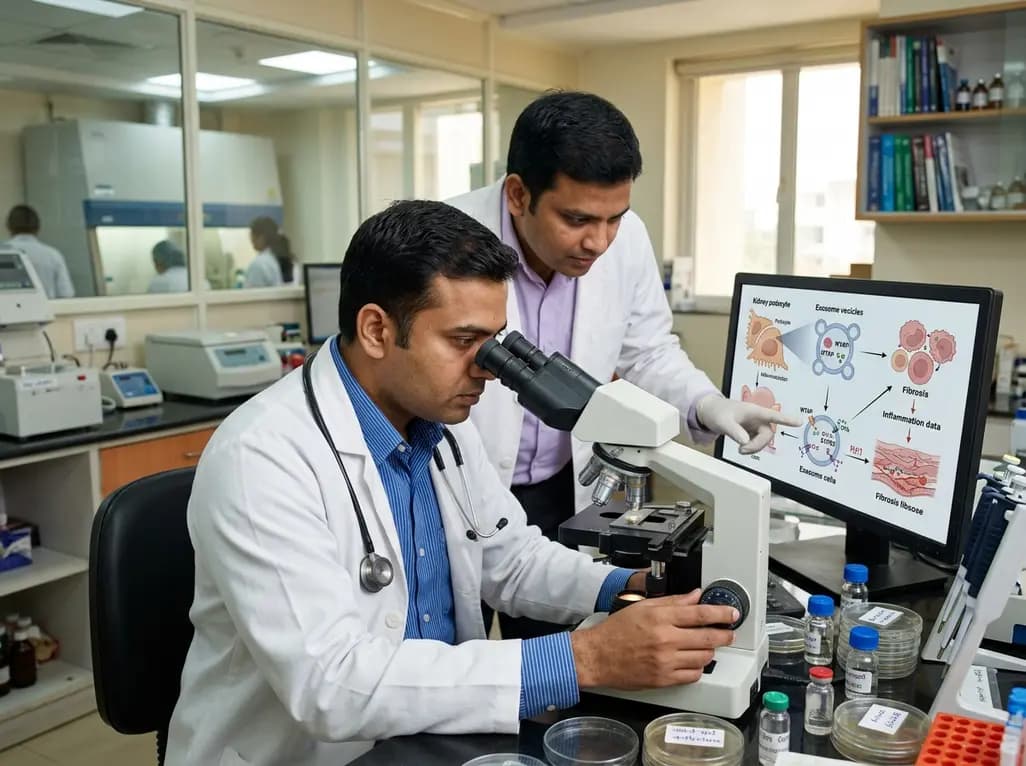
New research reveals that M1 macrophage-derived exosomes aggravate diabetic nephropathy by transferring WTAP to stabilize S1PR2 mRNA. Silencing WTAP in these vesicles attenuates endothelial injury and renal fibrosis, pointing toward innovative nanomedicine therapies.
Yesterday
