.webp&w=384&q=75)

Loading, please wait...
Loading, please wait...
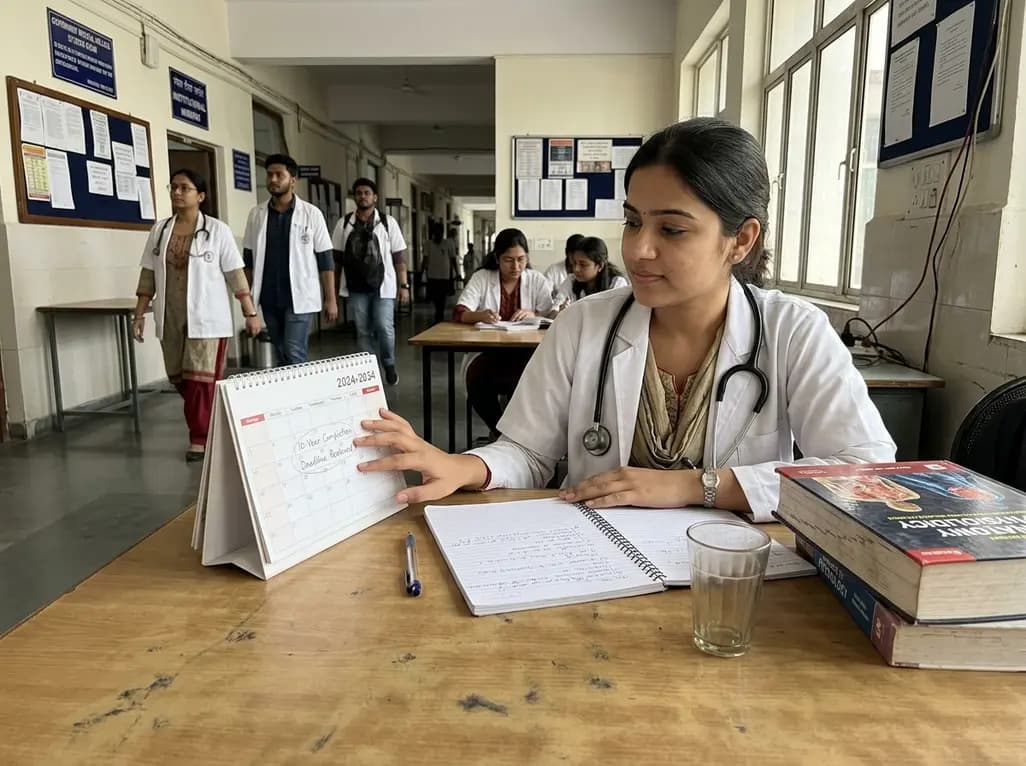
The National Medical Commission (NMC) has proposed a crucial revision to the Graduate Medical Education Regulations (GMER), 2023. Specifically, this draft amendment seeks to restore the maximum MBBS completion window to 10 years, including the compulsory internship. Consequently, this change reverses a June 2023 decision that had reduced the duration to nine years. Therefore, undergraduate medical students in India may soon get an extra year to complete their studies.
The NMC released the draft notification, titled "Graduate Medical Education (Amendment) Regulations, 2026," on May 18, 2026. Under these proposed guidelines, students must complete their entire MBBS curriculum and internship within ten years. Furthermore, this regulation aligns with the NMC's Foreign Medical Graduate Licentiate (FMGL) Regulations, 2021. In contrast, the current GMER 2023 regulations enforce a stricter nine-year timeline. Thus, the new amendment offers a welcome return to the previous, more flexible system.
Undoubtedly, medical education is highly demanding, meaning students often face unexpected difficulties during their academic journey. For instance, some individuals experience severe health issues, personal crises, or academic setbacks that delay their progress. Additionally, managing the rigorous internship alongside academic requirements can sometimes overwhelm students. Indeed, officials believe that an extra year will support those facing unforeseen circumstances. Ultimately, this relaxation ensures that capable candidates do not lose their eligibility due to personal emergencies.
Although the overall time limit may extend, academic standards will remain strictly rigorous. Specifically, students must still clear the First Professional MBBS examination within a maximum of four attempts. In other words, failing to pass within these four attempts leads to disqualification. Moreover, the amendment does not alter any attendance or training requirements for the course. Therefore, while students get more time overall, they must still meet all strict educational benchmarks.
Currently, the draft is in the public domain for review. Consequently, the commission has invited comments, objections, and suggestions from stakeholders and the general public. Specifically, individuals can submit their feedback within 30 days from the release date. The commission will finalize the regulations only after reviewing all received suggestions.
Q1: What is the proposed maximum duration for completing the MBBS course?
The proposed amendment extends the maximum completion limit to 10 years, which includes the mandatory one-year rotatory medical internship.
Q2: Has the NMC changed the limit on attempts for the first-year MBBS examinations?
No, the four-attempt limit to clear the First Professional MBBS examination remains unchanged under the draft regulations.
Q3: Why is the NMC proposing this extension?
The extension aims to support students facing health issues, personal emergencies, or academic setbacks by providing more flexibility.
Disclaimer: This content is for informational and educational purposes only. It does not constitute medical advice or replace professional judgment. Refer to the latest local and national guidelines for clinical practice.
References

Read summarized clinical updates, watch expert medical content, and earn CME certifications right from your smartphone.
Open your smartphone camera to scan and install.





The National Medical Commission (NMC) has drafted an amendment to extend the maximum time allowed to complete the undergraduate MBBS degree to ten years....
4 months ago

Novel diimide and hydrazone scaffolds, particularly compound #C4, synergistically reactivate latent HIV-1 when combined with JQ1 or PKC activators. Demonstrating donor-matched proviral transcription ex vivo and non-canonical signaling, these findings advance shock and kill strategies toward reservoir eradication.
Today

A comparative cohort study evaluates vNOTES vs TLH hysterectomy for benign conditions, demonstrating shorter operative duration, faster return to daily activities, and equivalent female sexual function scores without increased dyspareunia.
Today

Review how tailored exercise programs benefit frail older patients with heart failure. Explore pathophysiological mechanisms, individualized training prescriptions, and strategies to overcome adherence barriers in clinical practice.
Yesterday

This comparative study evaluates posterior labral tears with and without glenohumeral instability, highlighting distinct demographic patterns, MRI underestimation in stable shoulders, and successful arthroscopic repair outcomes.
Yesterday

A clinical study demonstrates that early intervention with tocilizumab, either as monotherapy or bridged with corticosteroids, achieves significant proptosis reduction and resolves active inflammation in treatment-naive thyroid eye disease.
Today
