.webp&w=384&q=75)

Loading, please wait...
Loading, please wait...
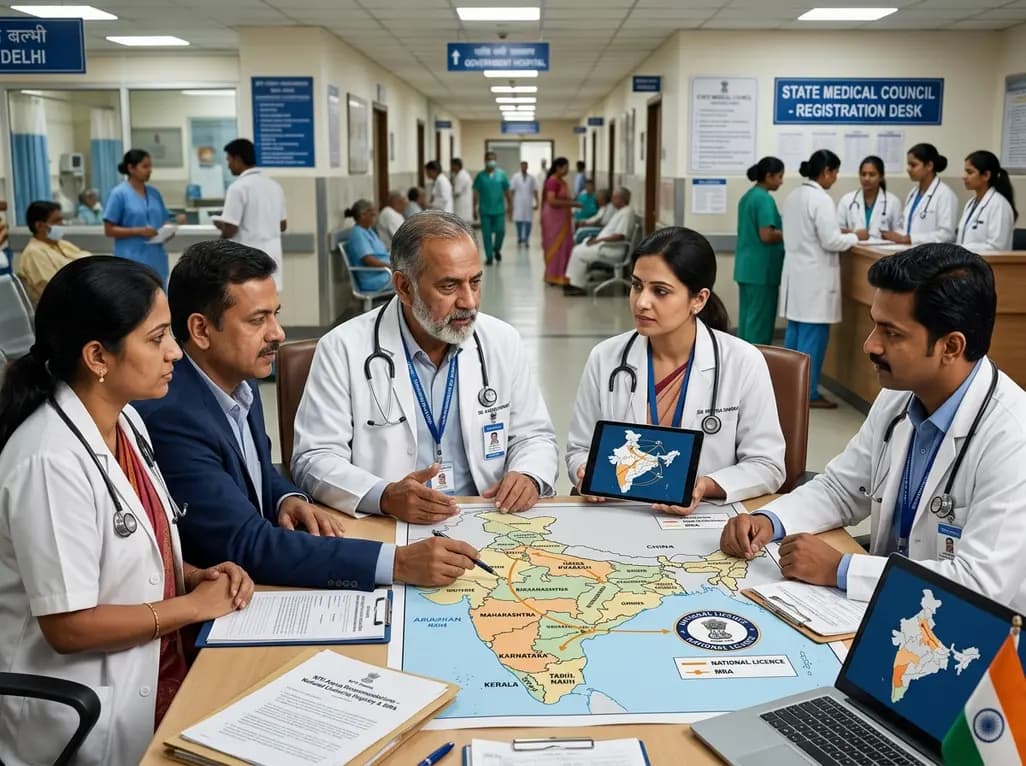
The regulatory framework governing medical and allied healthcare professionals in India stands on the verge of a historic transformation. Recently, the premier government think tank NITI Aayog released an extensive report titled India's Services Sector: Insights on Regulatory Regime in Professional Services. In this landmark publication, the policy body strongly advocated for interstate licence portability for doctors, nurses, and allied health workers. Currently, state-level registration barriers severely impede the fluid movement of clinical talent across state boundaries. Consequently, this progressive initiative seeks to dismantle bureaucratic hurdles and establish a truly unified healthcare workforce across the entire nation.
India currently faces significant regional disparities in medical infrastructure and clinical workforce distribution. While major metropolitan centers frequently maintain adequate doctor-to-patient ratios, rural and underserved districts continue to suffer from chronic specialist shortages. Therefore, the implementation of interstate licence portability serves as a vital strategic solution to this persistent healthcare imbalance.
Under the existing fragmented regime, medical practitioners encounter tremendous administrative friction whenever they relocate across state lines. In addition, healthcare facilities in underserved regions struggle to recruit qualified doctors rapidly during seasonal disease surges or clinical emergencies. By eliminating redundant licensing restrictions, healthcare systems can deploy skilled clinicians wherever patient demand peaks. Furthermore, this flexibility empowers practitioners to broaden their clinical exposure across varied demographic environments. Consequently, mobile clinicians can support critical public health programs without facing legal ambiguity. Moreover, seamless mobility ensures that specialized tertiary care expertise reaches tier-two and tier-three towns efficiently. Ultimately, removing interstate administrative barriers fosters a much more responsive, equitable, and resilient national healthcare delivery architecture for all citizens.
At present, individual state councils manage the primary registration of medical graduates, nurses, and allied healthcare professionals. While national regulatory councils provide overall policy oversight and standards, state-level bodies function as independent gatekeepers. Consequently, doctors moving to a new jurisdiction must navigate an exhausting, duplicative bureaucratic process that often takes several months to complete.
For example, NITI Aayog highlighted the stringent licensing protocols currently active in Maharashtra. Clinicians registered in other states must submit a fresh application and secure a formal No Objection Certificate from their parent council. In addition, practitioners must pay extra registration fees, verify physical credentials again, and wait through prolonged processing delays. As a result, many qualified clinicians abandon relocation plans, which severely restricts professional mobility. Furthermore, these administrative burdens discourage locum tenens work, cross-border telemedicine consultations, and temporary emergency disaster deployments. Hence, the current disjointed framework creates artificial barriers that restrict career growth and exacerbate regional staffing deficits across public and private hospitals alike.
To overcome state-level fragmentation, NITI Aayog recommends establishing a comprehensive national licence registry. This centralized digital infrastructure would operate alongside Mutual Recognition Agreements signed among state regulatory councils. Under this structured framework, state councils would officially recognize each other’s licensing decisions without demanding repetitive background checks or paperwork.
Additionally, the policy proposal recommends an automatic approval pathway for registered healthcare professionals. This automated route would instantly validate credentials across participating state councils through a centralized digital database. Consequently, clinicians would no longer need to solicit individual No Objection Certificates from their home state authorities. Furthermore, digital verification drastically minimizes administrative overhead for state medical councils while preserving robust regulatory integrity. In addition, the system enables regulatory authorities to monitor disciplinary actions and licence statuses in real time. Ultimately, this interconnected network establishes transparency, reduces fraudulent practices, and streamlines domestic mobility for thousands of healthcare providers nationwide.
A successful transition toward nationwide mobility also requires standardized baseline competencies across all medical institutions. Therefore, NITI Aayog has urged the expeditious implementation of the National Exit Test for graduating doctors. This standardized examination will serve as a common qualifying mechanism and licensing standard across all Indian states and medical colleges.
Furthermore, standardizing competency evaluations enhances the domestic and international credibility of Indian medical graduates. Simultaneously, NITI Aayog called for the comprehensive operationalization of the National Commission for Allied and Healthcare Professions Act of 2021. Although parliament enacted this legislation years ago, implementation across state governments remains notably incomplete. As of 2025, only twenty-six states and Union Territories have constituted their requisite State Allied and Healthcare Councils. Moreover, some existing state bodies have introduced local variations that deviate from the central statutory framework. Consequently, harmonizing allied health regulations and medical licensing will ensure that multidisciplinary clinical teams can move across borders collaboratively.
The establishment of seamless workforce mobility extends substantial benefits beyond individual physician career flexibility. Most importantly, it directly enhances patient access to quality clinical care in resource-constrained regions. When healthcare providers can move freely, private hospitals and public health agencies can mitigate critical workforce deficits swiftly during health crises.
In addition, simplified domestic mobility aligns with broader international trade and healthcare integration strategies. The NITI Aayog report recommends pursuing international Mutual Recognition Agreements with foreign regulatory counterparts. Such bilateral pacts would create streamlined recognition pathways for overseas medical practitioners and Indian professionals working abroad. Furthermore, standardizing domestic registries positions India as a forward-looking hub for global medical talent and international healthcare collaborations. Meanwhile, domestic healthcare organizations can scale specialty departments without encountering bureaucratic recruitment delays across state boundaries. Ultimately, these structural reforms modernize healthcare administration, elevate clinical training benchmarks, and reinforce India's universal healthcare access commitments.
Q1: What is the main objective of interstate licence portability for healthcare workers?
The primary objective is to allow medical and allied healthcare professionals registered in one Indian state to practise in another state seamlessly. By eliminating duplicate registrations and mandatory No Objection Certificates, the policy removes bureaucratic barriers to mobility. Consequently, healthcare providers can relocate easily, supporting healthcare facilities in underserved regions and improving equitable access to quality medical services throughout the country.
Q2: How will Mutual Recognition Agreements and the national registry work in practice?
Mutual Recognition Agreements establish legal accords where state councils officially acknowledge registrations granted by other state bodies. A centralized national licence registry will maintain digital records of verified credentials and professional standings. Therefore, when a doctor or nurse relocates, an automatic approval route validates their licence instantly. This mechanism removes repeated document verifications, administrative delays, and redundant council fees entirely.
Q3: How does the National Exit Test relate to interstate licence mobility?
The National Exit Test provides a standardized, merit-based competency evaluation for all medical graduates across India. By establishing a uniform national benchmark for licensing, it ensures consistent clinical capabilities among practitioners from different institutions. Consequently, state councils can trust the credentials of incoming doctors from other states without hesitation, facilitating seamless interstate portability and boosting international recognition of Indian medical qualifications.
Disclaimer: This content is for informational and educational purposes only. It does not constitute medical advice or replace professional judgment. Refer to the latest local and national guidelines for clinical practice.
References

Read summarized clinical updates, watch expert medical content, and earn CME certifications right from your smartphone.
Open your smartphone camera to scan and install.





NITI Aayog recommends establishing a national licence registry and Mutual Recognition Agreements to allow seamless practice across states. This reform aims to eliminate duplicate registrations, resolve regional healthcare staff shortages, and standardise professional assessments via the National Exit Test.
last month

Researchers developed a novel bezafibrate-L-proline cocrystal inclusion compound using ball milling, boosting saturation solubility by 3.9-fold and oral bioavailability twofold. This supramolecular strategy holds promising potential to enhance drug efficacy and consistency in atherogenic dyslipidemia management.
Today

A multiparametric MRI approach combining quantitative T2 shading, apparent diffusion coefficient (ADC) measurements, and morphological signs provides superior diagnostic accuracy over subjective evaluation to differentiate ovarian endometriomas from benign hemorrhagic cysts.
Yesterday
A landmark case report reveals a donor heart beating for a century in a 63-year-old recipient, challenging conventional age limits in cardiac transplantation and offering critical lessons on organ longevity, donor selection, and long-term graft survival.
Today
Fatty infiltration after rotator cuff tears impairs shoulder repair outcomes. A new study reveals that targeting MST1 kinase suppresses fibro/adipogenic progenitor adipogenesis via WNT/β-catenin signaling, reducing muscle fat accumulation and mitigating muscle atrophy.
Today
A randomized crossover study reveals that exercise-induced glycogen depletion combined with a low-carbohydrate diet significantly enhances peak fat oxidation without impairing skeletal muscle mitochondrial coupling control or efficiency in healthy trained men.
Today
