

Loading, please wait...
Loading, please wait...

Multiple sclerosis presents diverse mobility challenges, among which walking fatigability in MS stands out as a severely limiting feature. Clinical experts distinguish objective fatigability from subjective feelings of chronic exhaustion. Specifically, objective walking fatigability reflects a measurable decrement in motor performance during sustained physical activity. Patients frequently describe progressive heaviness in their lower limbs during standard daily ambulation. Consequently, this deterioration substantially increases their risk of falls and restricts their community participation. Neurologists have traditionally attributed this phenomenon to peripheral muscular weakness or corticospinal conduction failure. However, emerging research underscores the fundamental role of higher cerebral networks in maintaining locomotion. Cortical motor planning, sensory integration, and executive centers collaborate continuously to sustain coordinated bipedal walking. When demyelinating lesions compromise these circuits, the central nervous system must rapidly reorganize its operational strategy. As a result, the brain attempts compensatory resource reallocation to preserve forward propulsion. Unfortunately, this compensatory recruitment frequently fails over prolonged exertion. Therefore, investigating central neural correlates provides critical insight into functional deterioration. Understanding these cerebral dynamics enables physicians to evaluate disability progression with greater precision and tailor personalized neurorehabilitation programs accordingly.
To evaluate real-time brain activation during locomotion, researchers have turned to functional near-infrared spectroscopy. Unlike conventional neuroimaging modalities like functional MRI, fNIRS permits dynamic monitoring while participants walk unrestricted in natural environments. Specifically, this non-invasive optical technology measures localized changes in oxygenated and deoxygenated hemoglobin across superficial cerebral regions. In a pivotal clinical investigation, investigators examined forty-two individuals with multiple sclerosis alongside twenty-five healthy controls. Furthermore, all participants performed an instrumented six-minute walk test while wearing functional headcaps. Investigators strategically placed optodes over the prefrontal cortex, premotor regions, and primary motor cortices. Concurrently, synchronized inertial measurement units recorded minute-by-minute alterations in spatio-temporal gait metrics and kinematic consistency. This sophisticated methodology successfully captured both biomechanical deterioration and concurrent cortical hemodynamics during sustained physical effort. Historically, clinicians evaluated only gross endpoint walking distances, thereby overlooking subtle temporal adaptations. In contrast, portable fNIRS bridges this diagnostic gap by tracking cerebral activity throughout continuous ambulation. Consequently, the resulting hemodynamic data illuminate how distributed cortical networks respond under increasing motor stress. Ultimately, this approach transforms our physiological comprehension of neurological fatigue.
The investigation revealed striking differences in cortical activation patterns between patient cohorts and healthy individuals. Healthy controls and patients without walking fatigability demonstrated flexible, dynamic modulation across frontal, premotor, and primary motor areas. Specifically, these individuals adjusted their cortical engagement systematically to manage ongoing task demands during the six-minute walk test. Their neural activity peaked during the initial minute, stabilized across intermediate minutes, and rose again near completion. In contrast, patients exhibiting pronounced walking fatigability presented a markedly rigid activation profile. These impaired individuals, who possessed higher baseline disability scores, maintained excessive, sustained reliance on frontal executive regions. Moreover, they failed to recruit the broader motor and premotor networks necessary for efficient gait maintenance. Correlation analyses demonstrated that greater increases in cortical activity generally accompanied superior walking speed and stability. However, healthy subjects distributed this activation across an expansive sensorimotor network. Conversely, fatigued patients demonstrated a heavily executive-driven, prefrontal-dependent pattern of gait control. This persistent cognitive compensation indicates that impaired neural flexibility underlies the inability to sustain walking performance over extended periods. Therefore, when executive resources become exhausted, locomotor control abruptly deteriorates. This maladaptive reliance highlights a fundamental breakdown in distributed neural processing among severely affected individuals.
As cortical resources struggle to maintain equilibrium, measurable biomechanical deterioration unfolds rapidly in vulnerable patients. During the continuous walking trial, patients with walking fatigability experienced notable declines in forward speed and stride length. Furthermore, inertial sensors detected substantial deterioration in gait quality, including increased step duration variability and abnormal foot strike angles. Healthy individuals routinely delegate rhythmic walking to subcortical and spinal pattern generators, which minimizes cognitive load. In stark contrast, people with multiple sclerosis must consciously control each step due to disrupted spinal pathways. Consequently, their brains treat basic ambulation as a demanding executive task requiring intense prefrontal concentration. While this top-down cognitive compensation initially preserves functional balance, it rapidly depletes cognitive and energetic reserves. Once prefrontal capacity saturates, compensatory control falters and walking performance progressively degrades. In addition, patients experience heightened balance instability, bilateral coordination deficits, and an increased risk of stumbling. These objective findings mirror the subjective heaviness and clumsiness that individuals report during sustained daily walking. Thus, walking fatigability represents a dual failure of automated motor coordination and sustained cognitive compensation.
These neuroimaging discoveries provide crucial guidance for multidisciplinary rehabilitation teams managing multiple sclerosis in daily practice. Historically, clinicians prescribed generic endurance training or non-specific lower-limb strengthening for mobility deficits. However, the discovery of executive-driven gait indicates that therapy must address both cognitive load and motor execution. Physical therapists should incorporate dual-task training protocols that combine challenging cognitive exercises with prolonged rhythmic walking. Such dual-task conditioning trains the brain to manage divided attention and reduces excessive prefrontal dependence. Moreover, clinicians can utilize task-specific gait training with rhythmic auditory stimulation to stimulate subcortical rhythm generators. Assistive technology and robotic exoskeletons also offer meaningful avenues to unload fatigued cortical circuits during community ambulation. Furthermore, periodic resting intervals and energy conservation strategies help mitigate the progressive performance decrement observed during prolonged tests. By tracking objective sensor-based metrics alongside clinical assessments, physicians can accurately quantify therapeutic responses over time. Ultimately, integrating neural principles into neurorehabilitation will optimize functional independence and prevent catastrophic mobility loss in vulnerable individuals. Additionally, clinicians should educate patients regarding the physiological difference between perceived fatigue and objective walking breakdown. Consequently, targeted intervention plans foster greater self-management and long-term ambulatory endurance.
Generalized fatigue represents a subjective feeling of physical or mental exhaustion that does not always correlate with objective physical performance. In contrast, walking fatigability describes a measurable, progressive decline in walking speed, stride quality, or coordination during sustained ambulation over time, driven by impaired neural network recruitment.
Functional near-infrared spectroscopy uses lightweight, head-mounted optical sensors that emit near-infrared light to detect changes in cortical blood oxygenation during active walking. Consequently, researchers can monitor prefrontal and motor cortex activity in real time while subjects walk freely, avoiding the mobility restrictions imposed by standard magnetic resonance imaging.
Clinicians achieve the best outcomes by combining motor-cognitive dual-task training with rhythmic auditory cueing and energy conservation education. Furthermore, these multidisciplinary strategies encourage automatic motor execution, reduce maladaptive over-reliance on prefrontal resources, and optimize biomechanical efficiency, ultimately helping patients sustain walking speed and stability during prolonged mobility.
Disclaimer: This content is for informational and educational purposes only... Refer to the latest local and national guidelines for clinical practice.
References
Santinelli FB et al. The neural correlates of walking fatigability in people with multiple sclerosis: An fNIRS study. Neurobiol Dis. 2026 Oct 15. doi: 10.1016/j.nbd.2026.107579. PMID: 42632522.
Santinelli FB, Ramari C, Broscheid KC, Vitorio R, Kos D. Manifestations of walking fatigability in people with multiple sclerosis based on gait quality and distance walked during the six minutes walking test. Mult Scler Relat Disord. 2024;91:105868. doi: 10.1016/j.msard.2024.105868.
Leone C, Severini G, Favetta M, et al. Walking fatigability indices correspond with perception of changes in gait speed and quality during an instrumented 6-minute walk test. Mult Scler J. 2026;32(4):450-458. doi: 10.1177/1352458526110293.

Read summarized clinical updates, watch expert medical content, and earn CME certifications right from your smartphone.
Open your smartphone camera to scan and install.





An fNIRS study reveals that walking fatigability in multiple sclerosis stems from an inability to flexibly recruit cortical walking networks, causing persistent over-reliance on prefrontal executive circuits and progressive gait deterioration during continuous ambulation.
Today
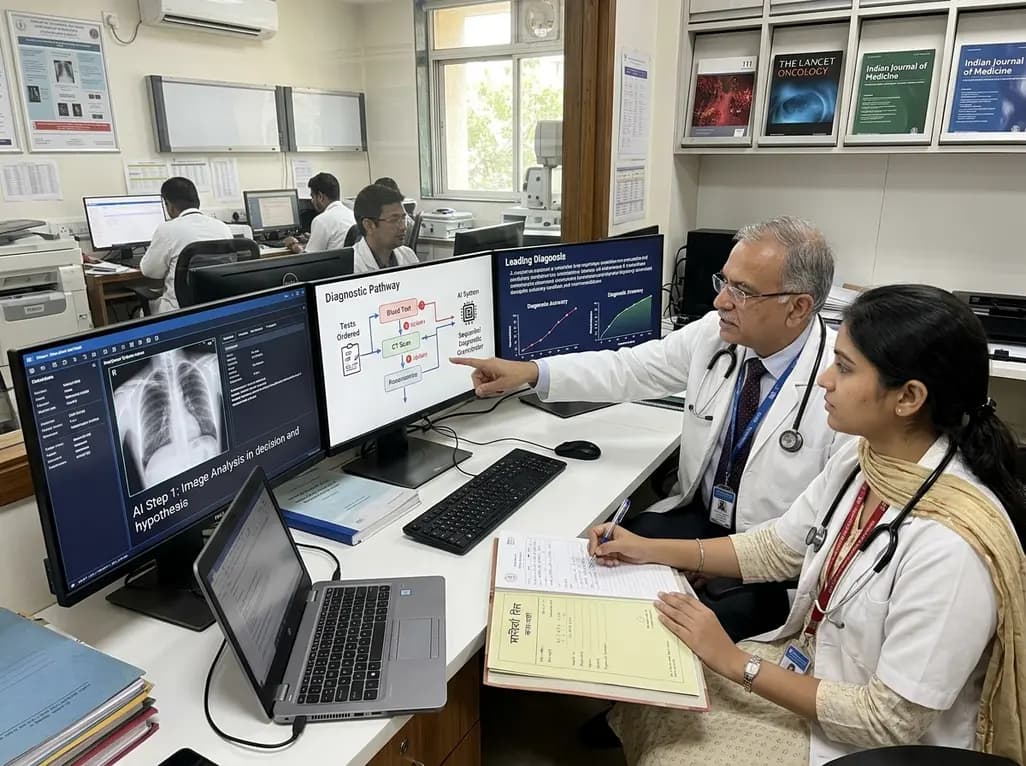
A breakthrough peer-reviewed study demonstrates that a sequential AI diagnosis system can mirror real-world clinical reasoning. By ordering stepwise tests and updating hypotheses dynamically, this multi-agent orchestrator achieved superior diagnostic accuracy while reducing investigative costs.
Today

A prenatal case highlights severe glutaric acidemia type II presenting as bilateral hyperechoic cystic kidneys at 18 weeks. Whole-exome sequencing revealed a novel homozygous ETFDH frameshift variant, demonstrating the power of rapid genetic testing in fetal renal anomalies.
Today

Review how tailored exercise programs benefit frail older patients with heart failure. Explore pathophysiological mechanisms, individualized training prescriptions, and strategies to overcome adherence barriers in clinical practice.
Yesterday

This comparative study evaluates posterior labral tears with and without glenohumeral instability, highlighting distinct demographic patterns, MRI underestimation in stable shoulders, and successful arthroscopic repair outcomes.
Yesterday

A clinical study demonstrates that early intervention with tocilizumab, either as monotherapy or bridged with corticosteroids, achieves significant proptosis reduction and resolves active inflammation in treatment-naive thyroid eye disease.
Yesterday
