.webp&w=384&q=75)

Loading, please wait...
Loading, please wait...

The Indian government is currently evaluating the NEET-UG hybrid exam model to eliminate persistent paper leak issues. Specifically, this proposed system aims to enhance security by reducing manual handling during the transportation of question papers. Therefore, authorities are considering the recommendations of the Radhakrishnan Committee to modernize the National Eligibility cum Entrance Test. However, implementing a completely online exam for 25 lakh students remains a significant logistical challenge for the National Testing Agency.
Under this proposal, the testing agency would transmit encrypted question papers digitally to secure servers at each examination center. Subsequently, staff at the centers would print these papers locally using high-speed printers just before the scheduled start time. Consequently, this approach minimizes the time that physical copies exist before the exam, which reduces the risk of leaks. Furthermore, it allows the exam to stay a single-day, single-paper event to ensure fairness among all medical aspirants. Thus, the system avoids the complex normalization processes usually required for multi-shift computer-based tests conducted over several days.
Many experts note that India lacks the specialized infrastructure needed to accommodate millions of online test-takers simultaneously in one day. Additionally, students in rural areas may lack familiarity with computer-based interfaces or face issues like unstable internet and electricity. Therefore, a hybrid model serves as a balanced solution that bridges the gap between traditional paper tests and digital innovation. Ultimately, these reforms aim to restore public trust in the medical admission process while ensuring equitable access for all candidates.
Q1: What is the primary objective of the proposed NEET-UG hybrid exam model?
The primary objective is to enhance exam security by transmitting encrypted question papers digitally and printing them locally, thereby reducing the manual handling points where leaks often occur.
Q2: Why is the hybrid model preferred over a fully online examination for NEET?
India currently lacks the massive infrastructure required for a single-day online exam for 25 lakh students. Furthermore, the hybrid model maintains a single-shift format, which avoids the fairness concerns associated with score normalization.
Disclaimer: This content is for informational and educational purposes only. It does not constitute medical advice or replace professional judgment. Refer to the latest local and national guidelines for clinical practice.
References

Read summarized clinical updates, watch expert medical content, and earn CME certifications right from your smartphone.
Open your smartphone camera to scan and install.





The government evaluates a NEET-UG hybrid exam model with digital delivery and local printing to bolster security and maintain fairness for 25 lakh students...
5 months ago
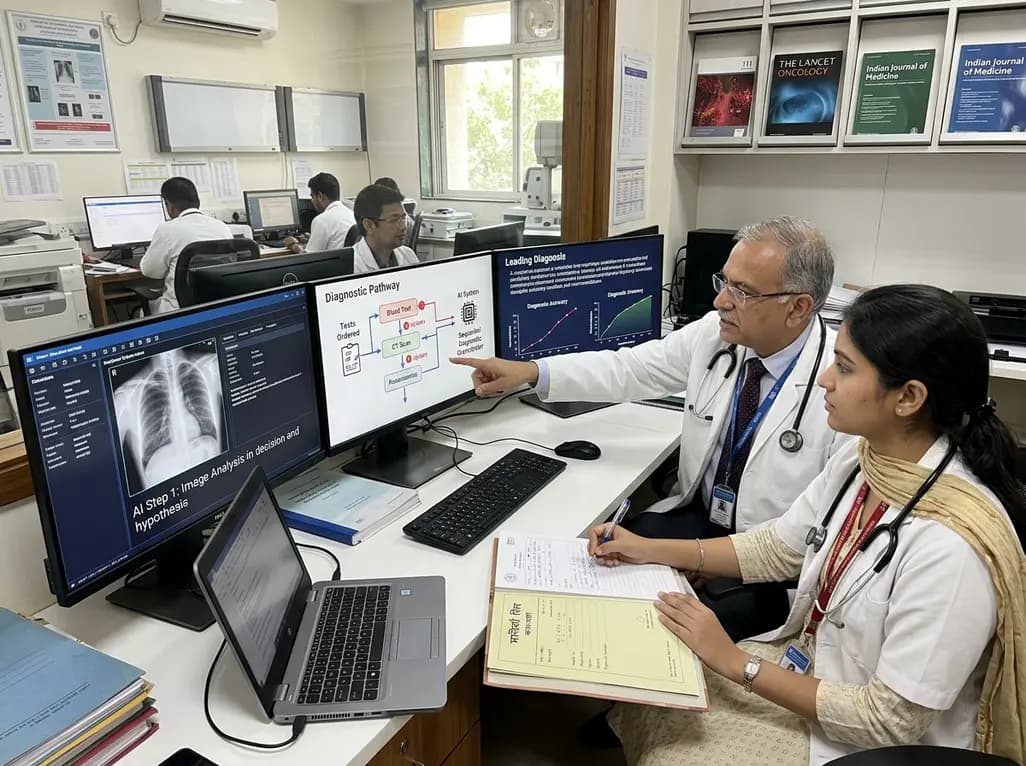
A breakthrough peer-reviewed study demonstrates that a sequential AI diagnosis system can mirror real-world clinical reasoning. By ordering stepwise tests and updating hypotheses dynamically, this multi-agent orchestrator achieved superior diagnostic accuracy while reducing investigative costs.
Today

A prenatal case highlights severe glutaric acidemia type II presenting as bilateral hyperechoic cystic kidneys at 18 weeks. Whole-exome sequencing revealed a novel homozygous ETFDH frameshift variant, demonstrating the power of rapid genetic testing in fetal renal anomalies.
Today

Review how tailored exercise programs benefit frail older patients with heart failure. Explore pathophysiological mechanisms, individualized training prescriptions, and strategies to overcome adherence barriers in clinical practice.
Yesterday

This comparative study evaluates posterior labral tears with and without glenohumeral instability, highlighting distinct demographic patterns, MRI underestimation in stable shoulders, and successful arthroscopic repair outcomes.
Yesterday

A clinical study demonstrates that early intervention with tocilizumab, either as monotherapy or bridged with corticosteroids, achieves significant proptosis reduction and resolves active inflammation in treatment-naive thyroid eye disease.
Yesterday
