.webp&w=384&q=75)

Loading, please wait...
Loading, please wait...

The National Board of Examinations in Medical Sciences (NBEMS) recently achieved a historic milestone. Specifically, the organization secured a Guinness World Record for hosting a massive AI healthcare training session. A peak of 17,999 doctors logged in simultaneously for the live-streamed lesson on YouTube. Consequently, this event set a new record for the most viewers of an artificial intelligence healthcare lesson. This achievement highlights the growing interest in digital health among Indian medical practitioners.
This record-breaking livestream was part of a structured six-month national programme. Specifically, the course includes 20 comprehensive modules delivered by global experts. Faculty members from prestigious institutions like Harvard University, IIM Lucknow, and IISc Bengaluru lead the sessions. Moreover, NBEMS provides this education entirely free of cost for all registered medical practitioners. Therefore, the initiative serves as a vital capacity-building effort for India's medical community. It ensures equitable access to high-quality education without revenue-driven motives.
The initiative was conceptualized under the leadership of Dr. Abhijat Sheth, President of NBEMS. Furthermore, the program draws inspiration from the Digital India vision of Prime Minister Narendra Modi. It emphasizes the responsible adoption of artificial intelligence in public service and governance. Additionally, the Union Health Minister, Shri J P Nadda, supported this academic drive. Ultimately, the goal is to prepare future-ready doctors for a technologically advanced healthcare landscape. Officials describe the turnout as unprecedented for a specialized medical education session.
Q1: What is the primary focus of the NBEMS AI course?
The course focuses on the ethical, safe, and practical application of artificial intelligence in clinical practice and medical education without requiring coding skills.
Q2: Who is eligible to participate in this training?
The program is open to registered medical practitioners, postgraduate trainees, faculty of NBEMS-accredited departments, and NBEMS alumni.
Disclaimer: This content is for informational and educational purposes only. It does not constitute medical advice or replace professional judgment. Refer to the latest local and national guidelines for clinical practice.
References

Read summarized clinical updates, watch expert medical content, and earn CME certifications right from your smartphone.
Open your smartphone camera to scan and install.





NBEMS achieves a Guinness World Record with 17,999 doctors tuning into its free national AI healthcare training program featuring global expert faculty....
7 months ago
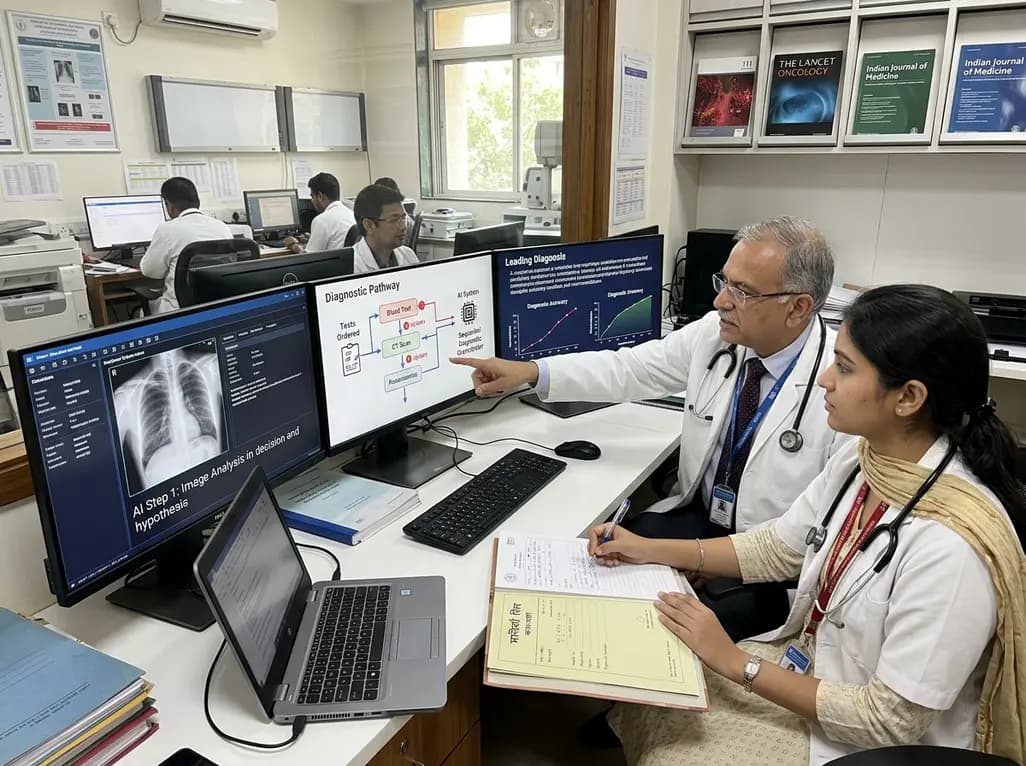
A breakthrough peer-reviewed study demonstrates that a sequential AI diagnosis system can mirror real-world clinical reasoning. By ordering stepwise tests and updating hypotheses dynamically, this multi-agent orchestrator achieved superior diagnostic accuracy while reducing investigative costs.
Today

A prenatal case highlights severe glutaric acidemia type II presenting as bilateral hyperechoic cystic kidneys at 18 weeks. Whole-exome sequencing revealed a novel homozygous ETFDH frameshift variant, demonstrating the power of rapid genetic testing in fetal renal anomalies.
Today

Review how tailored exercise programs benefit frail older patients with heart failure. Explore pathophysiological mechanisms, individualized training prescriptions, and strategies to overcome adherence barriers in clinical practice.
Yesterday

This comparative study evaluates posterior labral tears with and without glenohumeral instability, highlighting distinct demographic patterns, MRI underestimation in stable shoulders, and successful arthroscopic repair outcomes.
Yesterday

A clinical study demonstrates that early intervention with tocilizumab, either as monotherapy or bridged with corticosteroids, achieves significant proptosis reduction and resolves active inflammation in treatment-naive thyroid eye disease.
Yesterday
