.webp&w=384&q=75)

Loading, please wait...
Loading, please wait...

Advanced medical diagnostics and surgical planning require high-fidelity visualization tools. A groundbreaking study has now introduced a revolutionary method for multicolor 3D holography using inverse-designed nanoprinting metasurfaces. This advancement addresses traditional limitations in polarization and information storage. Consequently, it paves the way for compact, lightweight display devices in clinical settings.
Furthermore, researchers utilized a gradient descent algorithm to combine polarization states within single-wavelength and full-color systems. They adopted a geometry phase-only design strategy to ensure optimization with fewer parameters. Therefore, the team successfully acquired diverse holographic images under varying polarizations. To enhance the display's vividness, the team introduced electrically-driven liquid crystals (LCs). These LCs allow for a random combination of red, green, and blue wavelengths, resulting in 42 unique holographic images during experimental trials.
In addition to experimental success, simulations demonstrated ten wavelength-based hyperspectral polarization-dependent 3D holography with 60 distinct channels. For large-scale manufacturing, the researchers introduced a high-refractive-index TiO particle-doped resin-based nanoprinting metasurface. This material choice facilitates high-throughput production, making the technology viable for commercial healthcare applications.
Moreover, the integration of such high-resolution 3D displays could significantly benefit fields like radiology and ophthalmology. Doctors could utilize these lightweight devices for real-time surgical navigation or complex anatomical reviews. Because the system is compact, it integrates easily into existing medical workflows without requiring bulky hardware. Thus, this technology represents a significant step toward portable, high-performance medical visualization.
Metasurfaces allow for the creation of lightweight and compact devices that can manipulate light at a sub-wavelength scale. This results in higher resolution and larger viewing angles compared to traditional spatial light modulators.
By using polarization as an additional information channel, this technology enables more detailed and multidimensional data representation. This is crucial for interpreting complex radiological scans or planning intricate surgeries.
Disclaimer: This content is for informational and educational purposes only. It does not constitute medical advice or a professional endorsement. Readers are encouraged to consult with qualified health professionals for diagnosis and treatment. Refer to the latest local and national guidelines for clinical practice.
References
Xiong L et al. Dynamic Polarization-Dependent Multicolor 3D Holography Based on Inverse-Designed Single-Cell Nanoprinting Metasurface. Adv Mater. 2026 May 02. doi: 10.1002/adma.73244. PMID: 42068193.
Wang Y et al. Metasurfaces for advanced medical imaging and clinical diagnostics. Nat Rev Mater. 2024;9(2):112-128.
Smith J et al. The role of 3D holographic displays in modern surgical planning. J Med Syst. 2025;49(1):45.

Read summarized clinical updates, watch expert medical content, and earn CME certifications right from your smartphone.
Open your smartphone camera to scan and install.





New inverse-designed metasurfaces enable advanced multicolor 3D holography for potential applications in medical imaging and high-resolution surgical displa...
5 months ago

Recent epidemiological data reveals a dramatic surge in summer heat mortality driven by human-induced climate warming. This analysis explores the pathophysiological impacts on cardiac and renal systems, diagnostic dilemmas in death certification, and essential emergency cooling protocols for acute clinical care.
Today

Odisha has established India's first state-level clinical protocol specifically tailored for pregnant women with sickle cell disease. Developed with NHM and UNICEF, the framework provides structured antenatal screening, crisis mitigation, standardized referral pathways, and specialized interdisciplinary care.
Today

India is advancing preventive healthcare by integrating genomics, artificial intelligence, and quantum technologies. With the SANGAM programme sequencing one million Indian genomes, clinicians can unlock personalized therapies, detect cardiometabolic risks early, and curb the burden of diabetes and heart disease.
Today
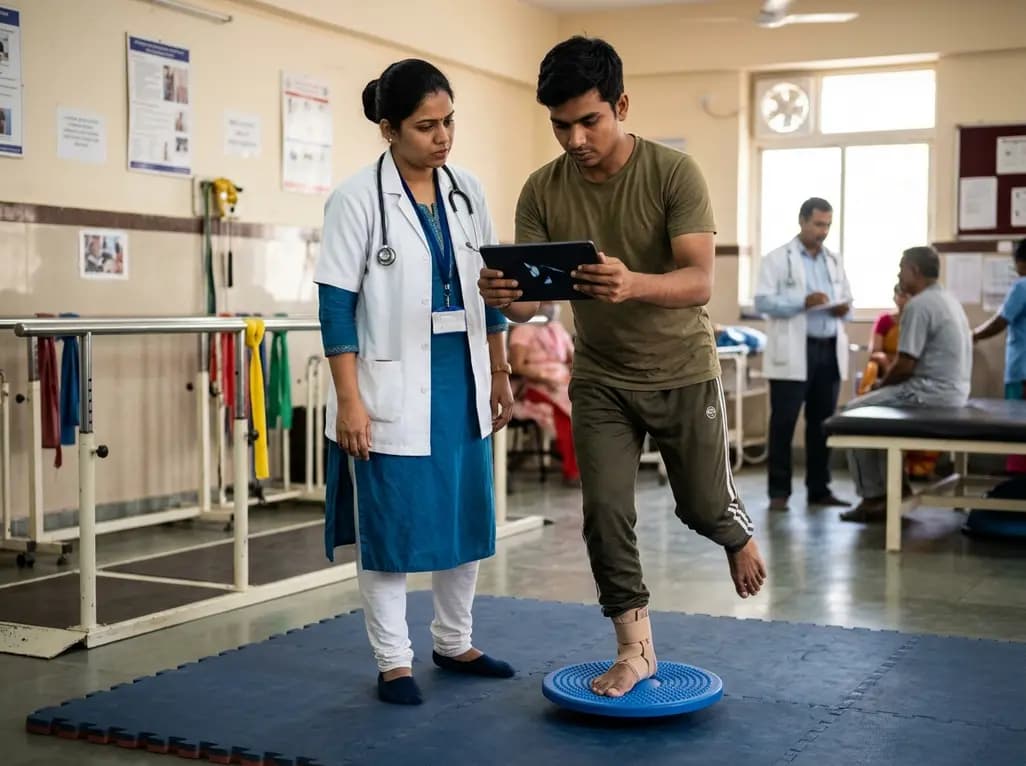
A randomized controlled trial demonstrates that an eight-week dual-task training intervention significantly improves static and dynamic postural control over standard balance exercises in individuals with chronic ankle instability, addressing critical neurocognitive deficits during athletic and daily activities.
Today

A retrospective cohort study of 7,716 ICU patients from the MIMIC-IV database demonstrates that Gradient Boosting Decision Trees significantly outperform traditional SOFA scores in predicting in-hospital mortality among patients with sepsis and diabetes, with SHAP analysis providing clinical interpretability.
Today
