.webp&w=384&q=75)

Loading, please wait...
Loading, please wait...

Focused ultrasound (FUS) thalamotomy provides a breakthrough minimally invasive treatment for patients with essential tremor and tremor-dominant Parkinson's disease. Since the thermal lesions created during the procedure are irreversible, clinicians must precisely map the treatment area. A recent study highlights the clinical utility of MR temperature imaging for predicting both tremor relief and potential side effects in real-time. By estimating heating and thermal doses during the procedure, doctors can optimize results for maximum efficacy and minimal risk.
Researchers analyzed data from 547 treatments involving 481 patients with a median age of 74 years. They utilized 2D MRTI data to estimate heating across various orientations and generated phase maps for accurate anatomical registration. Consequently, they compared thermal dose deposition between patients who experienced side effects and those who did not. The results showed that real-time temperature data effectively correlates with clinical outcomes, providing insights similar to post-procedural lesion segmentations.
Specifically, the study identified clear spatial patterns linked to common complications. For instance, heating that extended inferolaterally into the internal capsule significantly increased the risk of limb weakness and imbalance. Additionally, sensory deficits and taste disturbances occurred more frequently when heating reached posterior regions. Meanwhile, dysarthria was associated with superior or medial heating extensions. Therefore, these findings allow for immediate intraoperative adjustments during the sonication process to prevent permanent damage.
Despite the overlap between areas for tremor relief and side effects, the researchers identified a small anterior region within the thalamus. This specific zone offered a higher frequency of complete tremor response without triggering adverse effects. Furthermore, while larger lesion areas generally led to better tremor control, they also increased the risk of complications at early and late follow-ups. Moreover, using MR temperature imaging to monitor dose contours proved particularly useful for assessing immediate safety risks on the day of treatment.
Ultimately, combining thermal dose estimation with anatomical visualization via filtered phase maps provides a robust framework for real-time monitoring. This approach empowers neurosurgeons to refine targeting and improve the long-term success of focused ultrasound treatments for complex movement disorders.
MR temperature imaging provides real-time estimations of brain heating. Consequently, clinicians can stop or adjust sonications immediately if the heat approaches critical adjacent structures like the internal capsule.
Common side effects include limb weakness, balance issues, sensory deficits, and speech changes. These typically occur if the thermal dose extends beyond the intended target within the thalamus.
Yes, researchers identified a specific anterior region where tremor control is highly effective without causing side effects. Real-time imaging helps neurosurgeons target this specific zone with high precision.
Disclaimer: This content is for informational and educational purposes only. It does not constitute medical advice or establish a doctor-patient relationship. Always seek the advice of a qualified healthcare provider regarding any medical condition. Refer to the latest local and national guidelines for clinical practice.
References
McDannold N et al. Predicting tremor control and side effects during focused ultrasound thalamotomy using MR temperature imaging. J Neurosurg. 2026 Mar 13. doi: 10.3171/2025.10.JNS251763. PMID: 41825071.
Elias WJ, et al. A Randomized Trial of Focused Ultrasound Thalamotomy for Essential Tremor. N Engl J Med. 2016;375(8):730-739.
Krishna V, et al. Predicting outcome and complications for MR-guided focused ultrasound thalamotomy. Neurology. 2019;92(20):e2309-e2317.

Read summarized clinical updates, watch expert medical content, and earn CME certifications right from your smartphone.
Open your smartphone camera to scan and install.





Researchers show that MR temperature imaging predicts tremor control and specific side effects during focused ultrasound thalamotomy for essential tremor....
7 months ago
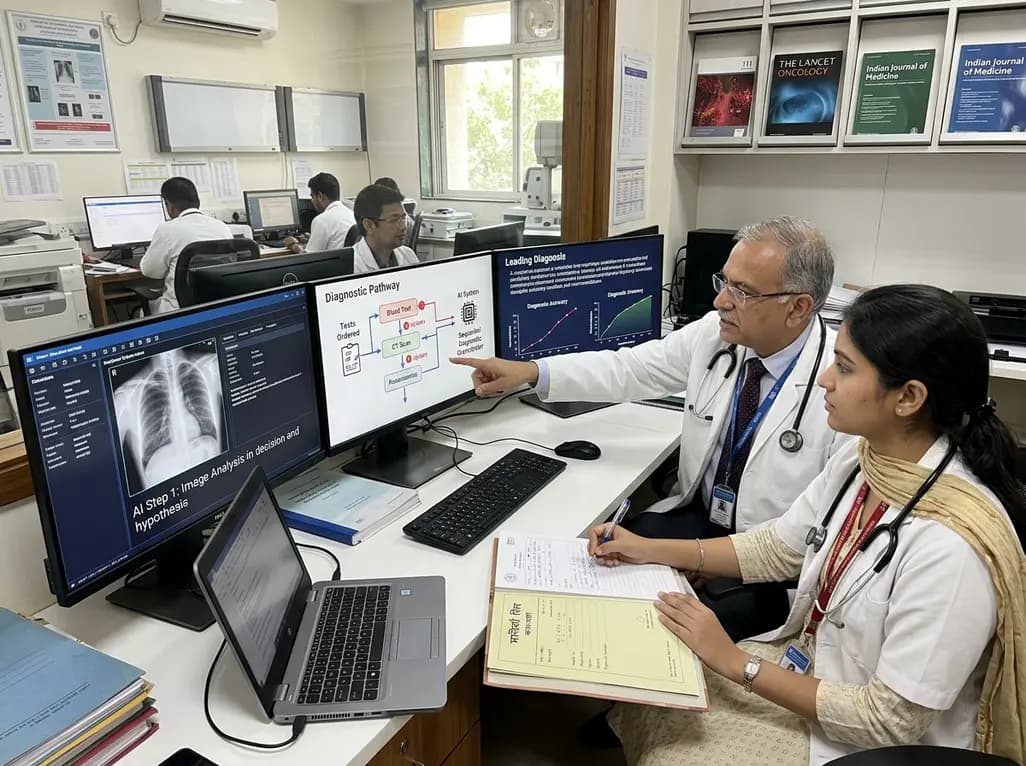
A breakthrough peer-reviewed study demonstrates that a sequential AI diagnosis system can mirror real-world clinical reasoning. By ordering stepwise tests and updating hypotheses dynamically, this multi-agent orchestrator achieved superior diagnostic accuracy while reducing investigative costs.
Today

A prenatal case highlights severe glutaric acidemia type II presenting as bilateral hyperechoic cystic kidneys at 18 weeks. Whole-exome sequencing revealed a novel homozygous ETFDH frameshift variant, demonstrating the power of rapid genetic testing in fetal renal anomalies.
Today

Review how tailored exercise programs benefit frail older patients with heart failure. Explore pathophysiological mechanisms, individualized training prescriptions, and strategies to overcome adherence barriers in clinical practice.
Yesterday

This comparative study evaluates posterior labral tears with and without glenohumeral instability, highlighting distinct demographic patterns, MRI underestimation in stable shoulders, and successful arthroscopic repair outcomes.
Yesterday

A clinical study demonstrates that early intervention with tocilizumab, either as monotherapy or bridged with corticosteroids, achieves significant proptosis reduction and resolves active inflammation in treatment-naive thyroid eye disease.
Yesterday
