.webp&w=384&q=75)

Loading, please wait...
Loading, please wait...
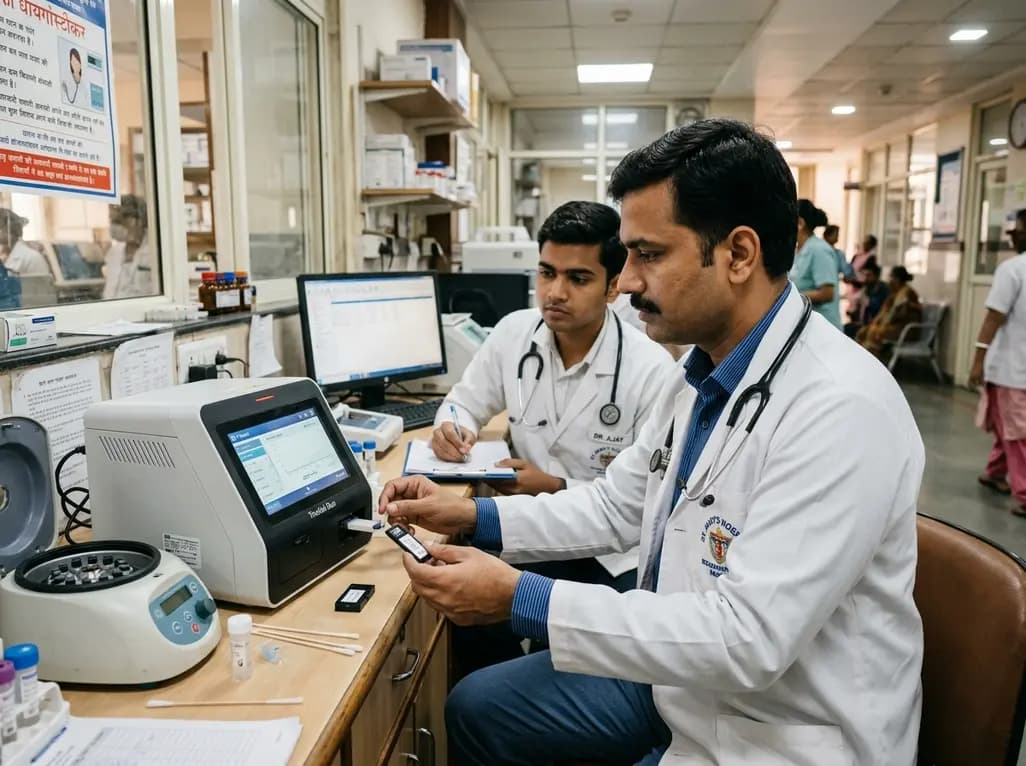
The announcement of the Molbio Diagnostics IPO marks a crucial milestone for the medical technology and diagnostics sector in India. Point-of-care diagnostics company Molbio Diagnostics Ltd has officially fixed a price band of Rs 768 to 807 per share for its upcoming Initial Public Offering opening on August 10. Consequently, this public issue represents a significant expansion phase for the Goa-based enterprise known worldwide for its flagship Truenat molecular diagnostic platform. Totaling between Rs 904 crore and Rs 940 crore, the equity offering includes a fresh issue worth Rs 200 crore alongside an Offer For Sale. Furthermore, the company has attracted substantial backing from major institutional investors like Temasek and Motilal Oswal Private Equity. Therefore, this listing highlights the growing clinical and economic importance of decentralized molecular testing technologies in primary healthcare settings.
In addition, anchor investor bidding opens on August 7, preparing the market for the three-day subscription window concluding on August 12. Half of the overall issue remains reserved for qualified institutional buyers, while fifteen percent is designated for non-institutional investors and thirty-five percent for retail participants. Subsequently, the equity shares will list on the BSE and NSE on August 17. Overall, this landmark public offering underscores the robust financial health and rapid operational expansion of Indian medical device innovators.
Incorporated in 2000, Molbio Diagnostics has established a transformative presence in molecular testing through its patented Truenat platform. This real-time micro-polymerase chain reaction system operates on battery power, which enables clinicians to perform gold-standard diagnostic evaluations directly at the point of care. Consequently, healthcare providers in rural or resource-limited settings can obtain actionable molecular results within one hour. Currently, the platform supports rapid detection for over thirty communicable and non-communicable conditions. These conditions include critical infectious diseases such as tuberculosis, COVID-19, human immunodeficiency virus, human papillomavirus, and viral hepatitis B and C.
Furthermore, the Truenat platform combines automated sample extraction with disease-specific micro-PCR chips, eliminating the need for complex laboratory infrastructure. Because the system utilizes room-temperature stable reagents and operates independently of continuous power grids, it effectively decentralizes advanced molecular pathology. For instance, primary healthcare centers can now confirm infectious pathogens quickly, avoiding delayed treatment initiation. Therefore, this diagnostic breakthrough significantly reduces transmission rates and improves patient outcomes across diverse clinical environments.
Out of the fresh issue proceeds, Molbio Diagnostics proposes to deploy Rs 106 crore towards capital expenditure for advanced infrastructure. Specifically, these funds will support a dedicated research and development facility, a Centre of Excellence, and connected corporate office space. Moreover, another Rs 72 crore will fund the acquisition of specialized plant machinery and industrial equipment for key manufacturing locations. These locations include the company's Goa Unit I, Goa Unit II, and Visakhapatnam production facilities. Meanwhile, the remaining proceeds will address general corporate requirements and operational growth strategies.
Additionally, expanding state-of-the-art laboratory facilities enables continuous technological evolution for chip-based diagnostic assays. By investing directly in research infrastructure, the company aims to broaden its diagnostic menu to address emerging public health threats and chronic conditions. Consequently, these infrastructure investments will reinforce India's domestic medical technology ecosystem while building global supply capacity for point-of-care PCR platforms.
The clinical impact of Molbio Diagnostics extends far beyond traditional diagnostic facilities into active public health management. Notably, the World Health Organization has endorsed the Truenat MTB assay for initial tuberculosis detection and rifampicin resistance screening. Therefore, public health programs across India and over ninety countries utilize Truenat devices for active case finding and epidemiological surveillance. Because rapid diagnosis enables immediate therapeutic intervention, clinicians can start patients on appropriate drug regimens on the same day.
Furthermore, decentralizing rapid PCR testing plays a pivotal role in controlling infectious disease outbreaks before they escalate. During recent viral epidemics, portable PCR technology enabled field teams to conduct immediate community screening in remote districts. Consequently, health authorities could isolate confirmed cases rapidly, cutting off transmission chains in vulnerable populations. As a result, expanding Truenat manufacturing capacity will strengthen pandemic preparedness and routine disease monitoring systems worldwide.
The financial foundation supporting Molbio Diagnostics reflects strong operational growth and sustained commercial adoption. As of March 31, 2026, the company maintained an installed manufacturing capacity of 5,400 diagnostic devices per year and 3.9 crore Truenat test kits annually. On the financial front, revenue from operations reached Rs 1,445 crore in fiscal 2026, while net profit stood at Rs 164 crore during the same fiscal period. At the upper end of the IPO price band, the company expects to command a post-issue market valuation of approximately Rs 9,300 crore.
Moreover, the company operates six specialized manufacturing facilities located in Goa, Bengaluru, Visakhapatnam, and Pune. This widespread production network ensures a steady supply of micro-PCR chips, reagents, and automated sample preparation devices. Therefore, the consistent recurring revenue from test kit sales provides financial stability, allowing the firm to reinvest continuously in high-impact medical research.
In modern clinical practice, timely diagnostic confirmation remains a primary bottleneck for effective patient care. Traditional centralized laboratories often require several days to return sensitive PCR test results, leading to empirical treatment or lost follow-up opportunities. However, portable point-of-care PCR testing changes this clinical paradigm by bringing laboratory-grade accuracy directly to outpatient clinics and rural health centers. Consequently, physicians can make definitive therapeutic decisions during a single consultation.
In addition, integrating digital radiology and pathology solutions into point-of-care platforms enhances diagnostic precision for complex cases. As Molbio Diagnostics expands its technological footprint, primary care providers gain access to comprehensive multi-disease diagnostic workflows. Consequently, this shift improves diagnostic equity, reduces out-of-pocket medical expenses for patients, and elevates the overall quality of care across primary healthcare networks.
Q1: What is the price band and schedule for the Molbio Diagnostics IPO?
The price band for the Molbio Diagnostics IPO is set at Rs 768 to 807 per equity share. The subscription opens on August 10 and closes on August 12, with anchor investor bidding opening on August 7. Furthermore, the final allotment is expected around August 13, and the company's equity shares are scheduled for listing on the BSE and NSE on August 17.
Q2: How does the Truenat platform benefit point-of-care clinical diagnostics?
The Truenat platform is a portable, battery-operated real-time micro-PCR system that delivers precise molecular diagnostic results within one hour. Because it operates effectively in resource-limited settings without specialized laboratory infrastructure, clinicians can rapidly detect conditions like tuberculosis, COVID-19, HIV, and viral hepatitis at primary health centers. Consequently, this decentralization enables immediate, evidence-based treatment decisions during patient consultations.
Q3: How will Molbio Diagnostics utilize the proceeds raised from its fresh issue?
Out of the Rs 200 crore fresh issue proceeds, Molbio Diagnostics proposes to allocate Rs 106 crore toward capital expenditure for a new R&D facility, a Centre of Excellence, and corporate office spaces. Additionally, another Rs 72 crore will fund new plant machinery and operational equipment for manufacturing facilities in Goa and Visakhapatnam, while remaining funds will support ongoing general corporate expansion.
Disclaimer: This content is for informational and educational purposes only. It does not constitute medical advice or replace professional judgment. Refer to the latest local and national guidelines for clinical practice.
References

Read summarized clinical updates, watch expert medical content, and earn CME certifications right from your smartphone.
Open your smartphone camera to scan and install.





Molbio Diagnostics has announced its IPO price band of Rs 768-807 per share, opening for subscription on August 10. The company plans to raise funds for R&D expansion, manufacturing units, and advancing its proprietary Truenat point-of-care PCR platform for decentralized disease testing across India.
last month

A recent study highlights the utility of two-dimensional speckle tracking echocardiography in assessing right atrial mechanics in OSAHS. Progressive reductions in reservoir and conduit strain, coupled with elevated contraction strain, signal early right heart remodeling correlated with apnea severity.
Today

A multicentre RCT in China shows that the PAICS AI system significantly boosts sonographer sensitivity in detecting fetal intracranial malformations by 8.7% without compromising specificity, offering promising diagnostic support for prenatal neurosonography.
Today

A 2026 meta-analysis evaluates PDE5 inhibitors in advanced ILD with severe gas exchange impairment. While overall mortality was not significantly reduced, a targeted subgroup with pulmonary hypertension showed a 49% risk reduction, underscoring the necessity of precise hemodynamic phenotyping.
Today

A premature neonate developed upper limb compartment syndrome after uterine rupture extruded the arm through a scar defect. Conservative management with continuous monitoring yielded complete functional recovery and normal limb growth at 10-year follow-up, highlighting non-operative safety in selected cases.
Yesterday

The Supreme Court questioned FSSAI's phased warning approach, urging single-phase implementation for foods exceeding limits in any nutrient of concern. Backed by ICMR-NIN recommendations, the proposed red hexagonal warnings target added sugar, salt, and fat to combat India's escalating chronic disease epidemic.
Today
