.webp&w=384&q=75)

Loading, please wait...
Loading, please wait...

Vessel-encoded arterial spin labeling (VEASL) allows for non-invasive imaging of multiple vascular territories simultaneously. While this technique is vital for cerebrovascular diagnostics, previous methods often faced significant signal-to-noise ratio (SNR) challenges. To overcome these hurdles, researchers developed the MOdulation-Guided ENcoding (MOGEN) scheme to enhance vessel-encoded ASL imaging. This approach exploits spatial modulation profiles to create a highly efficient encoding matrix. Consequently, it offers a more robust solution for mapping cerebral blood supply without contrast agents.
The MOGEN scheme demonstrates several advantages over previous encoding methods. In simulation studies, it achieved significantly higher SNR efficiency for four- and six-artery configurations. Clinical tests on healthy volunteers showed an in vivo SNR improvement of approximately 15%. Furthermore, the scheme provides robust vessel decoding, even when the spatial profile deviates from the expected cosine shape. Notably, in patients with Moyamoya disease, MOGEN enabled clear visualization of collateral pathways within five minutes. This efficiency is particularly beneficial in busy clinical settings in India, where scan time optimization is crucial.
Beyond SNR gains, MOGEN incorporates vessel size through multi-voxel representation. This feature improves single-artery selectivity, which is essential for accurate vascular territory mapping. Additionally, the scheme simplifies off-resonance correction for ultra-high field MRI applications. Therefore, MOGEN represents a substantial leap in the usability and reliability of VEASL. It provides a powerful tool for clinicians managing complex vascular pathologies and monitoring treatment responses.
MOGEN optimizes the encoding matrix by directly using spatial modulation profiles, which significantly increases signal-to-noise ratio (SNR) efficiency and improves vessel selectivity.
Yes, MOGEN effectively visualizes collateral pathways in Moyamoya patients, even when scan times are reduced to around five minutes for six major arteries.
Disclaimer: This content is for informational and educational purposes only. It does not constitute professional medical advice, diagnosis, or treatment. Always seek the advice of your physician or other qualified healthcare provider with any questions you may have regarding a medical condition. Refer to the latest local and national guidelines for clinical practice.
References
Li H et al. MOdulation-Guided ENcoding (MOGEN) Scheme for Vessel-Encoded Arterial Spin Labeling. Magn Reson Med. 2026 Mar 07. doi: 10.1002/mrm.70335. PMID: 41795084.
Suzuki Y et al. Evaluation of the contribution of individual arteries to the cerebral blood supply in patients with Moyamoya angiopathy: comparison of vessel-encoded arterial spin labeling and digital subtraction angiography. Neuroradiology. 2024;66(5):737-746.

Read summarized clinical updates, watch expert medical content, and earn CME certifications right from your smartphone.
Open your smartphone camera to scan and install.





The MOGEN scheme enhances vessel-encoded ASL by boosting SNR efficiency and improving the visualization of collateral pathways in diseases like Moyamoya....
7 months ago

A recent study demonstrates that spinal oxygen sensors do not require mitochondrial electron transport to trigger sympathetic excitation during acute hypoxia, revealing new insights into how mitochondrial oxidative stress modulates autonomic tone in cardiovascular and neurological diseases.
Today

Demanding exhaustive hormonal profiling can inadvertently discourage clinical studies involving females. Methodological standards must align with the specific scientific question to expand, not restrict, equitable evidence for women.
Today

The Directorate General of Health Services directs Indian states to halt the hazardous reuse and reprocessing of single-use medical devices. Discover regulatory implications under the Drugs and Cosmetics Act, critical infection risks, legal liabilities, and operational changes required across clinical specialties.
Today

A novel calcium polyphosphate coacervate enables injectable bone implants with in situ hierarchical porosity via phase separation and gas foaming, significantly enhancing cell proliferation, energy metabolism, and osteogenic differentiation for minimally invasive bone defect repair.
Today
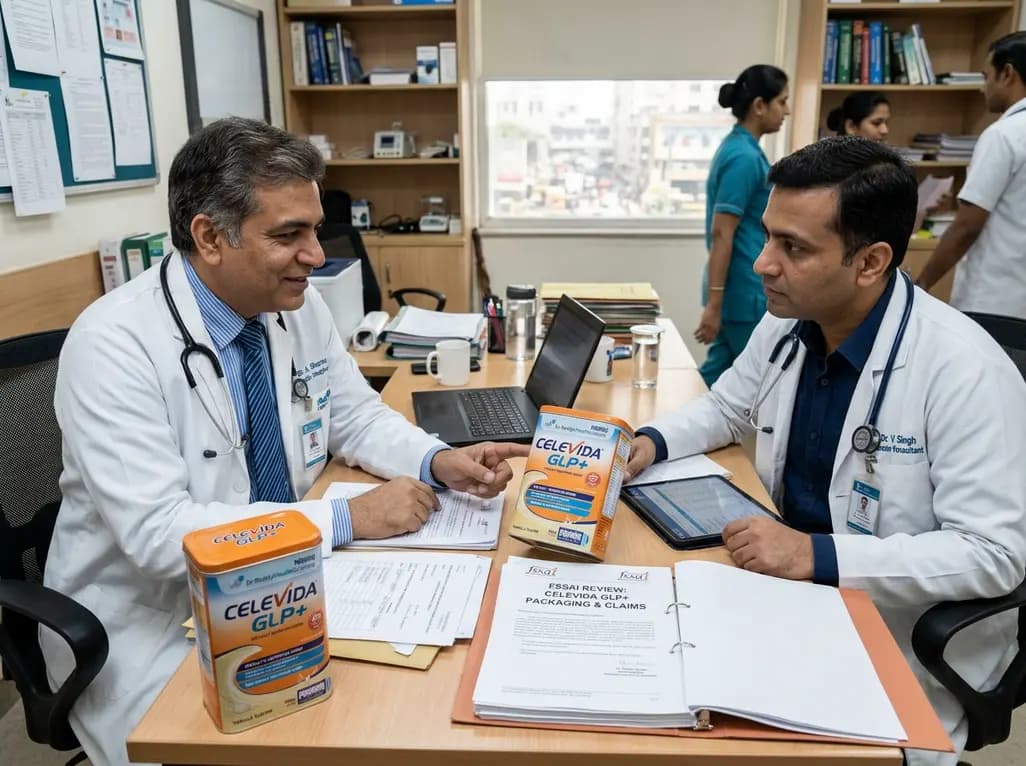
Following regulatory scrutiny from FSSAI regarding promotional representations and lean muscle preservation claims, Dr. Reddy's Laboratories and Nestlé Health Science are currently reviewing the branding and marketing strategy for their joint nutritional supplement Celevida GLP+.
Today
