.webp&w=384&q=75)

Loading, please wait...
Loading, please wait...

Minor hallucinations in Parkinson's disease often go unnoticed during routine clinical visits. These events serve as vital precursors to severe cognitive decline and structured visual hallucinations. However, standard neuropsychological assessments frequently fail to identify the early cognitive changes associated with these symptoms. A recent study has now established a definitive link between these sensory experiences and frontal subcortical executive dysfunction.
Researchers employed a unique robotic procedure that creates somatomotor conflicts to induce presence hallucinations experimentally. They observed that Parkinson's patients with a history of hallucinations were significantly more sensitive to these induced experiences. Furthermore, this heightened sensitivity directly correlated with poorer performance in specific cognitive domains. Specifically, the deficits appeared in frontal subcortical functions, which regulate executive control. Consequently, this robotic approach identifies vulnerability that traditional testing might overlook. Early detection allows for better prognostic mapping and tailored intervention strategies. Physicians must prioritize the assessment of minor hallucinations in Parkinson's to manage long-term cognitive health effectively.
Presence hallucinations are a type of minor hallucination where a patient feels a strong sensation that someone is nearby or behind them when no one is actually there. They often occur early in the disease progression and are frequently underreported.
The robot creates a sensory-motor mismatch that induces a brief "ghostly" sensation. Patients who are overly sensitive to this conflict often have underlying deficits in the frontal subcortical circuits responsible for executive function, marking them as high-risk for future decline.
Disclaimer: This content is for informational and educational purposes only. It does not constitute medical advice or a substitute for professional healthcare. Always consult a qualified medical professional for diagnosis and treatment. Refer to the latest local and national guidelines for clinical practice.
References

Read summarized clinical updates, watch expert medical content, and earn CME certifications right from your smartphone.
Open your smartphone camera to scan and install.





A study reveals that sensitivity to robot-induced presence hallucinations in Parkinson's disease identifies early frontal subcortical cognitive deficits....
5 months ago
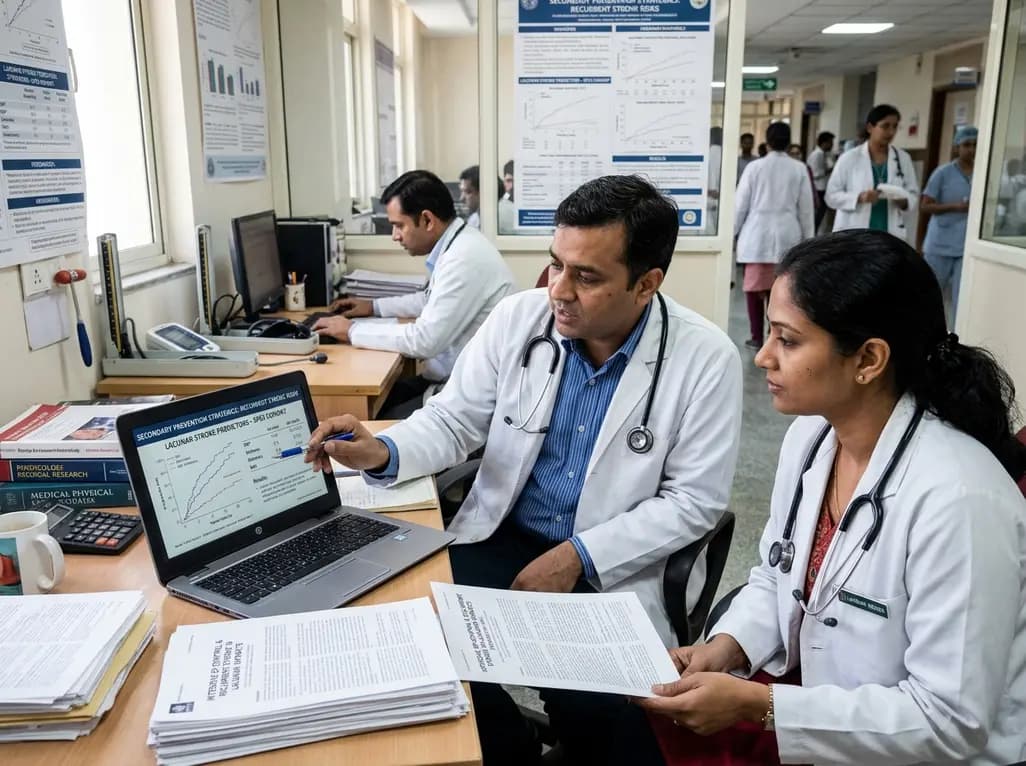
Explore vital recurrent stroke predictors in lacunar stroke patients managed with intensive blood pressure lowering. This analysis examines trial findings from SPS3 to uncover residual vascular risks, metabolic factors, and targeted secondary prevention strategies for high-risk neurological patients.
Today

Odisha has established India's first state-level clinical protocol specifically tailored for pregnant women with sickle cell disease. Developed with NHM and UNICEF, the framework provides structured antenatal screening, crisis mitigation, standardized referral pathways, and specialized interdisciplinary care.
Today

The Directorate General of Health Services directs Indian states to halt the hazardous reuse and reprocessing of single-use medical devices. Discover regulatory implications under the Drugs and Cosmetics Act, critical infection risks, legal liabilities, and operational changes required across clinical specialties.
Today

Mitochondria-targeted nanoparticles self-assembled from EGCG and L-glutamic acid effectively restore mitochondrial homeostasis, suppress synovial inflammation, and attenuate chondrocyte senescence in osteoarthritis, offering a promising disease-modifying nanotherapy.
Today

India is advancing preventive healthcare by integrating genomics, artificial intelligence, and quantum technologies. With the SANGAM programme sequencing one million Indian genomes, clinicians can unlock personalized therapies, detect cardiometabolic risks early, and curb the burden of diabetes and heart disease.
Today
