.webp&w=384&q=75)

Loading, please wait...
Loading, please wait...

Microbeam radiation therapy is a revolutionary approach to cancer treatment that utilizes spatially fractionated, micrometer-scale X-ray arrays. Unlike conventional radiation, this technique delivers alternating high-dose (peak) and low-dose (valley) regions. Consequently, it exploits the "dose-volume effect," which spares healthy tissue while effectively targeting malignant cells. Researchers at the PETRA III synchrotron in Hamburg, Germany, have recently achieved a technical milestone in this field. By implementing stereotactic multi-port delivery at the P61A beamline, they have significantly expanded the capabilities for preclinical oncological research.
Historically, microbeam radiation therapy at the P61A beamline faced significant physical constraints. The irradiation field remained limited to a fixed 2 mm width. Furthermore, delivery was restricted to a single direction. To resolve this, the team developed a custom motorized stage providing vertical and lateral translation and rotation. This setup enables discrete lateral patching and sequential delivery from up to nine different ports. Specifically, the microbeam arrays consist of five peaks, each only 50 µm wide, with precise 400 µm spacing.
Notably, the researchers utilized high-resolution Gafchromic HD-V2 film to verify the spatial accuracy of these arrays. The results were highly impressive. In 88% of the microbeam arrays, deviations stayed below the detection limit of 7.9 µm. Although some detectable displacements occurred in a small fraction of arrays, they remained localized to individual patches. Importantly, increasing the delivery speed and the number of ports did not introduce systematic alignment errors. This high level of reproducibility ensures that researchers can deliver complex, multi-angle doses with extreme confidence.
The achievement of reliable lateral field patching and multi-port delivery represents a major leap forward. Because the system can now extend the usable irradiation field, scientists can study a wider range of target sizes and locations. This capability is essential for translating experimental synchrotron techniques into future clinical applications. Moreover, the stable rotational isocentre allows for high-precision stereotactic treatments in small animal models, mimicking the complexity of human stereotactic radiosurgery.
Microbeam radiation therapy uses ultra-narrow X-ray beams that create high-dose peaks and low-dose valleys. This spatial fractionation allows normal tissues to repair more effectively than they do with the uniform broad beams used in conventional therapy.
The enhancement allows for larger irradiation fields through lateral patching and delivery from multiple angles. This enables researchers to target larger or more complex tumors with sub-10 micrometer precision in preclinical models.
The study demonstrated that 88% of the microbeam arrays had a spatial deviation of less than 7.9 micrometers. This level of accuracy ensures that the radiation is delivered exactly where intended, protecting surrounding healthy structures.
Disclaimer: This content is for informational and educational purposes only. It does not constitute medical advice or a substitute for professional healthcare. The techniques described are currently in the preclinical research stage and are not yet standard of care. Refer to the latest local and national guidelines for clinical practice.
References
Kügele M et al. Enhancing pre-clinical microbeam radiation therapy capabilities at PETRA III beamline P61A through high-precision beam delivery. Phys Med Biol. 2026 Mar 02. doi: 10.1088/1361-6560/ae4c13. PMID: 41771181.
Bouchet A et al. Unexpected Benefits of Multiport Synchrotron Microbeam Radiation Therapy for Brain Tumors. Cancers (Basel). 2021 Feb 24;13(5):936. doi: 10.3390/cancers13050936.
ReachMD. Innovative Microbeam Radiation Therapy: A Precise Approach to Tumor Treatment. Available at: https://reachmd.com/news/innovative-microbeam-radiation-therapy-a-precise-approach-to-tumor-treatment/2840909/ (Accessed March 2026).

Read summarized clinical updates, watch expert medical content, and earn CME certifications right from your smartphone.
Open your smartphone camera to scan and install.





Researchers at PETRA III have enhanced microbeam radiation therapy precision, enabling larger target coverage and multi-port delivery for preclinical studie...
7 months ago
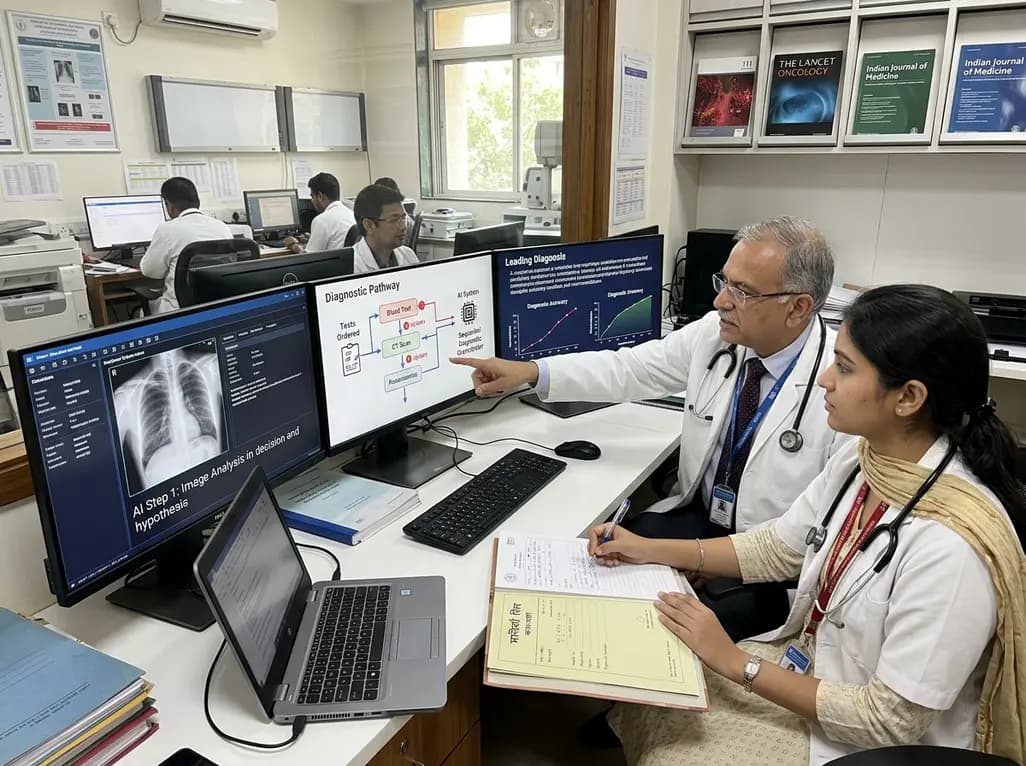
A breakthrough peer-reviewed study demonstrates that a sequential AI diagnosis system can mirror real-world clinical reasoning. By ordering stepwise tests and updating hypotheses dynamically, this multi-agent orchestrator achieved superior diagnostic accuracy while reducing investigative costs.
Today

A prenatal case highlights severe glutaric acidemia type II presenting as bilateral hyperechoic cystic kidneys at 18 weeks. Whole-exome sequencing revealed a novel homozygous ETFDH frameshift variant, demonstrating the power of rapid genetic testing in fetal renal anomalies.
Today

Review how tailored exercise programs benefit frail older patients with heart failure. Explore pathophysiological mechanisms, individualized training prescriptions, and strategies to overcome adherence barriers in clinical practice.
Yesterday

This comparative study evaluates posterior labral tears with and without glenohumeral instability, highlighting distinct demographic patterns, MRI underestimation in stable shoulders, and successful arthroscopic repair outcomes.
Yesterday

A clinical study demonstrates that early intervention with tocilizumab, either as monotherapy or bridged with corticosteroids, achieves significant proptosis reduction and resolves active inflammation in treatment-naive thyroid eye disease.
Yesterday
