.webp&w=384&q=75)

Loading, please wait...
Loading, please wait...

Accurate evaluation of MGMT methylation in glioma remains a clinical cornerstone of modern neuro-oncology. Glioblastomas and high-grade diffuse gliomas represent aggressive adult brain neoplasms requiring precise molecular characterization to guide personalized treatment. Neuro-oncologists rely on robust biomarkers to determine prognosis and predict therapeutic responsiveness. Specifically, epigenetic silencing of the O6-methylguanine-DNA methyltransferase promoter limits tumor DNA repair, significantly enhancing the efficacy of alkylating chemotherapy. Historically, diagnostic centers regarded pyrosequencing as the gold standard for this assessment. However, expanding diagnostic volumes demand superior analytical throughput, reduced hands-on laboratory time, and improved cost efficiency. Recent comparative evidence shows that amplicon-based next-generation sequencing offers greater precision and operational scalability, providing clinicians with a dependable alternative.
The O6-methylguanine-DNA methyltransferase gene encodes a specialized DNA repair enzyme. This enzyme counteracts the cytotoxic effects of alkylating agents like temozolomide by removing dangerous alkyl groups from the O6 position of guanine. When promoter hypermethylation epigenetically silences this gene, glioma cells cannot repair chemotherapy-induced DNA damage. Consequently, patients with methylated tumors experience significantly superior progression-free survival and overall survival compared to unmethylated counterparts. Moreover, this epigenetic biomarker critically directs clinical decision-making in elderly or frail glioblastoma patients. In this subgroup, clinicians frequently prescribe temozolomide monotherapy alone when promoter methylation is documented, sparing patients from debilitating radiotherapy. Conversely, unmethylated status indicates intrinsic chemoresistance, encouraging enrollment in innovative clinical trials. In addition, accurate molecular stratification prevents prognostic misinterpretation across clinical oncology trials. Despite its established importance, clinicians have frequently encountered inter-laboratory discordance with older diagnostic platforms. Therefore, contemporary neuro-oncology requires an assay that guarantees high sensitivity and reproducible quantification across challenging clinical tissue samples.
For years, diagnostic pathology laboratories considered bisulfite pyrosequencing the gold standard for quantifying promoter methylation. This sequencing-by-synthesis method measures light signals emitted during nucleotide incorporation across target cytosine-phosphate-guanine dinucleotide positions. Unlike qualitative methylation-specific PCR, pyrosequencing provides quantitative data for specific CpG loci. Consequently, laboratories can establish precise numerical cut-offs to categorize patient samples accurately. Nevertheless, pyrosequencing carries major technical and logistical drawbacks that hinder routine clinical workflows. First, the technique requires complex pre-analytical handling, including tedious bisulfite treatment, biotinylated primer amplification, and streptavidin bead isolation. Furthermore, pyrosequencing instruments provide low sample throughput, processing only small specimen batches during each run. Reagent kits also remain expensive, creating substantial financial burdens for busy healthcare centers. In addition, low-quality or degraded DNA extracted from routine formalin-fixed paraffin-embedded tissue often triggers assay failure or ambiguous pyrogram traces. Thus, while pyrosequencing established an important historical standard, modern neuropathology services require a more robust, automated, and scalable diagnostic methodology.
Next-generation sequencing has revolutionized molecular pathology by enabling massively parallel high-throughput genomic and epigenomic analysis. Recently, molecular biologists engineered amplicon-based next-generation sequencing workflows specifically designed for quantitative promoter methylation detection. In this protocol, targeted primers amplify bisulfite-treated DNA spanning essential regulatory CpG islands. Subsequently, high-throughput sequencers generate thousands of clonal reads per targeted locus. Therefore, this methodology provides unparalleled statistical depth to determine methylation percentages at single-base resolution across individual alleles. Furthermore, next-generation sequencing delivers superior multiplexing capability compared to older technologies. Diagnostic laboratories can easily pool numerous patient samples into a single sequencing run, thereby substantially decreasing per-test costs. The streamlined protocol also reduces manual pipetting and minimizes potential laboratory errors. Importantly, amplicon-based next-generation sequencing demonstrates exceptional tolerance for fragmented DNA extracted from archival formalin-fixed paraffin-embedded specimens. By maintaining high read depths across short amplicons, the platform prevents assay failure in degraded specimens. Hence, next-generation sequencing provides an ideal combination of diagnostic depth and workflow efficiency.
A landmark clinical investigation evaluated the diagnostic concordance of pyrosequencing and next-generation sequencing using 50 formalin-fixed paraffin-embedded glioma samples. Initially, researchers identified a high quantitative correlation coefficient of 0.88 between the two sequencing platforms. Furthermore, the overall categorical agreement reached 94%, with 47 of the 50 specimens demonstrating fully concordant methylation classifications. However, the study revealed three notable discordant results between the modalities. Specifically, one sample tested negative by pyrosequencing but positive by next-generation sequencing, while two samples tested positive by pyrosequencing but negative by next-generation sequencing. To resolve these crucial clinical discrepancies, investigators performed orthogonal validation using MethyLight technology. Remarkably, MethyLight results completely matched the next-generation sequencing classifications across all three discordant cases. These results confirmed one false negative and two false positives generated by pyrosequencing. Consequently, the findings demonstrate that next-generation sequencing provides superior quantitative accuracy, eliminates background optical artifacts, and enhances diagnostic reliability.
Transitioning from traditional pyrosequencing to next-generation sequencing brings substantial operational and clinical advantages to neuro-oncology services. Modern diagnostic laboratories increasingly consolidate individual molecular tests into centralized genomic profiling panels. By incorporating promoter methylation assessment into broader targeted next-generation sequencing panels, pathologists can simultaneously evaluate IDH mutations, 1p/19q codeletions, and promoter methylation from a single DNA aliquot. Consequently, this comprehensive multi-omic approach conserves scarce tumor tissue obtained from stereotactic brain biopsies. Furthermore, consolidating molecular tests onto one sequencing platform shortens diagnostic turnaround times, empowering neuro-oncology multidisciplinary teams to initiate therapy without delay. In resource-limited healthcare environments, high-throughput sequencing significantly lowers consumable expenses per sample. Clinicians gain highly reliable molecular profiles, ensuring that patients receive tailored temozolomide chemotherapy without risk of misclassification. Therefore, adopting amplicon-based next-generation sequencing refines diagnostic precision, streamlines laboratory operations, and elevates clinical care for glioma patients worldwide.
MGMT promoter methylation silences an essential DNA repair enzyme, leaving glioma cells vulnerable to alkylating chemotherapy such as temozolomide. Testing this epigenetic biomarker provides vital prognostic information and predicts clinical treatment response. In elderly or frail patients, confirmed methylation justifies using temozolomide monotherapy alone, sparing them from potentially debilitating whole-brain radiation therapy.
Next-generation sequencing provides higher analytical throughput, improved cost-effectiveness, and superior quantitative accuracy compared to traditional pyrosequencing. By generating thousands of clonal reads per targeted locus, it reliably detects fractional methylation without optical signal interference. Additionally, next-generation sequencing demonstrates remarkable resilience when analyzing degraded DNA from archival formalin-fixed paraffin-embedded glioma tissue specimens.
Researchers resolved discrepancies between pyrosequencing and next-generation sequencing using MethyLight, an established real-time fluorescence PCR assay. MethyLight results matched the next-generation sequencing findings in all discordant samples, confirming one false negative and two false positives produced by pyrosequencing. This orthogonal validation established that next-generation sequencing offers higher diagnostic accuracy than pyrosequencing.
Disclaimer: This content is for informational and educational purposes only and should not be considered medical advice. Always consult a qualified healthcare provider for diagnosis and treatment decisions. Refer to the latest local and national guidelines for clinical practice.
References

Read summarized clinical updates, watch expert medical content, and earn CME certifications right from your smartphone.
Open your smartphone camera to scan and install.





A comparative study demonstrates that amplicon-based next-generation sequencing offers superior accuracy and efficiency over traditional pyrosequencing for quantifying MGMT promoter methylation in glioma, establishing a scalable and reliable molecular diagnostic workflow for neuro-oncology.
Today

A North Texas pilot study reveals that combining virtual physician consultations with in-person house calls safely manages adult pneumonia. By utilizing CRB-65 severity scores, clinicians effectively triaged patients, providing home-based recovery while directing higher-risk individuals to emergency care.
Today

A quasi-experimental study demonstrates that culturally tailored educational interventions significantly boost HPV knowledge and vaccination intentions. These findings provide actionable strategies for healthcare providers in India to overcome vaccine hesitancy and advance cervical cancer prevention.
Today

A comprehensive meta-analysis evaluates the association between Body Mass Index and outcomes following abdominal aortic aneurysm repair. Discover how overweight and obesity correlate with lower mortality while underweight status confers heightened risk, challenging conventional preoperative risk stratification.
Today

The SOLARIO trial shows that a short course (≤7 days) of systemic antibiotic therapy is noninferior to long courses (≥4 weeks) in orthopedic infections treated with local antibiotic carriers, with significantly fewer adverse events.
Today
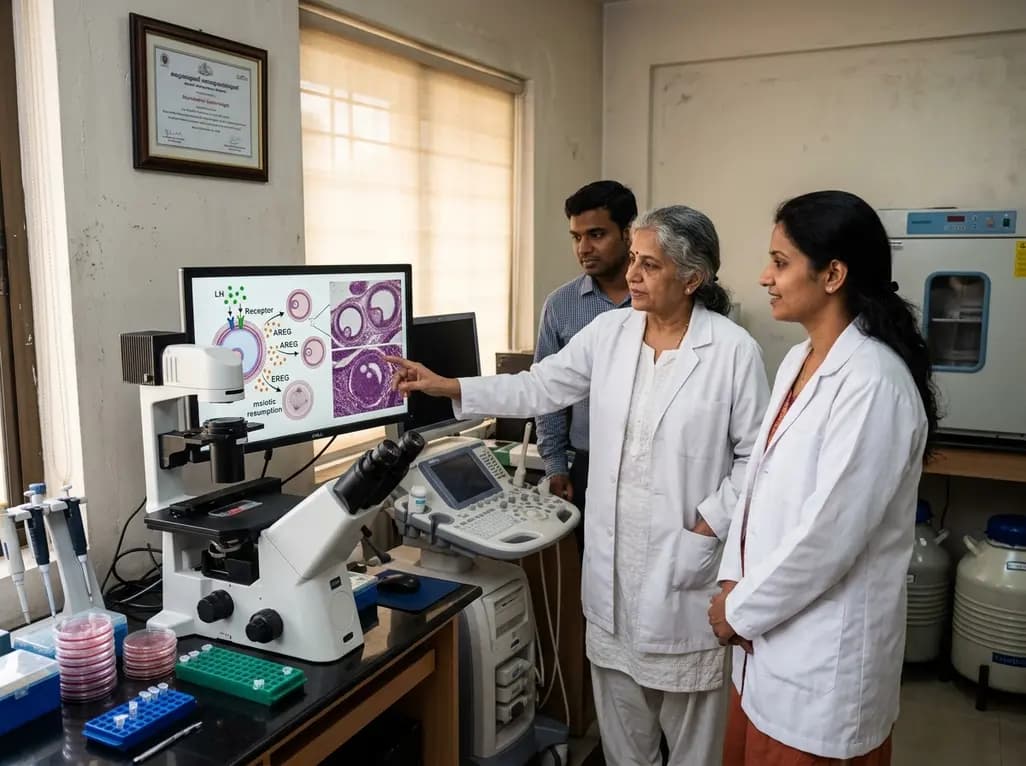
New research reveals that preovulatory follicles communicate via LH-induced paracrine signaling. Diffusible EGF ligands epiregulin and amphiregulin coordinate oocyte meiotic resumption across neighboring follicles, challenging traditional concepts of follicular autonomy.
Today
