.webp&w=384&q=75)

Loading, please wait...
Loading, please wait...

Characterizing Meniere's disease nystagmus effectively often requires real-time observation during an acute vertigo attack. Consequently, researchers have begun using portable eye movement recorders (PEMR) to capture these critical diagnostic windows. A recent study specifically analyzed how endolymphatic hydrops (EH) confirmed via MRI correlates with specific nystagmus patterns. This technology allows clinicians to monitor eye movements immediately after symptoms start, even outside a clinical setting.
The study enrolled 54 patients diagnosed with Meniere's disease. Furthermore, the medical team used contrast-enhanced magnetic resonance imaging (CE-MRI) to categorize participants into two groups. One group had confirmed endolymphatic hydrops, while the other did not. Additionally, each patient used a PEMR to record eye movements during vertigo episodes. This approach ensures that clinicians receive accurate data from the very onset of an attack. Notably, 41 out of 54 patients exhibited EH on their MRI scans. Within this group, irritative nystagmus appeared much more frequently than paralytic patterns.
Moreover, the researchers observed a significant difference in the distribution of nystagmus types between the groups. Specifically, patients with confirmed hydrops typically showed irritative nystagmus, which beats toward the affected ear. Conversely, those without visible hydrops on MRI often displayed paralytic nystagmus. This finding suggests that irritative patterns likely reflect active stimulation of the vestibular apparatus by the hydropic state. Therefore, the direction of eye movement serves as a vital indicator of the underlying physiological activity.
Although the direction of Meniere's disease nystagmus can reverse within 24 hours, the study found this trend more often in the hydrops group. However, the difference between groups regarding direction reversal was not statistically significant. Similarly, the location of the hydrops—whether cochlear or vestibular—did not strongly correlate with a specific nystagmus direction. Thus, clinicians should focus primarily on the initial pattern recorded during the acute phase. These real-time recordings provide a clearer picture of vestibular health than delayed clinical examinations.
Finally, the researchers concluded that PEMR is a feasible and valuable tool for home-based monitoring. It empowers patients to contribute to their own diagnostic process. Consequently, doctors can make more informed decisions regarding treatment strategies. Future studies should continue to explore how these digital tools can refine the management of fluctuating hearing loss and vertigo.
Irritative nystagmus typically beats toward the affected ear and suggests acute vestibular excitation. In contrast, paralytic nystagmus beats away from the affected ear, indicating a relative deficit in vestibular function.
Contrast-enhanced MRI can detect endolymphatic hydrops, which is the pathological hallmark of Meniere's disease. This imaging allows doctors to visualize the swelling of the inner ear structures.
Vertigo attacks are often unpredictable and short-lived. A portable recorder allows patients to capture high-quality data at the exact moment symptoms begin, which is often impossible in a doctor's office.
Disclaimer: This content is for informational and educational purposes only and does not constitute medical advice. Always seek the advice of a qualified healthcare provider with any questions regarding a medical condition. Refer to the latest local and national guidelines for clinical practice.
References
Oya R et al. Characterizing nystagmus using a portable eye movement recorder in patients with Meniere's disease and MRI-confirmed endolymphatic hydrops. Auris Nasus Larynx. 2026 May 20. doi: undefined. PMID: 42160796.
Bance M, et al. The changing direction of nystagmus in acute Meniere's disease: pathophysiological implications. Laryngoscope. 1991;101(2):197-201.
Bernaerts A, et al. The Value of Four-Hour Delayed Gadolinium-Enhanced MR Imaging of the Inner Ear in Patients with Suspected Meniere's Disease. Radiographics. 2019;39(6):1582-1602.

Read summarized clinical updates, watch expert medical content, and earn CME certifications right from your smartphone.
Open your smartphone camera to scan and install.





A study evaluates nystagmus patterns in Meniere's disease using portable recorders and MRI, highlighting the link between irritative nystagmus and hydrops....
5 months ago
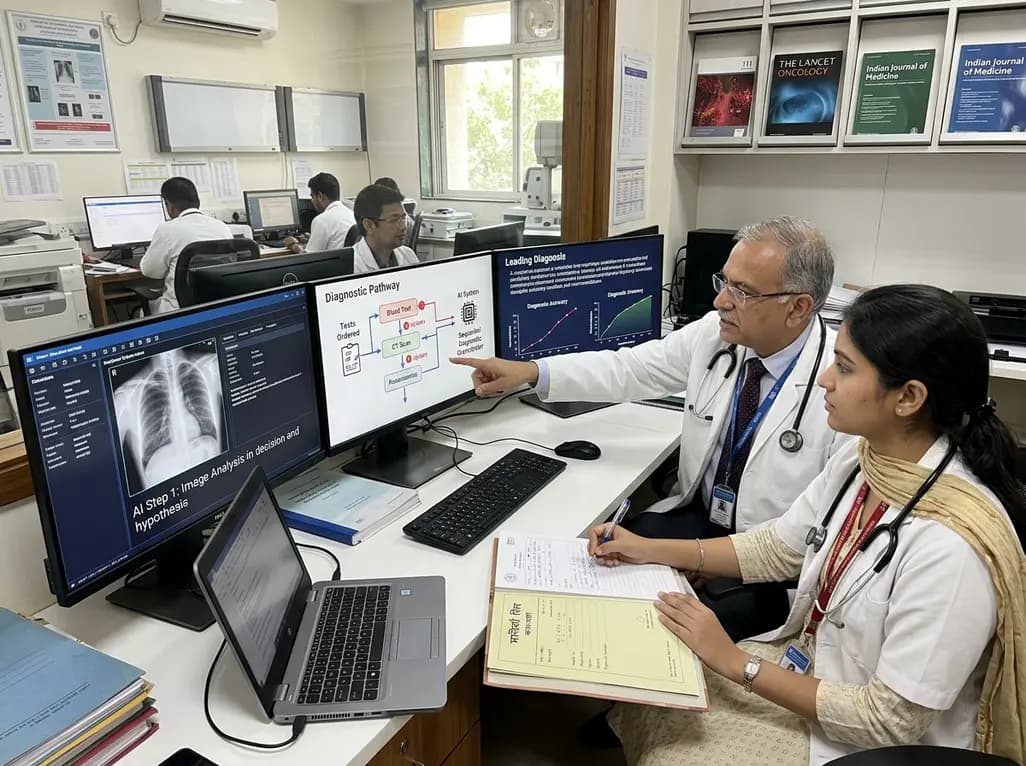
A breakthrough peer-reviewed study demonstrates that a sequential AI diagnosis system can mirror real-world clinical reasoning. By ordering stepwise tests and updating hypotheses dynamically, this multi-agent orchestrator achieved superior diagnostic accuracy while reducing investigative costs.
Today

A prenatal case highlights severe glutaric acidemia type II presenting as bilateral hyperechoic cystic kidneys at 18 weeks. Whole-exome sequencing revealed a novel homozygous ETFDH frameshift variant, demonstrating the power of rapid genetic testing in fetal renal anomalies.
Today

Review how tailored exercise programs benefit frail older patients with heart failure. Explore pathophysiological mechanisms, individualized training prescriptions, and strategies to overcome adherence barriers in clinical practice.
Yesterday

This comparative study evaluates posterior labral tears with and without glenohumeral instability, highlighting distinct demographic patterns, MRI underestimation in stable shoulders, and successful arthroscopic repair outcomes.
Yesterday

A clinical study demonstrates that early intervention with tocilizumab, either as monotherapy or bridged with corticosteroids, achieves significant proptosis reduction and resolves active inflammation in treatment-naive thyroid eye disease.
Yesterday
