.webp&w=384&q=75)

Loading, please wait...
Loading, please wait...

Dr. Rakesh Kalpala will soon showcase innovative MedTech AI solutions at the upcoming India AI Impact Summit in New Delhi. Moreover, this event marks a significant milestone for localized digital health in the subcontinent. The session will specifically address challenges in managing fatty liver disease using artificial intelligence. In addition, he will discuss AI-driven nutrition monitoring during pregnancy. These tools offer a cost-effective approach for Indian clinicians working in diverse settings. However, successful integration requires robust data validation across local populations. Consequently, AIG Hospitals emphasizes the urgent need for Indian-specific medical literature rather than relying on Western data.
Dr. Kalpala aims to streamline electronic medical records (EMR) through advanced artificial intelligence. Furthermore, the collaboration between the Andhra Pradesh government, the AIM Foundation, and AIG Hospitals has yielded impressive results over recent months. Therefore, the upcoming summit provides a critical platform for sharing these research developments. Additionally, clinicians will learn how MedTech AI solutions can enhance diagnostic accuracy in hepatology and maternal care. India must develop its own randomized control trials to ensure clinical safety. As a result, healthcare providers can eventually rely on evidence-based local data for better patient outcomes. Finally, the India AI Impact Summit will run from February 16-20, 2026, at Bharat Mandapam.
Q1: What are the primary medical areas addressed by these new MedTech AI solutions?
The presentation focuses on managing fatty liver disease, monitoring maternal nutrition during pregnancy, and streamlining Electronic Medical Records (EMR) systems for better efficiency.
Q2: Why is Indian-validated data essential for healthcare AI according to Dr. Kalpala?
Localized data is vital because Western medical literature may not accurately reflect the Indian demographic. Therefore, randomized control trials and local data validation are necessary to ensure AI accuracy in India.
Disclaimer: This content is for informational and educational purposes only. It does not constitute medical advice or replace professional judgment. Refer to the latest local and national guidelines for clinical practice.
References

Read summarized clinical updates, watch expert medical content, and earn CME certifications right from your smartphone.
Open your smartphone camera to scan and install.





Dr. Rakesh Kalpala from AIG Hospitals presents localized MedTech AI solutions for fatty liver and maternal health at the India AI Impact Summit 2026....
8 months ago

Review how tailored exercise programs benefit frail older patients with heart failure. Explore pathophysiological mechanisms, individualized training prescriptions, and strategies to overcome adherence barriers in clinical practice.
Today
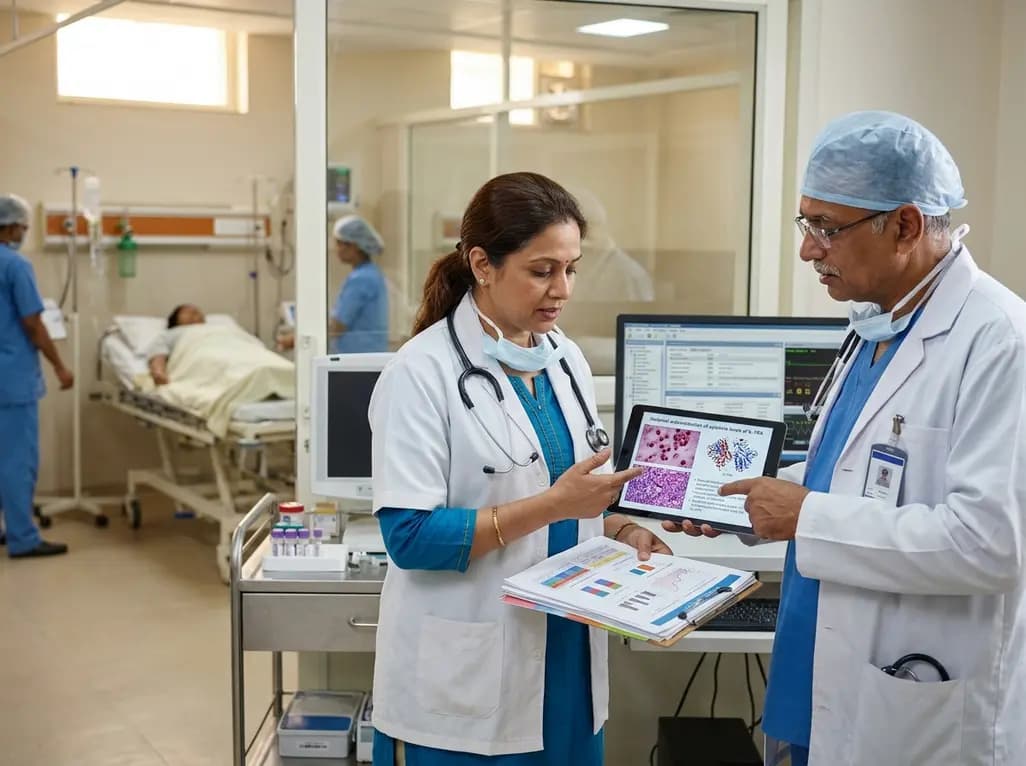
Recent clinical studies reveal maternal autoantibodies targeting IL-1RA as potential triggers for preterm labor, opening avenues for targeted cytokine therapies. Concurrently, new perioperative findings show inhaled cannabis increases propofol requirements during upper endoscopy compared to oral edible consumption.
Today

In high-risk pulmonary embolism complicated by severe anemia and active uterine bleeding, systemic thrombolysis is contraindicated. Large-bore aspiration thrombectomy provides rapid hemodynamic rescue without fibrinolysis, supported by inferior vena cava filter placement and multidisciplinary critical care.
Today

This comparative study evaluates posterior labral tears with and without glenohumeral instability, highlighting distinct demographic patterns, MRI underestimation in stable shoulders, and successful arthroscopic repair outcomes.
Today

A clinical study demonstrates that early intervention with tocilizumab, either as monotherapy or bridged with corticosteroids, achieves significant proptosis reduction and resolves active inflammation in treatment-naive thyroid eye disease.
Today
