.webp&w=384&q=75)

Loading, please wait...
Loading, please wait...

Recent research highlights the importance of medical mask filtration efficacy in real-world scenarios. Specifically, a new study validated an animatronic headform test method designed to simulate how individuals actually wear masks. Unlike traditional tests that use sealed systems, this approach evaluates total filtration efficacy and breathing resistance during a simulated 10-minute fit test. Consequently, the method provides more realistic data for healthcare professionals and the public.
The study clearly demonstrated that fit is a primary driver of mask performance. When researchers tightened the ear loops on medical masks, they observed a significant increase in total filtration efficacy across all products. However, this adjustment also increased breathing resistance, which could impact user comfort. Moreover, the headform method differentiated between products with efficiencies ranging from 14% to 93%. Furthermore, the results showed good measurement stability with low variation. Therefore, proper donning techniques remain vital for maximizing the protective capabilities of any barrier face covering. Although more research is needed for breathing resistance sensitivity, this system-level assessment marks a significant advancement. Ultimately, comparing these results to ASTM F3502-21 standards underscores that leakage significantly reduces real-world effectiveness.
The headform method incorporates fit and leakage into the evaluation, whereas standard sealed tests only measure material efficiency. This provides a realistic assessment of the \"as-worn\" performance of masks.
Tightening ear loops significantly improves medical mask filtration efficacy but simultaneously increases breathing resistance. This finding emphasizes the tradeoff between protection and breathability.
Disclaimer: This content is for informational and educational purposes only. It does not constitute medical advice or professional diagnostic/treatment services. Refer to the latest local and national guidelines for clinical practice.
References

Read summarized clinical updates, watch expert medical content, and earn CME certifications right from your smartphone.
Open your smartphone camera to scan and install.





This study validates an animatronic headform method for measuring real-world medical mask filtration efficacy, highlighting the significant impact of fit....
8 months ago
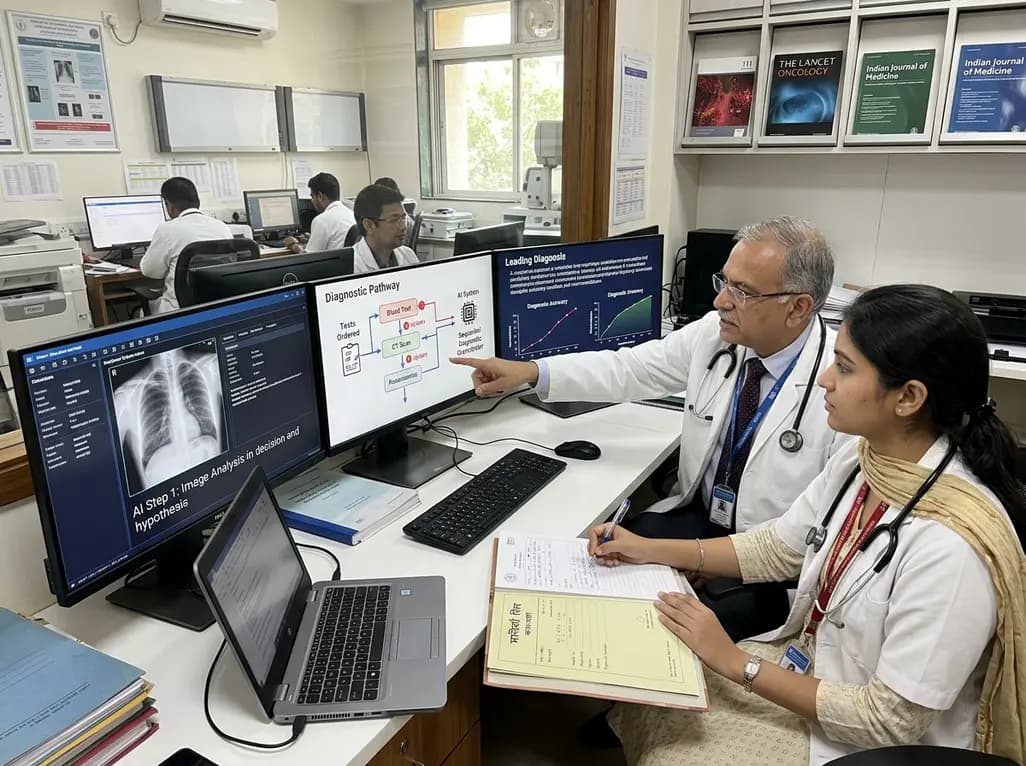
A breakthrough peer-reviewed study demonstrates that a sequential AI diagnosis system can mirror real-world clinical reasoning. By ordering stepwise tests and updating hypotheses dynamically, this multi-agent orchestrator achieved superior diagnostic accuracy while reducing investigative costs.
Today

A prenatal case highlights severe glutaric acidemia type II presenting as bilateral hyperechoic cystic kidneys at 18 weeks. Whole-exome sequencing revealed a novel homozygous ETFDH frameshift variant, demonstrating the power of rapid genetic testing in fetal renal anomalies.
Today

Review how tailored exercise programs benefit frail older patients with heart failure. Explore pathophysiological mechanisms, individualized training prescriptions, and strategies to overcome adherence barriers in clinical practice.
Yesterday

This comparative study evaluates posterior labral tears with and without glenohumeral instability, highlighting distinct demographic patterns, MRI underestimation in stable shoulders, and successful arthroscopic repair outcomes.
Yesterday

A clinical study demonstrates that early intervention with tocilizumab, either as monotherapy or bridged with corticosteroids, achieves significant proptosis reduction and resolves active inflammation in treatment-naive thyroid eye disease.
Yesterday
