.webp&w=384&q=75)

Loading, please wait...
Loading, please wait...
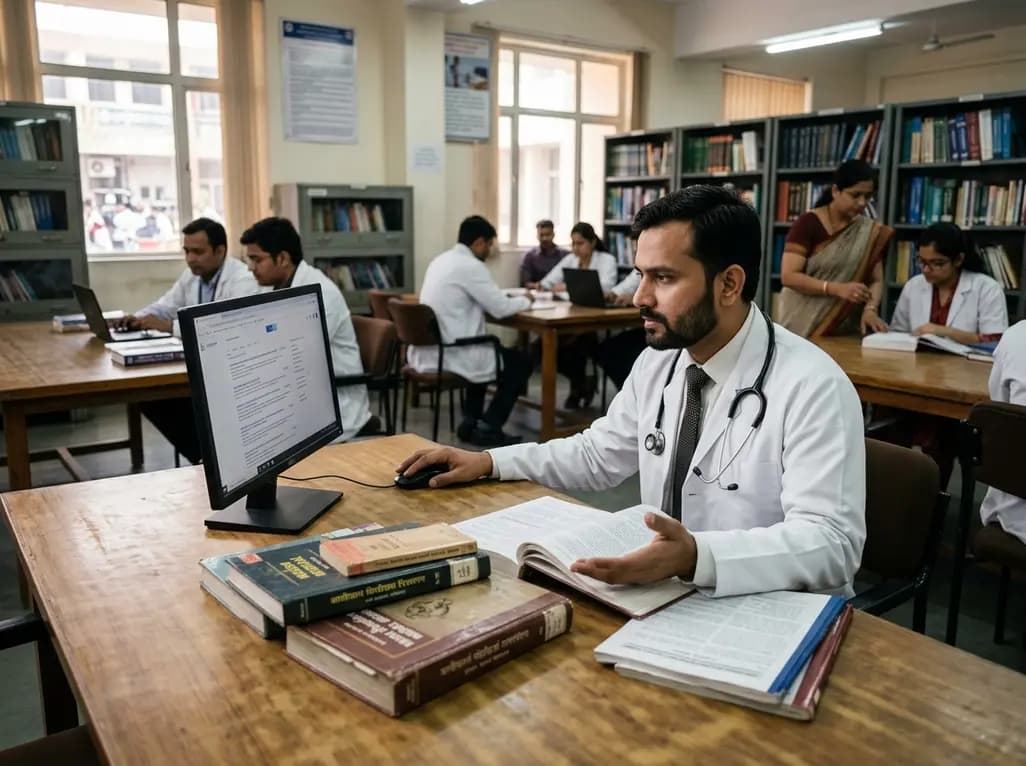
Modern clinical practice relies heavily on accessible, verified, and rapidly updated scientific data. Recent research from Lucknow University’s Department of Library and Information Science demonstrates that medical libraries patient care outcomes improve significantly when healthcare institutions actively integrate robust information services. Published in the Scopus-indexed Journal of Electronic Resources in Medical Libraries, this landmark study analyzed feedback from 375 medical stakeholders. These participants included MBBS students, postgraduate residents, practicing physicians, faculty members, and research scholars across premier institutions in Uttar Pradesh, namely King George’s Medical University, Sanjay Gandhi Postgraduate Institute of Medical Sciences, and Dr. Ram Manohar Lohia Institute of Medical Sciences. Consequently, the research highlights how central academic repositories serve as indispensable pillars for institutional clinical excellence and health literacy advancement.
Furthermore, the researchers evaluated how digital information resources, e-journals, and structured library programs influence daily decision-making in clinical environments. Ultimately, the findings establish that structured library facilities directly support practitioners in differentiating evidence-based clinical protocols from unverified claims. Therefore, institutional investment in modern library infrastructure remains a primary driver for overall healthcare quality improvement.
Integrating medical libraries patient care workflows directly enhances the implementation of evidence-based medicine across various clinical specialties. Modern medical treatment protocols continuously evolve as new clinical trials and systematic reviews emerge daily. Without systematic access to peer-reviewed databases and e-journals, healthcare providers often struggle to stay aligned with current international standards. Fortunately, institutional libraries bridge this knowledge gap by delivering rapid access to high-impact research, clinical guidelines, and diagnostic algorithms. Consequently, medical residents and senior consultants can rapidly verify complex drug interactions, rare clinical presentations, and novel surgical techniques directly at the point of care.
Moreover, active utilization of medical library databases encourages a culture of continuous learning and critical thinking within hospital departments. Doctors who regularly consult updated scientific literature demonstrate greater confidence when establishing personalized treatment plans for complex patients. Thus, medical libraries transform traditional clinical settings into dynamic, knowledge-driven environments where patient safety and optimal clinical outcomes remain paramount.
The widespread proliferation of unverified medical information presents a substantial challenge to modern public health and clinical management. Unsubstantiated claims, outdated therapeutic guidelines, and sensationalized wellness trends can obscure clinical judgment and lead to suboptimal patient management strategies. In this context, institutional medical libraries serve as vital digital filters and authoritative sources of truth for medical professionals. By offering direct access to indexed journals and vetted clinical decision-support tools, libraries empower clinicians to quickly identify and discard misleading clinical claims.
Additionally, trained medical librarians regularly assist clinical staff by conducting comprehensive literature searches and organizing systematic reviews. This collaborative framework ensures that treatment decisions rely entirely on validated clinical trials rather than anecdotal opinions. Consequently, healthcare providers can confidently communicate accurate diagnostic insights and prognosis details to their patients, thereby reinforcing professional integrity and patient trust.
Health literacy extends beyond patient education; it also encompasses the ability of medical professionals to systematically critically appraise complex scientific literature. The study conducted by Lucknow University emphasizes that structured health literacy training programs offered by medical libraries significantly enhance information retrieval skills among medical trainees and junior doctors. As medical knowledge expands exponentially, acquiring efficient searching techniques becomes essential for maintaining clinical competence.
Furthermore, these literacy initiatives teach scholars how to navigate comprehensive biomedical databases such as PubMed, Scopus, and Cochrane Library effectively. By mastering Boolean operators, advanced filters, and critical appraisal frameworks, medical students can swiftly extract relevant clinical data during intensive ward rounds and academic seminars. Ultimately, fostering advanced information literacy among young healthcare professionals ensures a durable foundation for lifetime learning and clinical rigor.
To maximize the clinical benefit of academic repositories, healthcare institutions must prioritize robust digital infrastructure and seamless electronic resource accessibility. Traditional print archives, while historically significant, are no longer sufficient to meet the fast-paced demands of modern tertiary healthcare centers. Today, electronic journals, online textbooks, remote database access, and specialized clinical software represent the backbone of effective medical library services.
However, optimal resource utilization requires continuous technical upgrades, high-speed campus networks, and user-friendly portal interfaces. Institutional leaders must allocate dedicated budgets to sustain journal subscriptions and integrate artificial intelligence tools for efficient literature mapping. When medical libraries provide seamless remote access to digital tools, clinicians can retrieve urgent therapeutic guidance during critical patient care scenarios, regardless of physical location.
Looking forward, medical libraries must transition from passive repositories into active clinical partners within tertiary healthcare institutions. Future strategies should focus on expanding clinical librarianship programs, where trained information specialists directly participate in interdisciplinary ward rounds and department morbidity meetings. This direct integration ensures real-time literature support for complex clinical cases and rare medical conditions.
In addition, establishing joint health literacy campaigns between medical libraries and hospital departments can help extend verified medical facts directly to patients and caregivers. By modernizing physical learning spaces, expanding digital archives, and promoting interprofessional collaboration, academic medical institutions can create a resilient healthcare environment dedicated to continuous academic growth and superior patient outcomes.
Q1: What role do medical libraries play in direct patient care?
Medical libraries provide clinicians with immediate access to updated e-journals, peer-reviewed clinical guidelines, and drug databases. This evidence-based information assists doctors in making accurate diagnostic and therapeutic decisions, thereby improving clinical accuracy, minimizing medical errors, and enhancing overall patient safety.
Q2: How was the Lucknow University study conducted?
Researchers surveyed 375 participants, including medical students, doctors, faculty, and research scholars across three premier government institutions in Lucknow: KGMU, SGPGIMS, and RMLIMS. The study evaluated how library services impact information retrieval, health literacy, and clinical decision-making.
Q3: How do medical libraries help combat medical misinformation?
Medical libraries offer authenticated digital databases, systematic review tools, and expert literature search support. These authoritative resources allow clinicians to distinguish rigorously tested medical evidence from unverified claims, ensuring that treatment choices rest on verified scientific data.
Disclaimer: This content is for informational and educational purposes only. It does not constitute medical advice or replace professional judgment. Refer to the latest local and national guidelines for clinical practice.
References

Read summarized clinical updates, watch expert medical content, and earn CME certifications right from your smartphone.
Open your smartphone camera to scan and install.





A landmark study by Lucknow University highlights the fundamental role of medical libraries in government healthcare institutions. By providing digital e-journals and verified information services, these academic hubs empower clinicians to combat medical misinformation and deliver evidence-based patient care.
2 months ago

Novel diimide and hydrazone scaffolds, particularly compound #C4, synergistically reactivate latent HIV-1 when combined with JQ1 or PKC activators. Demonstrating donor-matched proviral transcription ex vivo and non-canonical signaling, these findings advance shock and kill strategies toward reservoir eradication.
Today

A comparative cohort study evaluates vNOTES vs TLH hysterectomy for benign conditions, demonstrating shorter operative duration, faster return to daily activities, and equivalent female sexual function scores without increased dyspareunia.
Today

Review how tailored exercise programs benefit frail older patients with heart failure. Explore pathophysiological mechanisms, individualized training prescriptions, and strategies to overcome adherence barriers in clinical practice.
Yesterday

This comparative study evaluates posterior labral tears with and without glenohumeral instability, highlighting distinct demographic patterns, MRI underestimation in stable shoulders, and successful arthroscopic repair outcomes.
Yesterday

A clinical study demonstrates that early intervention with tocilizumab, either as monotherapy or bridged with corticosteroids, achieves significant proptosis reduction and resolves active inflammation in treatment-naive thyroid eye disease.
Today
