.webp&w=384&q=75)

Loading, please wait...
Loading, please wait...

Continuous exposure to disaster, armed conflict, and community violence across digital screens has made media-induced indirect trauma an escalating mental health concern for adolescents worldwide. Young people spend significant hours navigating video platforms and algorithmic social feeds where uncensored, graphic events circulate instantly. Consequently, clinicians observe increasing patterns of sleep disruption, persistent anxiety, hyperarousal, and somatic distress among adolescents who were never physically present at trauma scenes. Despite growing clinical awareness, identifying and grading these reactions requires robust diagnostic and screening tools. A systematic review using rigorous international measurement standards reveals that current self-report instruments suffer from notable psychometric limitations, especially regarding adolescent applicability.
Indirect exposure to catastrophic events differs significantly from direct physical victimization, yet it triggers comparable neurobiological stress pathways. Historically, researchers categorized vicarious or secondary traumatization primarily within occupational groups, such as healthcare providers, emergency responders, and crisis counselors. However, the universal adoption of smartphones has democratized graphic disaster viewing across younger demographics. Adolescents undergo rapid neural remodeling, particularly within affective limbic networks and cognitive control circuits. Because their regulatory capacities are still developing, repeated exposure to distressing footage can overwhelm their adaptive coping mechanisms. Consequently, young users frequently experience intrusive mental imagery, chronic emotional numbness, irritability, and altered worldviews regarding personal safety. Furthermore, compulsive news consumption, often described as doomscrolling, creates an unrelenting feedback loop that magnifies psychological vulnerability. Clinicians must recognize that digital trauma presentations in pediatric populations may mimic generalized anxiety or depressive disorders. Therefore, healthcare providers require standardized, reliable instruments that accurately differentiate normal empathetic distress from debilitating traumatic pathology.
To determine how effectively existing questionnaires evaluate media-related secondary stress, investigators employed the COnsensus-based Standards for the selection of health Measurement INstruments methodology. The researchers conducted a systematic review following the updated 2024 PRISMA-COSMIN guidelines across eight major biomedical and psychological databases. Specifically, the search encompassed studies published from January 2000 through late October 2025 in English and Korean. The systematic review identified seven unique self-report outcome measurement instruments designed to capture secondary, vicarious, or indirect traumatic responses following disaster-laden media consumption. Next, reviewers applied the standardized COSMIN Risk of Bias checklist to appraise study methodology. In addition, the authors used a modified Grading of Recommendations Assessment, Development and Evaluation framework to determine the overall certainty of evidence. This methodological rigor provided a transparent appraisal of how scale developers constructed items, collected data, and evaluated psychometric properties. Ultimately, this evaluation revealed considerable heterogeneity among available tools regarding their recall windows, theoretical premises, and contextual framing.
The review established that while structural validity and internal consistency showed moderate psychometric evidence, content validity was deficient across all evaluated instruments. Most tools demonstrated acceptable factor structures, confirming that related questions reliably clustered into recognizable symptom dimensions. Similarly, internal consistency ratings suggested adequate statistical cohesion among individual survey items. However, content validity, widely regarded as the cornerstone property of any clinical scale, earned a rating of very low quality for every single instrument. Scale developers frequently bypassed direct adolescent involvement during item generation and cognitive pre-testing. Moreover, few studies consulted child psychology specialists to verify whether proposed questions accurately reflected developmental manifestations of indirect trauma. Most scales also lacked robust assessments of test-retest reliability, measurement error, responsiveness over time, and meaningful score interpretability. Consequently, existing scales do not reliably differentiate transient digital stress from enduring impairment. Clinicians therefore cannot confidently use these unrefined instruments to screen adolescent populations without risking misclassification.
For pediatricians, psychiatrists, and family physicians, these psychometric shortcomings mandate a cautious, multifaceted assessment approach during routine consultations. Clinicians should not rely solely on brief unvalidated questionnaires when evaluating media-related distress in adolescents. Instead, healthcare providers must conduct structured clinical interviews that explore daily screen habits, preferred platforms, and exposure to viral disaster footage. In addition, practitioners should investigate whether emotional symptoms temporally coincide with catastrophic news cycles or local crises. Primary care doctors can guide parents to monitor algorithmic feeds and promote healthy digital boundaries without resorting to punitive restriction. When adolescents present with functional impairment, evidence-based psychotherapeutic modalities offer meaningful relief. Cognitive behavioral therapy helps youth challenge catastrophizing assumptions and develop deliberate media consumption habits. Concurrently, clinicians should screen for underlying vulnerabilities, including preexisting mood disorders or previous adverse childhood experiences, which significantly amplify susceptibility to distressing broadcasts.
Addressing the current psychometric void requires fundamental reforms in how researchers construct and validate digital mental health instruments. Future validation studies must actively recruit diverse adolescent cohorts to participate in qualitative focus groups and cognitive debriefing sessions. By incorporating youth perspectives directly, researchers can ensure item phrasing accurately captures contemporary social media dynamics and developmental language. Furthermore, investigators must examine measurement invariance across gender groups, developmental stages, and socioeconomic backgrounds. Longitudinal research designs are equally essential to establish test-retest stability and identify clinically meaningful score changes following interventions. Standardizing recall periods will also prevent recall bias when youth report fluctuating media consumption patterns. Until researchers publish fully validated adolescent instruments, clinicians must pair existing tools with comprehensive developmental evaluations to deliver balanced, empathetic, and personalized mental healthcare.
Media-induced indirect trauma refers to the psychological distress, intrusive thoughts, hyperarousal, and emotional numbness that develop after viewing graphic disasters, violence, or wars through digital media. Although youth do not experience the trauma directly, repeated graphic exposure overstimulates their developing nervous systems, producing clinical symptoms that closely mirror classical post-traumatic stress responses.
Existing instruments earned very low content validity ratings because developers rarely involved adolescents during item generation or comprehensibility testing. Most questionnaires were originally adapted from adult occupational trauma measures without pediatric input. Consequently, the questions often fail to capture unique developmental emotional reactions or the nuanced realities of modern social media usage.
Clinicians should screen for problematic media habits, discuss digital boundaries, and conduct thorough psychiatric evaluations rather than relying solely on unvalidated surveys. Recommending balanced screen routines, educating families on algorithmic exposure, and utilizing cognitive behavioral therapy techniques can effectively reduce catastrophic thinking, mitigate chronic hyperarousal, and restore emotional resilience in affected teenagers.
Disclaimer: This content is for informational and educational purposes only and should not be construed as professional medical advice. Always seek the guidance of a qualified physician or healthcare provider regarding any clinical condition. Refer to the latest local and national guidelines for clinical practice.
References
Baek S et al. Media-induced indirect trauma for adolescents: a COSMIN-based systematic review of measurement instruments and their psychometric suitability. Eur J Psychotraumatol. 2026 Dec undefined. doi: 10.1080/20008066.2026.2732540. PMID: 42831276.
Mokkink LB, Terwee CB, Patrick DL, et al. The COSMIN study reached international consensus on taxonomy, terminology, and definitions of measurement properties for health-related patient-reported outcomes. J Clin Epidemiol. 2010;63(7):737-745.
Pfefferbaum B, Newman E, Nelson SD, et al. Disaster media coverage and psychological outcomes in children and adolescents: A systematic review. Curr Psychiatry Rep. 2014;16(9):460.

Read summarized clinical updates, watch expert medical content, and earn CME certifications right from your smartphone.
Open your smartphone camera to scan and install.





Continuous exposure to disaster and violence coverage on social feeds exposes youth to psychological distress. A systematic review using COSMIN standards highlights major measurement limitations in existing instruments for media-induced indirect trauma, underscoring the urgent need for validated pediatric scales.
Today
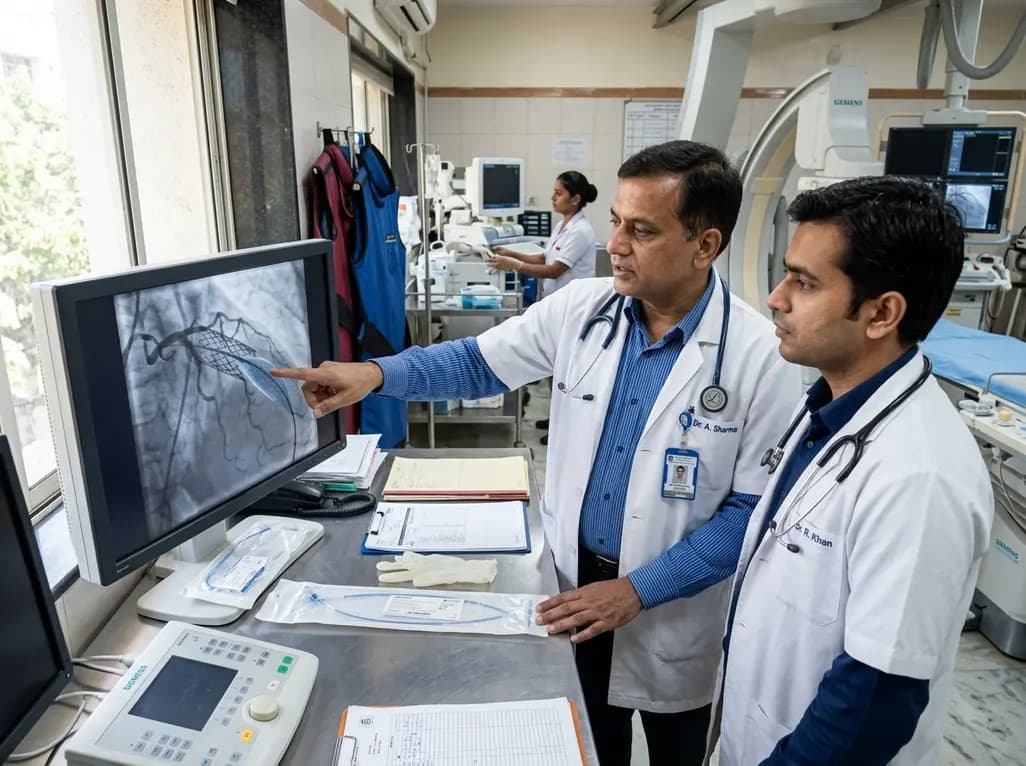
The US FDA has granted approval to the SELUTION SLR drug-eluting balloon for treating coronary in-stent restenosis. This milestone introduces a sustained-release sirolimus platform that eliminates the need for additional permanent metallic stents while maintaining robust vascular healing and luminal patency.
Today

Fetal foramen ovale restriction typically emerges in the third trimester with right heart enlargement. Evidence demonstrates it does not independently mandate cesarean delivery, and over 93% of postnatal cardiac findings resolve spontaneously within one year, supporting conservative obstetric management.
Today

The latest WHO Global Health Estimates highlight India's life expectancy reaching 71 years alongside a healthy lifespan of 60.6 years. While longevity rebounds post-pandemic, non-communicable conditions now account for three-quarters of top mortalities, underscoring urgent clinical shifts in routine primary care.
Today

The Thumbs-Out Classification (TOC) is a reliable screening tool for detecting thumb-in-palm deformity in children with cerebral palsy. Utilizing traffic-light tiers for radial abduction, TOC enables clinicians to monitor upper limb function and initiate timely therapeutic or surgical interventions.
Today

A comprehensive review analyzes periconceptional GLP-1 receptor agonist exposure, revealing reassuring data on congenital anomalies and adverse perinatal outcomes while emphasizing the need for cautious patient counseling.
Today
