.webp&w=384&q=75)

Loading, please wait...
Loading, please wait...
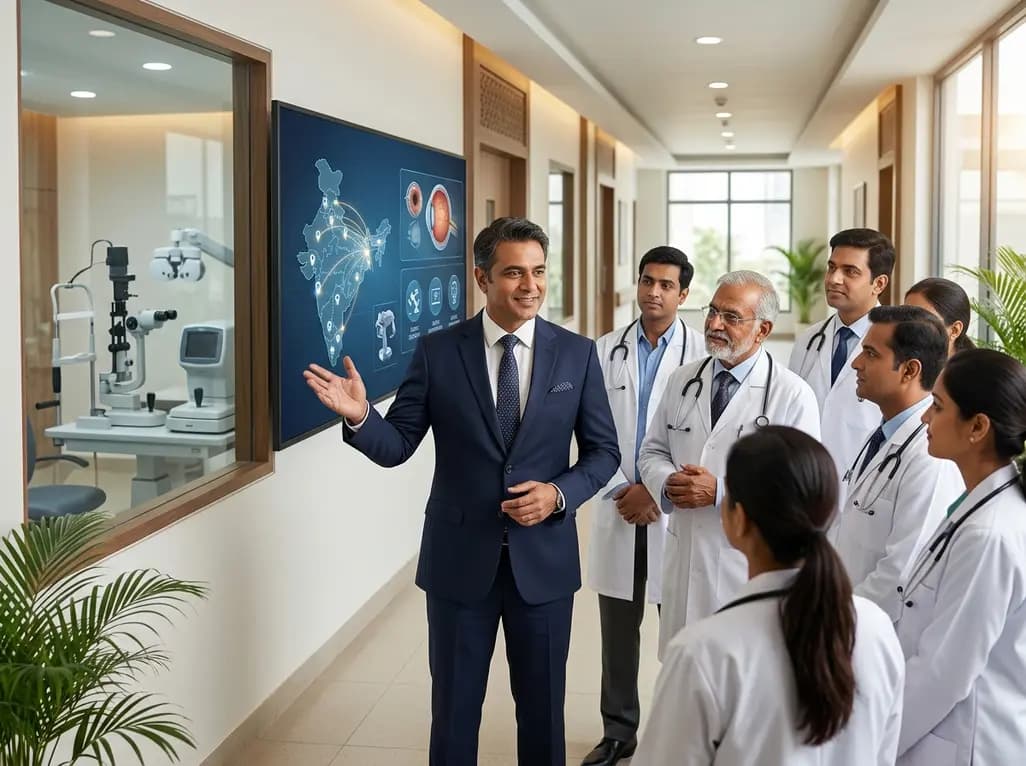
Maxivision Super Speciality Eye Hospitals recently announced a significant leadership transition to support its nationwide expansion goals. The prominent healthcare network has elevated its former Group Chief Financial Officer, Badrinarayan Srikanth, to the position of Maxivision Group CEO. This strategic progression reflects the organization's focus on professional administration and robust operational management. By placing an experienced strategist at the helm, the network intends to accelerate geographical expansion while maintaining clinical excellence. Indian ophthalmologists and healthcare executives closely follow these corporate movements. Leadership decisions directly impact regional eye care delivery.
Maxivision Super Speciality Eye Hospitals clarified that the elevation of Badrinarayan Srikanth represents a deliberate advancement for the business. Specifically, the board believes his deep operations and fiscal management expertise will steer the company forward. Srikant brings over twenty years of professional experience, including more than fifteen years in financial leadership roles. Consequently, his appointment aligns with the organization's efforts to expand its network across multiple Indian states. Dr. G.S.K. Velu, Chairman of Maxivision, expressed strong confidence in Srikanth’s leadership capabilities and strategic approach. Furthermore, the chairman emphasized that Srikanth’s profound understanding of the business makes him the right person to guide the company. Dr. Kasu Prasad Reddy founded the chain in 1996 to deliver affordable, high-quality eye care. Currently, the company operates over sixty hospitals and thirty vision centers in south and west India. Therefore, Srikanth will oversee a massive infrastructure that serves thousands of patients. This leadership change marks a pivotal moment. The network aims to strengthen its clinical footprint and enhance regional accessibility. This objective will remain central during his tenure. Additionally, he will focus on improving clinical infrastructure to drive the highest standards of safety. Ultimately, these measures will create a more resilient and efficient healthcare model for patients in every region.
Transitioning from a Chief Financial Officer to a Chief Executive Officer is an increasingly common trend in modern healthcare management. Historically, clinical heads managed medical facilities. However, complex operations require specialized administrative skills. Srikanth's journey at Maxivision country-wide network exemplifies this transition. He previously managed the company's financial strategy before taking the top executive role. In addition, his background as a Chartered Accountant provides him with unique analytical tools to evaluate operational efficiency. Healthcare organizations frequently struggle to balance quality patient care with financial sustainability. Fortunately, an executive who understands both balance sheets and clinical workflows can bridge this gap effectively. Moreover, Srikanth's previous tenure as CFO ensures a seamless transition without the typical friction associated with external hires. Ultimately, this internal promotion ensures continuity in strategic planning and maintains momentum for ongoing initiatives. As a result, the hospital chain can avoid operational disruptions and focus entirely on expanding its clinical services. By trusting an insider with deep financial knowledge, Maxivision positions itself for steady growth in a competitive market. Consequently, industry experts watch this leadership transition with great interest. Indeed, many believe it sets a clear precedent.
Maxivision operates over sixty hospitals and thirty vision centers across six major states in South and West India. Under the new leadership, the company plans to rapidly scale up its operations. For instance, the network is investing heavily in states like Gujarat, Kerala, and Tamil Nadu. Specifically, they aim to open new centers to tap into rising demand for advanced ophthalmic care. Additionally, this geographical expansion requires substantial capital and complex logistical planning. Therefore, Srikanth's financial acumen will play a critical role in allocating resources efficiently. He must balance the high costs of setting up super-speciality facilities with the goal of keeping care affordable. Furthermore, the organization aims to form strategic joint ventures with successful local doctors. In contrast to purely corporate expansions, this collaborative model leverages local medical expertise while providing corporate backing. Subsequently, the network can establish a trusted presence in new cities much faster. Ultimately, these expansion efforts will bring state-of-the-art diagnostic and surgical technologies to underserved regions. Patients in tier-two and tier-three cities will benefit immensely from having access to premium eye care closer to home.
An eye care network's success depends on consistent, high-quality patient outcomes. However, maintaining these standards across ninety locations remains challenging. To address this, the leadership plans to standardize operational protocols across the entire group. Moreover, they will invest in staff training programs to ensure uniform patient care. Specifically, front-desk interactions, diagnostic workflows, and post-operative follow-ups will undergo rigorous refinement. As a result, patients will experience the same premium service regardless of which hospital they visit. In addition, the organization plans to utilize advanced healthcare IT systems to streamline clinical data management. This technological integration allows ophthalmologists to access patient history instantly, reducing diagnostic errors. Consequently, clinics can handle higher patient volumes without compromising safety or care quality. Indeed, Dr. Kasu Prasad Reddy’s original vision focused heavily on combining patient-centric care with extreme affordability. By optimizing clinical operations, Srikanth intends to honor this legacy while driving business profitability. Ultimately, this balanced approach ensures that the hospital chain remains a preferred choice for families seeking reliable vision correction and eye disease management. Additionally, the administrative team will work closely with clinical directors.
Modern ophthalmology relies on cutting-edge technology to deliver precise surgical outcomes. To maintain its competitive edge, Maxivision consistently integrates advanced ophthalmic platforms across its centers. For instance, several of their premier hospitals feature state-of-the-art robotic cataract surgery systems. In addition, they utilize high-precision lasers like SMILE 800 and Contura Vision for refractive surgeries. These technologies allow surgeons to perform complex procedures with remarkable accuracy and shorter recovery times. However, procuring such advanced equipment requires substantial capital investments and long-term financial planning. Consequently, Srikanth's background as CFO will prove invaluable in managing these heavy equipment acquisitions. Specifically, he can negotiate favorable procurement terms and secure financing models that preserve company liquidity. Furthermore, the network is investing in specialized diabetic retinopathy and pediatric ophthalmology clinics. By equipping these clinics with advanced diagnostic tools, the hospital chain can identify silent eye diseases much earlier. Ultimately, this technological focus benefits patients who receive world-class treatment without traveling to major metropolitan hubs. Through smart capital allocation and strategic tech adoption, the organization will continue to lead the Indian eye care market. Indeed, ophthalmologists in these centers can provide safer interventions and achieve highly predictable results for their patients.
Q1: Why did Maxivision Super Speciality Eye Hospitals appoint Badrinarayan Srikanth as its Group CEO?
Maxivision elevated Badrinarayan Srikanth because of his extensive financial leadership and deep expertise in healthcare operations. Having served as the Group Chief Financial Officer, he possesses an intimate understanding of the company's fiscal management and business structures. Therefore, the board selected him to guide the hospital chain through its next critical phase of regional expansion, network optimization, and patient care enhancement across India.
Q2: What is Badrinarayan Srikanth's professional background prior to becoming Group CEO?
Badrinarayan Srikanth is a Chartered Accountant and a highly seasoned finance professional. Specifically, he boasts over twenty years of total experience, with more than fifteen years spent in senior financial leadership roles. Before his tenure at Maxivision as CFO, he managed financial operations and capital strategy at prominent healthcare networks like SPARSH Hospital, Starcare Hospital, and Kauvery Hospital. Consequently, he has deep expertise in managing complex hospital networks.
Q3: How many facilities does the Maxivision Eye Hospitals network currently operate?
Dr. Kasu Prasad Reddy founded the eye care network in 1996. Today, Maxivision Super Speciality Eye Hospitals operates over sixty hospitals and thirty vision centers. These facilities are strategically spread across six Indian states in the south and west. Furthermore, under Srikanth’s new executive leadership, the network plans to aggressively expand its presence into other key states, including Gujarat, Kerala, and Tamil Nadu.
Disclaimer: This content is for informational and educational purposes only. It does not constitute medical advice or replace professional judgment. Refer to the latest local and national guidelines for clinical practice.
References

Read summarized clinical updates, watch expert medical content, and earn CME certifications right from your smartphone.
Open your smartphone camera to scan and install.





Maxivision Super Speciality Eye Hospitals has elevated Badrinarayan Srikanth from Group CFO to Group CEO. With over 20 years of experience, Srikanth will steer the eye care network's next phase of expansion and technological advancement across India.
3 months ago

As monsoon seasons elevate arboviral disease threats, Tamil Nadu has initiated an ICMR-monitored evaluation of the tetravalent dengue vaccine in Tenkasi district. Clinicians emphasize clinical monitoring, public prevention, and high-quality early pediatric care to reduce disease morbidity across endemic regions.
Today

Leucine Rich Bio has introduced South Asia's first comprehensive vaginal microbiome test, BugSpeaks. By profiling microbial dysbiosis, pathogens, and antimicrobial resistance, this next-generation diagnostic platform provides clinicians with deeper insights into recurrent infections, fertility, and reproductive health.
Today

Review how tailored exercise programs benefit frail older patients with heart failure. Explore pathophysiological mechanisms, individualized training prescriptions, and strategies to overcome adherence barriers in clinical practice.
Today

This comparative study evaluates posterior labral tears with and without glenohumeral instability, highlighting distinct demographic patterns, MRI underestimation in stable shoulders, and successful arthroscopic repair outcomes.
Today

A clinical study demonstrates that early intervention with tocilizumab, either as monotherapy or bridged with corticosteroids, achieves significant proptosis reduction and resolves active inflammation in treatment-naive thyroid eye disease.
Today
