.webp&w=384&q=75)

Loading, please wait...
Loading, please wait...

The Maharashtra government recently announced the establishment of a Special Task Force (STF) to launch a state-wide crackdown on unauthorized medical clinics. Consequently, the state plans to target both unlicensed sonography clinics and illegal IVF centres to prevent patient exploitation. Public Health Minister Prakash Abitkar highlighted these plans in the state legislative assembly. Furthermore, the government is considering bringing these serious violations under the stringent Maharashtra Control of Organised Crime Act (MCOCA). This legislative shift highlights the severe nature of unregulated reproductive medicine and diagnostic practices.
The proposed task force will conduct comprehensive inspections across all districts to identify unaccredited operations. Many of these unauthorized centres operate without proper licensing or qualified personnel. Therefore, the STF aims to regulate assisted reproductive technology (ART) and prenatal diagnostic procedures effectively. This move responds directly to rising concerns regarding unethical medical procedures. For instance, recent investigations exposed complex rackets that repeatedly exploited vulnerable women for egg extraction. Consequently, the new task force will strictly monitor compliance with national fertility laws and safety standards.
Recent criminal investigations in Thane and Badlapur revealed the disturbing details of illegal egg-donation rings. In these rackets, unauthorized agents lured economically vulnerable women into undergoing multiple egg-retrieval cycles. Unlicensed practitioners administered repeated hormone injections and performed surgeries without medical supervision. These unauthorized practices pose severe risks to physical and mental health. Meanwhile, many sonography centres performed unprescribed scans to facilitate illegal gender determination.
These activities violate the Pre-Conception and Pre-Natal Diagnostic Techniques (PCPNDT) Act. To combat this, authorities are tightening diagnostic regulations. Therefore, the state government has directed medical councils to cancel the licenses of doctors involved in sex-selective practices. Additionally, officials are conducting extensive sting operations to catch violators in the act. The new Special Task Force will provide the necessary teeth to shut down these networks permanently. Consequently, hospitals must verify that their clinical staff hold proper credentials and that all diagnostic machinery is legally registered.
Medical practitioners in Maharashtra must understand that compliance with the PCPNDT Act is non-negotiable. Historically, prosecuting violators under this act has proven challenging due to poor documentation and technical errors. Therefore, the health department is implementing much stricter inspection protocols. All sonography clinics must update their records and submit Form F accurately for every scan performed. Failure to upload patient data on time will trigger immediate audits and potential clinic closure.
Furthermore, any participation in unauthorized egg donation or unapproved IVF procedures will lead to immediate license cancellation. The state has already suspended multiple medical licenses for serious ethical breaches. Healthcare facilities must ensure that their reproductive clinics fully comply with the Assisted Reproductive Technology (Regulation) Act, 2021. Consequently, doctors must educate their patients about the risks of unlicensed clinics. By maintaining high standards of clinical documentation and transparency, registered facilities can help dismantle the market for illegal IVF centres and illicit diagnostic services.
Beyond regulatory crackdowns, the Maharashtra government is actively addressing the critical staff shortages in rural healthcare. Public Health Minister Prakash Abitkar announced the recruitment of 1,400 new doctors to fill vacant posts. This massive recruitment drive coincided with National Doctors' Day to emphasize the importance of medical professionals. Additionally, the government has promised to release the pending allowances for ASHA workers, Anganwadi helpers, and other frontline staff. These frontline workers provided critical services during the COVID-19 pandemic and deserve their overdue payments.
Furthermore, the state will prioritize funding for partially completed hospital projects in rural areas. Currently, several healthcare facilities are stalled due to a lack of resources. The government plans to increase allocations for Primary Health Centres (PHCs) to ensure they can adequately serve surrounding villages. These infrastructure improvements will help reduce the gap in healthcare access. Consequently, rural populations will have better access to legitimate, safe medical treatments. This reduction in service gaps will also discourage patients from seeking care at unauthorized, dangerous facilities.
The state legislative assembly also addressed the operational standards of blood banks across Maharashtra. Minister Prakash Abitkar clarified that blood banks must update their inventory daily on the designated portals. Specifically, real-time data must be uploaded to the e-RaktKosh portal and the State Blood Transfusion Council website. While some facilities occasionally delayed these updates, the minister confirmed that no patients suffered due to a lack of blood supply. Additionally, there were no reported incidents of blood wasting due to delayed online logs.
To enforce compliance, the government continues to penalize negligent blood banks at a rate of Rs 1,000 per day. Over the past year, authorities collected over Rs 32 lakh in fines from non-compliant blood centres. Meanwhile, the government reiterated that all registered blood banks must provide blood free of cost to thalassaemia patients. This policy aligns with the central government's directives and a state circular from 2014. Consequently, healthcare administrators must monitor their blood bank operations carefully to avoid severe financial penalties and legal action.
Q1: Why is the Maharashtra government setting up a Special Task Force?
The government is establishing the Special Task Force to launch a rigorous state-wide crackdown on unauthorized sonography clinics and illegal IVF centres. This task force will conduct thorough inspections to identify and shut down clinics operating without proper licenses. Ultimately, this initiative aims to protect vulnerable patients from medical exploitation, prevent illegal gender-determination activities, and ensure strict compliance with health regulations.
Q2: What is the proposed legal penalty for operating unauthorized IVF or sonography clinics?
To deter offenders, the state is considering bringing these illegal operations under the Maharashtra Control of Organised Crime Act (MCOCA). This stringent law treats unauthorized clinical practices as organized syndicates, which can lead to severe criminal charges, significant prison sentences, and massive financial fines. The necessary legal provisions are expected to be introduced during the next legislative session.
Q3: How are blood banks in Maharashtra being regulated to ensure transparency?
Blood banks are mandatorily required to upload real-time stock details daily to the national e-RaktKosh portal and the Maharashtra State Blood Transfusion Council website. Violating facilities face a fine of Rs 1,000 per day. Furthermore, all government and private blood banks must provide blood free of cost to thalassaemia patients, ensuring equitable healthcare access.
Disclaimer: This content is for informational and educational purposes only. It does not constitute medical advice or replace professional judgment. Refer to the latest local and national guidelines for clinical practice.
References

Read summarized clinical updates, watch expert medical content, and earn CME certifications right from your smartphone.
Open your smartphone camera to scan and install.





In a major regulatory move, the Maharashtra government is establishing a Special Task Force (STF) to crack down on illegal IVF and sonography centres across the state. This initiative aims to protect patient safety and enforce strict compliance with reproductive health and diagnostic guidelines.
3 months ago
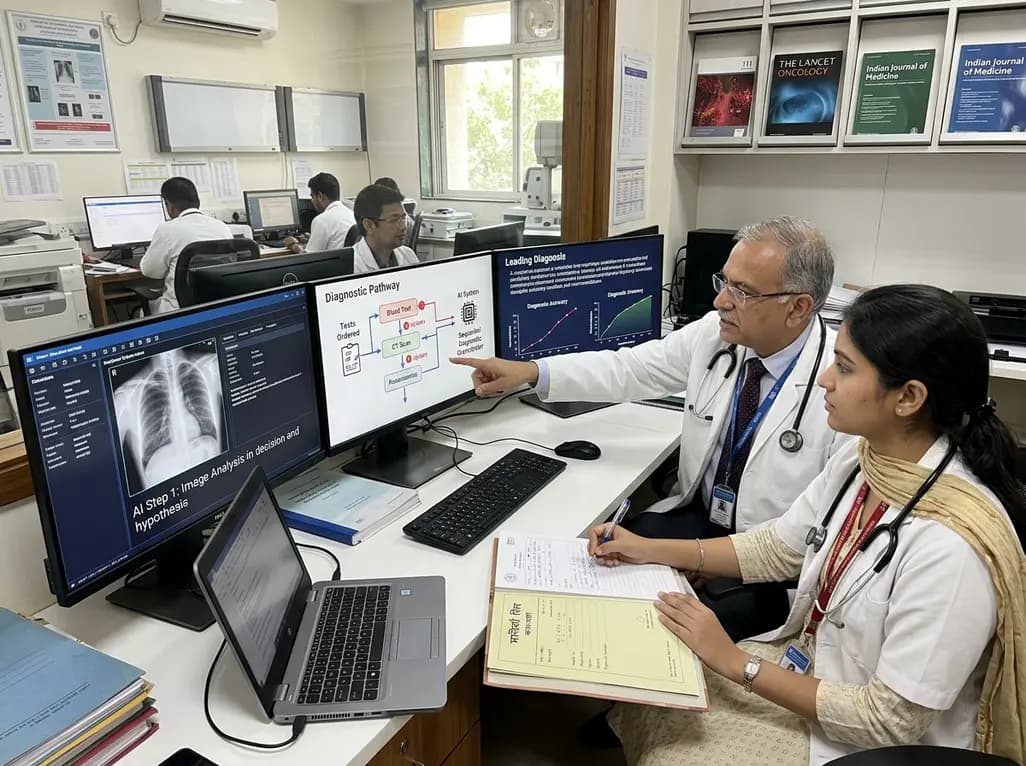
A breakthrough peer-reviewed study demonstrates that a sequential AI diagnosis system can mirror real-world clinical reasoning. By ordering stepwise tests and updating hypotheses dynamically, this multi-agent orchestrator achieved superior diagnostic accuracy while reducing investigative costs.
Today

A prenatal case highlights severe glutaric acidemia type II presenting as bilateral hyperechoic cystic kidneys at 18 weeks. Whole-exome sequencing revealed a novel homozygous ETFDH frameshift variant, demonstrating the power of rapid genetic testing in fetal renal anomalies.
Today

Review how tailored exercise programs benefit frail older patients with heart failure. Explore pathophysiological mechanisms, individualized training prescriptions, and strategies to overcome adherence barriers in clinical practice.
Yesterday

This comparative study evaluates posterior labral tears with and without glenohumeral instability, highlighting distinct demographic patterns, MRI underestimation in stable shoulders, and successful arthroscopic repair outcomes.
Yesterday

A clinical study demonstrates that early intervention with tocilizumab, either as monotherapy or bridged with corticosteroids, achieves significant proptosis reduction and resolves active inflammation in treatment-naive thyroid eye disease.
Yesterday
