.webp&w=384&q=75)

Loading, please wait...
Loading, please wait...
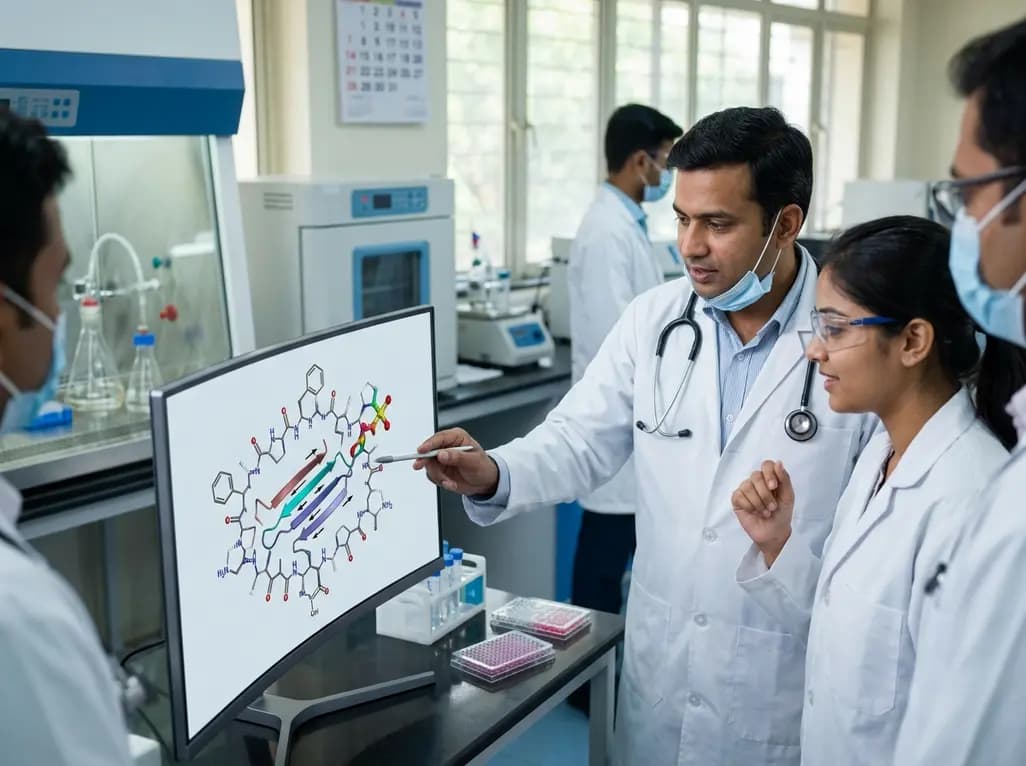
Designing stable protein secondary structures remains a significant challenge in synthetic biology. While β-hairpins are essential for biological functions, their sequence-dependent folding often complicates the creation of stable synthetic versions. Recently, researchers have made a breakthrough by developing macrocyclic β-sheet mimics using sulfonyl-γ-AAs as artificial β-turn inducers. This innovation allows for the creation of robust, well-folded structures that mimic natural antiparallel β-sheets.
Researchers utilize sulfonyl-γ-AAs (γ-substituted-N-sulfonyl-N-aminoethyl amino acids) to drive stable conformations in macrocyclic peptides. Furthermore, single-crystal X-ray diffraction analysis of these molecules reveals that the sulfonamido moiety possesses an intrinsic curvature. Consequently, this curvature, combined with intramolecular hydrogen bonding, facilitates a β-turn-like conformation. This specific geometry enforces the formation of a folded β-sheet structure even in complex polyalanine sequences.
To confirm the stability of these macrocyclic β-sheet mimics, the study employed circular dichroism (CD) spectroscopy and 2D-NMR studies. The CD results showed characteristic signatures between 208-214 nm, which are consistent with robust β-sheet formations. Additionally, 2D-NMR data corroborated the solution structures with the findings from X-ray crystallography. These results establish sulfonyl-γ-AAs as versatile templates that can be used to engineer novel peptides with high structural integrity.
The ability to reliably induce β-sheet conformations opens new avenues in drug discovery. Many pathological processes, such as protein aggregation in neurodegenerative diseases or specific protein-protein interactions, involve β-sheet structures. Therefore, these mimics could serve as potent inhibitors or diagnostic tools. Furthermore, their stability makes them excellent candidates for biomaterials design and long-acting peptide therapeutics.
They are synthetic cyclic peptides designed to replicate the antiparallel β-sheet structures found in natural proteins, often used to study biological interactions or develop new drugs.
Sulfonyl-γ-AAs act as β-turn templates. They stabilize the peptide backbone through hydrogen bonding and the natural curvature of the sulfonamide group, ensuring the peptide folds into the desired β-sheet shape.
Scientists use a combination of X-ray crystallography to see the atomic arrangement, and CD spectroscopy or 2D-NMR to confirm the structure remains stable in liquid environments.
Disclaimer: This content is for informational and educational purposes only and does not constitute medical advice. It is intended for healthcare professionals to stay updated on pharmaceutical and biochemical research. Refer to the latest local and national guidelines for clinical practice.
References
1. Liu H et al. Sulfonyl-γ-AAs as Turn Templates Inducing β-Sheet Conformation in Macrocyclic Peptides. J Am Chem Soc. 2026 Jun 15. doi: 10.1021/jacs.6c05451. PMID: 42290461.
2. Fontaine J, Cai J. Sulfonyl γ-AApeptide tools for modulating biology. Methods Enzymol. 2024;698:247-262. doi: 10.1016/bs.mie.2024.04.021.
3. Sang P et al. α/Sulfonyl-γ-AApeptide foldamers mitigate Alzheimer's disease pathology by stabilizing transient helical domains in Aβ. Nat Commun. 2026;17(1):7307. doi: 10.1038/s41467-026-73075-3.
"
Read summarized clinical updates, watch expert medical content, and earn CME certifications right from your smartphone.
Open your smartphone camera to scan and install.





Researchers have identified sulfonyl-γ-AAs as powerful artificial β-turn inducers. These templates stabilize antiparallel β-sheet conformations in macrocyclic peptides, providing a robust framework for developing new peptidomimetics with significant potential in therapeutics and material science.
4 months ago

Novel diimide and hydrazone scaffolds, particularly compound #C4, synergistically reactivate latent HIV-1 when combined with JQ1 or PKC activators. Demonstrating donor-matched proviral transcription ex vivo and non-canonical signaling, these findings advance shock and kill strategies toward reservoir eradication.
Today

A comparative cohort study evaluates vNOTES vs TLH hysterectomy for benign conditions, demonstrating shorter operative duration, faster return to daily activities, and equivalent female sexual function scores without increased dyspareunia.
Today

Review how tailored exercise programs benefit frail older patients with heart failure. Explore pathophysiological mechanisms, individualized training prescriptions, and strategies to overcome adherence barriers in clinical practice.
Yesterday

This comparative study evaluates posterior labral tears with and without glenohumeral instability, highlighting distinct demographic patterns, MRI underestimation in stable shoulders, and successful arthroscopic repair outcomes.
Yesterday

A clinical study demonstrates that early intervention with tocilizumab, either as monotherapy or bridged with corticosteroids, achieves significant proptosis reduction and resolves active inflammation in treatment-naive thyroid eye disease.
Today
