.webp&w=384&q=75)

Loading, please wait...
Loading, please wait...

India currently faces a significant demographic shift as its total fertility rate drops below the replacement level of 2.1. Consequently, reproductive healthcare has emerged as a crucial national priority for clinicians and policymakers alike. Recent healthcare estimates indicate that nearly 3.5 crore couples across the country grapple with reproductive challenges. However, only 42 lakh individuals successfully receive appropriate clinical interventions. This vast disparity highlights an urgent need to expand IVF access in India so that couples can receive timely medical support. Furthermore, reproductive issues carry a severe emotional burden for families seeking specialized treatment.
Historically, reproductive policies in India prioritized population control rather than fertility management. As a result, clinical management of reproductive disorders remained largely neglected in public health programs. Today, changing lifestyles and socio-demographic factors contribute to rising rates of both female and male factor infertility. Conditions such as polycystic ovary syndrome, endometriosis, and tubal factor disorders affect millions of women nationwide. Meanwhile, male factor infertility accounts for a substantial proportion of clinical cases, yet remains widely underdiagnosed due to social stigma. Therefore, health advocates emphasize that infertility must be recognized as a core reproductive health condition. Integrating fertility care into mainstream clinical practice will help destigmatize diagnosis and ensure equitable care delivery across urban and rural regions.
To address structural barriers in reproductive healthcare, stakeholders recently released a landmark white paper titled \"Beyond the Burden of Infertility in India: Towards Reproductive Equity through Mission Fertility 2.1.\" Launched on World IVF Day during the 7th India IVF Summit, this policy document outlines strategic reforms to lower financial barriers for patients. Specifically, the paper advocates for establishing a dedicated fertility benefit package under Ayushman Bharat (PM-JAY). Such inclusion would provide critical financial protection for economically vulnerable families facing high out-of-pocket costs.
Additionally, the proposal urges immediate private insurance reforms to transform clinical accessibility. Most private health policies currently impose lengthy waiting periods or exclude assisted reproductive technologies altogether. Therefore, reducing mandatory waiting times and expanding standard coverage will significantly ease the financial burden on infertile couples. Furthermore, modernizing reimbursement structures under government schemes like the Central Government Health Scheme and Employees' State Insurance Corporation remains essential. Public sector undertakings must also update their employee medical benefits to include assisted reproduction. Moreover, state-specific financing initiatives in Goa, Sikkim, and West Bengal demonstrate that public-private partnerships can successfully expand clinical availability. By implementing these financial protections, policymakers can ensure that financial constraints do not prevent patients from building families.
Despite rapid advancements in reproductive technology, a wide gap remains between medical capabilities and clinical access. Science has progressed remarkably, yet public awareness has lagged behind. Consequently, couples often delay seeking clinical assistance until valuable reproductive years have passed. Clinical experts stress that early diagnosis and timely intervention directly improve outcomes in assisted reproduction. Therefore, expanding community-level education represents a vital strategy for improving overall reproductive health.
Specifically, front-line healthcare providers like Accredited Social Health Activists play an essential role in spreading awareness at the grassroots level. By training community workers, health systems can systematically screen couples and provide timely referrals to specialized centers. In addition, educational programs in schools and workplaces can normalize conversations around reproductive health and male factor infertility. Workplace wellness programs should also integrate employer-sponsored fertility benefits to support working professionals. Furthermore, clinical awareness campaigns must emphasize that both partners require comprehensive medical evaluation. Male factor issues contribute significantly to couple subfertility, yet social taboos frequently delay male testing. By fostering open communication and clinical education, healthcare systems can reduce diagnostic delays and help couples pursue evidence-based treatments much earlier in their reproductive journey.
Over the past three decades, assisted reproductive infrastructure in India has expanded dramatically. The country has grown from barely ten specialized fertility clinics in its early years to over five thousand centers today. However, geographical concentration in urban centers continues to limit equitable distribution. To establish sustainable health equity, leaders emphasize four fundamental pillars: awareness, availability, affordability, and assurance of ethical outcomes. Strengthening these pillars will directly improve IVF access in India for diverse patient demographics.
In addition, ethical governance and quality assurance remain non-negotiable standards for clinical practice. The implementation of the Assisted Reproductive Technology Regulation Act provides a legal framework to monitor procedures and protect patient safety. Nevertheless, clinicians themselves hold immense responsibility in delivering compassionate, patient-centered care. Leading obstetricians and gynecologists encourage practitioners to offer discounted or charitable treatments to socioeconomically disadvantaged couples whenever feasible. Moreover, public health authorities must collaborate with private fertility centers through structured public-private partnerships. Such collaborations can expand diagnostic facilities and low-cost cycles in district hospitals and tier-two cities. Consequently, establishing standardized protocols and affordable package rates will protect families from catastrophic health expenditures while maintaining rigorous quality standards across all facilities.
Achieving comprehensive reproductive equity requires coordinated action among clinicians, industry leaders, and policy advocates. The white paper serves as an actionable roadmap to embed fertility care into mainstream public health. Medical organizations such as the Indian Society for Assisted Reproduction and the Federation of Obstetric and Gynaecological Societies of India advocate for unified guidelines. Furthermore, public health advocates highlight that fertility management must no longer be treated as a luxury service.
Additionally, pharmaceutical and medical technology providers must join this national movement by driving innovation and affordability. Local production of quality gonadotropins, culture media, and diagnostic kits can lower overall cycle expenses. Meanwhile, clinical fellowship programs and ongoing medical education are essential to train young gynecologists and embryologists across emerging healthcare hubs. By strengthening technical expertise in tier-two and tier-three cities, health networks can bring advanced reproductive science closer to underserved communities. In addition, public health campaigns should continuously monitor treatment safety, registry reporting, and long-term clinical outcomes. Consequently, a collaborative ecosystem involving government agencies, medical societies, and industry leaders will create a sustainable model. Ultimately, these unified efforts will empower every couple to realize their dream of parenthood safely and affordably.
Q1: Why is there an urgent call to include IVF under Ayushman Bharat PM-JAY?
Infertility treatment imposes severe financial burdens on Indian families, with high out-of-pocket expenses driving many into catastrophic debt. Currently, fewer than ten percent of affected couples can afford assisted reproductive therapies. Including a dedicated fertility package under Ayushman Bharat PM-JAY would offer vital financial protection to economically vulnerable households. Consequently, this coverage would democratize reproductive healthcare and ensure that low-income couples gain equitable access to advanced fertility treatments across India.
Q2: How can employer-sponsored benefits improve access to fertility care?
Employer-sponsored fertility benefits integrate reproductive healthcare into standard workplace wellness programs. By providing medical coverage for diagnostic evaluations, ovulation induction, and assisted reproductive cycles, companies relieve financial stress for working professionals. Furthermore, corporate fertility policies foster supportive work environments, reduce social stigma, and encourage early medical consultation. Consequently, employer participation helps employees seek timely interventions without compromising their career goals or financial stability.
Q3: What role do ASHA workers play in expanding fertility awareness?
Accredited Social Health Activists serve as essential liaisons between rural communities and the formal healthcare system. By training ASHA workers on reproductive health, public health systems can promote early awareness, dispel common myths, and address social stigma around infertility. Furthermore, these front-line workers can identify struggling couples, emphasize male fertility evaluations, and facilitate timely referrals to district hospitals. Consequently, ASHA involvement dramatically improves community-level screening and diagnostic timelines.
Disclaimer: This content is for informational and educational purposes only. It does not constitute medical advice or replace professional judgment. Refer to the latest local and national guidelines for clinical practice.
References

Read summarized clinical updates, watch expert medical content, and earn CME certifications right from your smartphone.
Open your smartphone camera to scan and install.





A recent national white paper highlights the need for major policy changes, insurance reforms, and Ayushman Bharat coverage to make fertility care accessible and affordable in India. Experts urge public-private partnerships, male fertility focus, and workplace benefits to bridge the care gap.
2 months ago
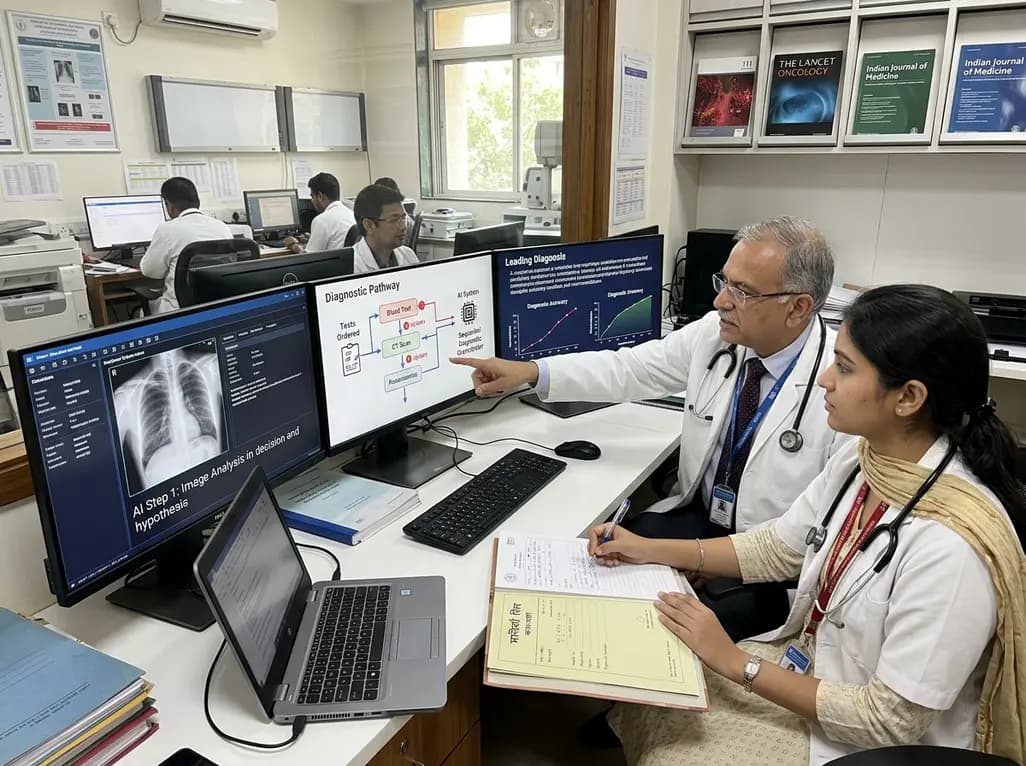
A breakthrough peer-reviewed study demonstrates that a sequential AI diagnosis system can mirror real-world clinical reasoning. By ordering stepwise tests and updating hypotheses dynamically, this multi-agent orchestrator achieved superior diagnostic accuracy while reducing investigative costs.
Today

A prenatal case highlights severe glutaric acidemia type II presenting as bilateral hyperechoic cystic kidneys at 18 weeks. Whole-exome sequencing revealed a novel homozygous ETFDH frameshift variant, demonstrating the power of rapid genetic testing in fetal renal anomalies.
Today

Review how tailored exercise programs benefit frail older patients with heart failure. Explore pathophysiological mechanisms, individualized training prescriptions, and strategies to overcome adherence barriers in clinical practice.
Yesterday

This comparative study evaluates posterior labral tears with and without glenohumeral instability, highlighting distinct demographic patterns, MRI underestimation in stable shoulders, and successful arthroscopic repair outcomes.
Yesterday

A clinical study demonstrates that early intervention with tocilizumab, either as monotherapy or bridged with corticosteroids, achieves significant proptosis reduction and resolves active inflammation in treatment-naive thyroid eye disease.
Yesterday
