.webp&w=384&q=75)

Loading, please wait...
Loading, please wait...

Union Health Minister Jagat Prakash Nadda recently inaugurated several digital initiatives to support India's preventive healthcare push. During the 10th National Summit on Innovation and Inclusivity, he launched the Swasth Bharat and JANANI platforms. These tools aim to reduce the administrative burden on frontline health workers. Consequently, they will improve public health delivery across the country.
The Swasth Bharat Portal serves as a unified digital interface for national health programs. It ensures interoperability through the Ayushman Bharat Digital Mission (ABDM). Moreover, it supports the secure exchange of patient records via ABHA health accounts. By consolidating multiple logins, the portal streamlines reporting for health professionals. Therefore, medical officers can focus more on patient care rather than paperwork.
The JANANI platform provides integrated care from pre-pregnancy to childhood. Specifically, it enables real-time tracking of maternal and neonatal data. This digital system helps identify high-risk pregnancies at an early stage. As a result, healthcare teams can provide timely interventions to reduce maternal mortality. Furthermore, the updated RBSK 2.0 guidelines expand screening for emerging childhood conditions. This lifecycle approach ensures that every child receives a healthy start in life.
India has already achieved significant milestones, such as becoming polio-free in 2014. Currently, the government is focusing on the rising burden of non-communicable diseases. To address this, over 1.85 lakh Ayushman Arogya Mandirs conduct large-scale screenings for diabetes and hypertension. Additionally, more than 50,000 facilities have secured National Quality Assurance Standards certification. This commitment to quality ensures that preventive services remain affordable and effective for all citizens.
Q1: What is the primary function of the Swasth Bharat Portal?
The Swasth Bharat Portal integrates various national health programs into a single digital interface. It reduces reporting burdens and links with the Ayushman Bharat Digital Mission for seamless data exchange.
Q2: How does the JANANI platform support pregnant women?
The JANANI platform tracks health data in real-time to identify high-risk pregnancies early. It ensures a continuous path of care from pre-pregnancy through the neonatal stage.
Q3: What are the key updates in the RBSK 2.0 guidelines?
RBSK 2.0 expands the scope of childhood health screenings. It now includes emerging non-communicable diseases and strengthens referral systems for early intervention.
Disclaimer: This content is for informational and educational purposes only. It does not constitute medical advice or replace professional judgment. Refer to the latest local and national guidelines for clinical practice.
References

Read summarized clinical updates, watch expert medical content, and earn CME certifications right from your smartphone.
Open your smartphone camera to scan and install.





India launches Swasth Bharat and JANANI platforms to boost preventive healthcare, maternal health tracking, and digital health integration nationwide....
5 months ago
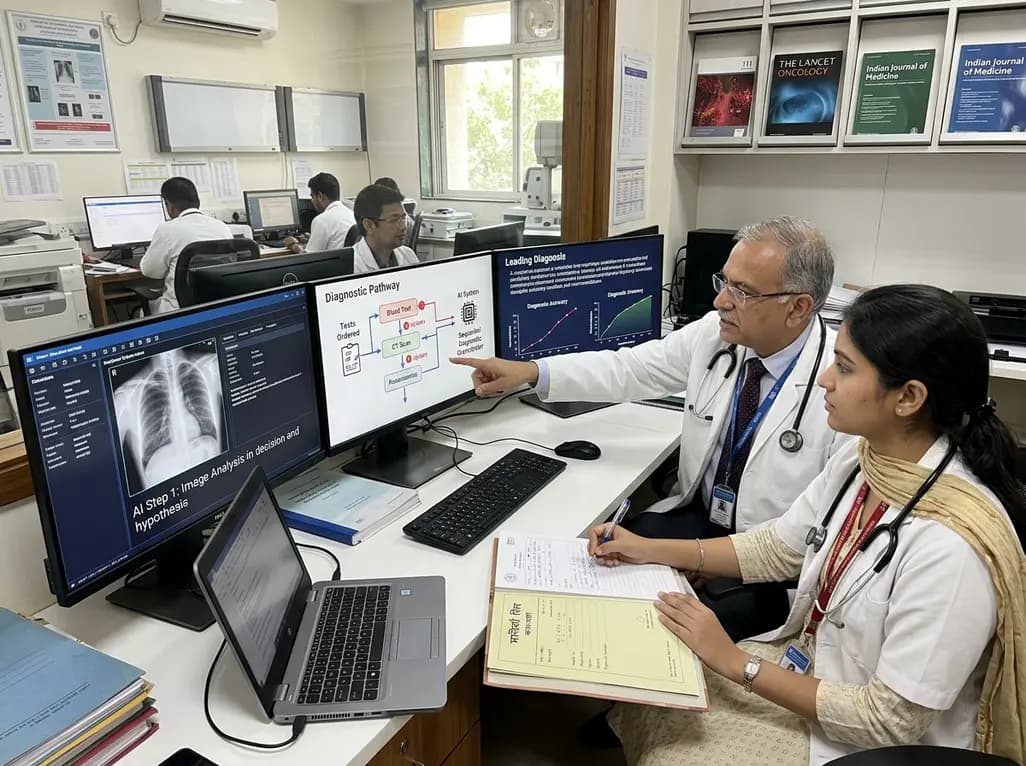
A breakthrough peer-reviewed study demonstrates that a sequential AI diagnosis system can mirror real-world clinical reasoning. By ordering stepwise tests and updating hypotheses dynamically, this multi-agent orchestrator achieved superior diagnostic accuracy while reducing investigative costs.
Today

A prenatal case highlights severe glutaric acidemia type II presenting as bilateral hyperechoic cystic kidneys at 18 weeks. Whole-exome sequencing revealed a novel homozygous ETFDH frameshift variant, demonstrating the power of rapid genetic testing in fetal renal anomalies.
Today

Review how tailored exercise programs benefit frail older patients with heart failure. Explore pathophysiological mechanisms, individualized training prescriptions, and strategies to overcome adherence barriers in clinical practice.
Yesterday

This comparative study evaluates posterior labral tears with and without glenohumeral instability, highlighting distinct demographic patterns, MRI underestimation in stable shoulders, and successful arthroscopic repair outcomes.
Yesterday

A clinical study demonstrates that early intervention with tocilizumab, either as monotherapy or bridged with corticosteroids, achieves significant proptosis reduction and resolves active inflammation in treatment-naive thyroid eye disease.
Yesterday
