.webp&w=384&q=75)

Loading, please wait...
Loading, please wait...

India hospital sector growth is entering a significant and sustained expansion phase. Consequently, listed hospital chains are shifting their strategic focus from profitability alone to volume-driven expansion. This transition follows years of rigorous financial consolidation and meticulous planning across the industry.
Several structural factors drive this massive expansion cycle. First, private insurance penetration is rising rapidly across the nation. Additionally, an ageing population and a growing burden of chronic diseases create persistent healthcare demand. Moreover, India faces an acute shortage of hospital beds. Currently, the nation provides only 1.3 beds per 1,000 people. This figure is well below the global median of 2.9 beds. Therefore, new capacity is essential to meet the growing patient needs.
Technology plays a pivotal role in this modern transformation. Hospitals are now rapidly adopting AI diagnostics and teleconsultation services. These digital tools improve clinical efficiency and significantly expand patient reach. Furthermore, medical tourism remains a vital revenue stream for major chains. High-margin treatments attract international patients to Indian facilities. Meanwhile, government schemes like Ayushman Bharat are broadening market access in smaller cities. These initiatives ensure that quality healthcare reaches tier-2 and tier-3 regions effectively.
Q1: Why is the Indian hospital sector expanding so rapidly?
The expansion is driven by an acute bed shortage and rising insurance coverage. Furthermore, increased per-capita income and an ageing population boost long-term demand for healthcare infrastructure.
Q2: How is AI impacting healthcare delivery in India?
AI improves diagnostic accuracy and overall operational efficiency. Additionally, it helps hospitals manage high patient volumes and enhances the quality of care through advanced medical analytics.
Disclaimer: This content is for informational and educational purposes only. It does not constitute medical advice or replace professional judgment. Refer to the latest local and national guidelines for clinical practice.
References

Read summarized clinical updates, watch expert medical content, and earn CME certifications right from your smartphone.
Open your smartphone camera to scan and install.





India's hospital sector enters a volume-driven growth cycle with massive capacity expansion and AI adoption, reshaping the private healthcare landscape by 2...
5 months ago

Review how tailored exercise programs benefit frail older patients with heart failure. Explore pathophysiological mechanisms, individualized training prescriptions, and strategies to overcome adherence barriers in clinical practice.
Today
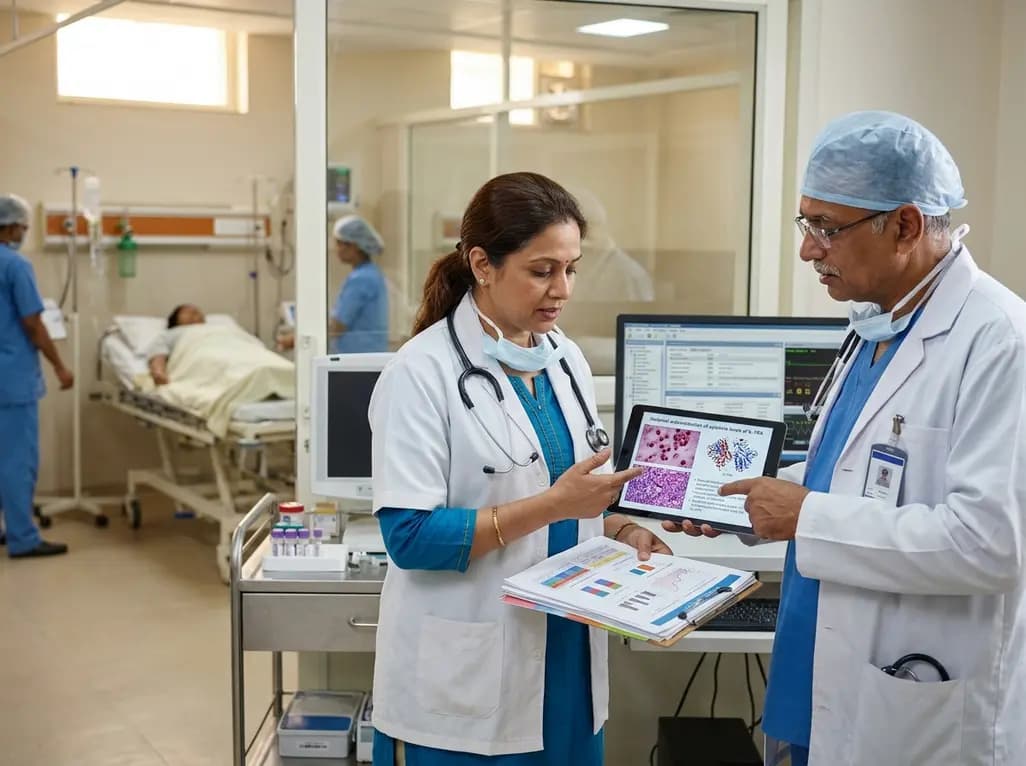
Recent clinical studies reveal maternal autoantibodies targeting IL-1RA as potential triggers for preterm labor, opening avenues for targeted cytokine therapies. Concurrently, new perioperative findings show inhaled cannabis increases propofol requirements during upper endoscopy compared to oral edible consumption.
Today

In high-risk pulmonary embolism complicated by severe anemia and active uterine bleeding, systemic thrombolysis is contraindicated. Large-bore aspiration thrombectomy provides rapid hemodynamic rescue without fibrinolysis, supported by inferior vena cava filter placement and multidisciplinary critical care.
Today

This comparative study evaluates posterior labral tears with and without glenohumeral instability, highlighting distinct demographic patterns, MRI underestimation in stable shoulders, and successful arthroscopic repair outcomes.
Today

A clinical study demonstrates that early intervention with tocilizumab, either as monotherapy or bridged with corticosteroids, achieves significant proptosis reduction and resolves active inflammation in treatment-naive thyroid eye disease.
Today
