.webp&w=384&q=75)

Loading, please wait...
Loading, please wait...

Managing advanced endometrial cancer requires a multidisciplinary approach. A recent study highlights the potential of using IGBT for endometrial cancer in patients with inoperable stage IVB disease. While palliative care is often the only route, findings suggest that image-guided brachytherapy (IGBT), with or without external-beam irradiation (EBRT), significantly improves survival for some. Therefore, clinicians should evaluate these local treatment options for patients showing good responses to initial chemotherapy.
The research analyzed outcomes for 11 patients diagnosed with FIGO 2009 stage IVB endometrial cancer. These patients were not candidates for palliative surgery. Among them, several patients exhibited metastases in locations such as the lungs, liver, and bone. Consequently, most patients underwent chemotherapy before starting radiation treatments. Five individuals achieved a complete response after systemic therapy. Nine patients received a combination of EBRT and IGBT, while two received IGBT as a standalone treatment. Throughout the follow-up period, the researchers monitored disease evolution and survival rates closely.
The clinical outcomes revealed surprisingly high survival rates for such an advanced stage. At two and three years, the overall survival (OS) reached 69.3%. Furthermore, the 5 and 10-year survival rates remained stable at 41.6%. These results indicate that local-regional control plays a vital role even in metastatic disease. However, patients who developed uterine or lymph node relapses faced poor prognoses. Consequently, doctors should prioritize this aggressive local strategy for those who respond well to chemotherapy. Future prospective trials including biological markers will help refine these therapeutic protocols.
IGBT for endometrial cancer provides precise, high-dose radiation to the tumor site. This helps achieve better local control, which is linked to improved overall survival in patients who have already responded well to systemic chemotherapy.
Patients with inoperable stage IVB disease who show a complete or good response to chemotherapy are the primary candidates. The treatment aims to consolidate the response and prevent local relapse.
In this specific series, patients achieved a 5-year overall survival rate of 41.6%. This is significantly higher than historical averages for stage IVB disease treated with palliative care alone.
Disclaimer: This content is for informational and educational purposes only. It does not constitute medical advice and is not intended to be a substitute for professional medical diagnosis, treatment, or clinical judgment. Refer to the latest local and national guidelines for clinical practice.
References

Read summarized clinical updates, watch expert medical content, and earn CME certifications right from your smartphone.
Open your smartphone camera to scan and install.





Analysis of IGBT outcomes in 11 patients with stage IVB endometrial cancer, showing a 41.6% 10-year survival rate for chemotherapy responders....
4 months ago
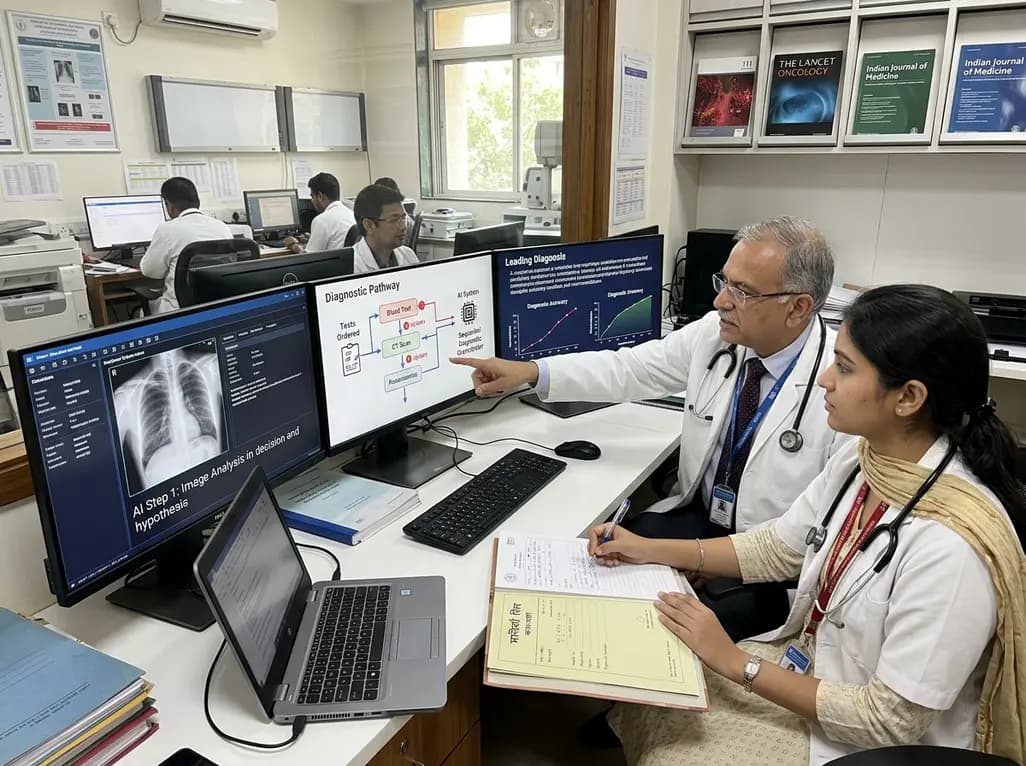
A breakthrough peer-reviewed study demonstrates that a sequential AI diagnosis system can mirror real-world clinical reasoning. By ordering stepwise tests and updating hypotheses dynamically, this multi-agent orchestrator achieved superior diagnostic accuracy while reducing investigative costs.
Today

A prenatal case highlights severe glutaric acidemia type II presenting as bilateral hyperechoic cystic kidneys at 18 weeks. Whole-exome sequencing revealed a novel homozygous ETFDH frameshift variant, demonstrating the power of rapid genetic testing in fetal renal anomalies.
Today

Review how tailored exercise programs benefit frail older patients with heart failure. Explore pathophysiological mechanisms, individualized training prescriptions, and strategies to overcome adherence barriers in clinical practice.
Yesterday

This comparative study evaluates posterior labral tears with and without glenohumeral instability, highlighting distinct demographic patterns, MRI underestimation in stable shoulders, and successful arthroscopic repair outcomes.
Yesterday

A clinical study demonstrates that early intervention with tocilizumab, either as monotherapy or bridged with corticosteroids, achieves significant proptosis reduction and resolves active inflammation in treatment-naive thyroid eye disease.
Yesterday
