.webp&w=384&q=75)

Loading, please wait...
Loading, please wait...
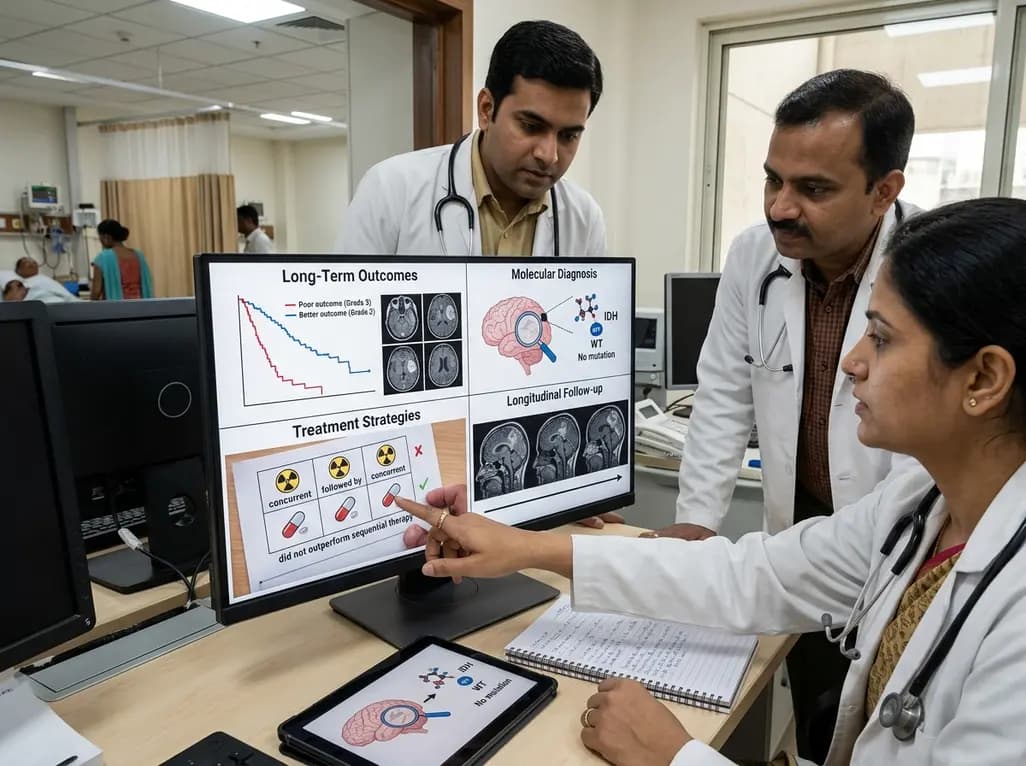
Diffuse gliomas present significant therapeutic challenges due to their biological diversity and variable clinical trajectories. The management of IDH-wildtype gliomas has evolved dramatically following recent updates to the World Health Organization classification of central nervous system tumors. Historically, neuro-oncologists categorized diffuse gliomas primarily by histopathological features, separating them into lower-grade astrocytomas and grade 4 glioblastomas. However, contemporary molecular diagnostics have revealed that many tumors historically classified as WHO grade 2 or 3 exhibit molecular features identical to glioblastoma, such as TERT promoter mutations or EGFR amplification. Despite this reclassification as molecular glioblastoma, real-world clinical outcomes and optimal therapeutic strategies for historical lower-grade IDH-wildtype tumors remain incompletely defined. Practitioners often struggle to determine whether aggressive glioblastoma-style therapy is immediately necessary for all patients with lower histologic grades. Understanding long-term outcomes in contemporary cohorts is critical for refining risk stratification and clinical management. This review explores recent cohort data assessing survival patterns and treatment intensity in adults diagnosed with historical WHO grade 2 and grade 3 IDH-wildtype tumors.
The shift toward integrated diagnosis has fundamentally transformed how clinicians approach diffuse brain tumors. Historically, histologic grading relied on microscopic features including nuclear atypia, mitotic figures, and vascular proliferation. In the current diagnostic paradigm, the absence of IDH mutations places these tumors in the IDH-wildtype category. Consequently, tumors lacking overt histological glioblastoma features are frequently reclassified based on genomic profiling. Researchers recently evaluated long-term outcomes in a contemporary cohort of 134 adult patients diagnosed with historical grade 2 and grade 3 IDH-wildtype tumors. To ensure diagnostic accuracy and account for noncanonical IDH mutations, investigators performed subgroup analyses in patients aged 55 or older and those receiving next-generation sequencing. Over a median follow-up period of 29.8 months, median overall survival reached 35 months, while median progression-free survival was 20.9 months. These overall findings demonstrate that while IDH-wildtype status portends aggressive behavior compared to IDH-mutant gliomas, substantial clinical heterogeneity exists within historical lower-grade categories. Clinicians must look beyond binary molecular labels to evaluate individual prognostic factors influencing overall clinical trajectories.
A central finding from long-term observational data is the pronounced survival discrepancy between historical grade 2 and grade 3 IDH-wildtype tumors. Patients presenting with grade 2 histology demonstrated significantly superior outcomes compared to those with grade 3 histology. Specifically, median overall survival reached 94.5 months in grade 2 tumors compared to 29.8 months in grade 3 tumors. Progression-free survival mirrored this divergence, with median values of 50.6 months for grade 2 disease versus 15.3 months for grade 3 disease. These findings indicate that histopathological grade remains a powerful independent prognostic marker, even within molecularly defined IDH-wildtype cohorts. While grade 3 IDH-wildtype tumors display aggressive behavior highly comparable to classic glioblastoma, a distinct subset of grade 2 tumors achieves prolonged, multi-year survival. Therefore, assuming uniform rapid progression for every lower-grade IDH-wildtype lesion may lead to overestimation of early disease mortality. Clinicians should recognize that microscopic differentiation still offers valuable prognostic insights alongside molecular testing, allowing neuro-oncology teams to counsel patients more accurately regarding long-term disease trajectories.
The standard management for high-grade IDH-wildtype glioblastoma typically involves maximal safe surgical resection followed by concurrent chemoradiation with temozolomide and adjuvant chemotherapy. However, whether historical grade 3 IDH-wildtype tumors require this maximal upfront treatment intensity remains a topic of active clinical debate. Investigators evaluated treatment patterns among patients with grade 3 tumors to assess whether concurrent chemoradiation conferred a measurable benefit over sequential therapy. In the analyzed cohort, patients receiving sequential radiation therapy and chemotherapy achieved a median overall survival of 29.8 months. Remarkably, patients treated with concurrent chemoradiation followed by chemotherapy experienced an identical median overall survival of 29.8 months, with no statistically significant difference between approaches. Furthermore, median progression-free survival remained comparable between treatment arms. These findings suggest that concurrent chemoradiotherapy does not automatically confer a survival advantage over sequential treatment in historical grade 3 IDH-wildtype gliomas. Consequently, clinicians may reconsider routine escalation of treatment intensity for every patient. Selecting sequential therapy could preserve quality of life and minimize acute toxicity without compromising overall survival in carefully selected individuals.
Accurate prognostic stratification in IDH-wildtype gliomas requires comprehensive genomic profiling to exclude false-negative IDH mutation status. Standard immunohistochemistry targeting the IDH1 R132H variant can miss rarer noncanonical mutations, particularly in younger adults. In the cohort analysis, targeted subgroup evaluations utilizing next-generation sequencing ensured that true IDH-wildtype biology was confirmed. Furthermore, secondary molecular alterations such as MGMT promoter methylation status, TERT promoter alterations, and EGFR copy number changes play pivotal roles in determining treatment response and overall prognosis. Although molecular classification rightfully groups historical lower-grade IDH-wildtype tumors under molecular glioblastoma, variable clinical outcomes highlight the influence of underlying tumor biology and patient characteristics. Factors such as patient age, performance status, extent of surgical resection, and specific molecular signatures interact to shape survival outcomes. Clinicians must integrate these multifaceted data points when formulating individual treatment plans. Relying solely on histological grade or single molecular markers is insufficient; instead, a comprehensive composite evaluation allows neuro-oncology teams to balance aggressive tumor control with preservation of neurological function and long-term quality of life.
The findings from long-term outcome studies provide important actionable guidance for practicing oncologists and neurologists. First, clinicians should maintain a nuanced view of prognosis when diagnosing historical grade 2 IDH-wildtype gliomas. Because a subset of these patients achieves prolonged survival exceeding seven years, treatment strategies should be personalized rather than automatically adopting hyper-aggressive protocols. Second, for patients with grade 3 IDH-wildtype tumors, the lack of significant survival superiority with concurrent chemoradiation over sequential therapy supports re-evaluating routine treatment intensity. In patients at higher risk for chemoradiation toxicity or those with significant comorbidities, sequential radiation followed by chemotherapy represents a viable and effective strategy. Third, thorough molecular testing including next-generation sequencing remains mandatory to prevent misclassification and guide targeted therapy selection. Multidisciplinary brain tumor boards should carefully review histopathological details, extent of resection, and molecular markers prior to finalizing adjuvant treatment plans. By combining molecular diagnostics with traditional histological grading, clinical teams can deliver optimized, patient-centered care that maximizes survival while safeguarding functional independence.
An IDH-wildtype glioma is a diffuse astrocytic tumor lacking mutations in the IDH1 and IDH2 genes. Under current CNS classification guidelines, historical grade 2 or 3 tumors exhibiting specific molecular features, such as TERT promoter mutations or EGFR amplification, are classified as molecular glioblastoma due to their aggressive clinical potential.
Grade 2 IDH-wildtype gliomas demonstrate significantly longer overall survival compared to grade 3 tumors, reaching a median of 94.5 months versus 29.8 months. Similarly, progression-free survival is markedly higher in grade 2 disease, indicating that historical histological grade remains a crucial independent prognostic factor despite shared molecular features.
Recent clinical evidence demonstrates that concurrent chemoradiation followed by chemotherapy does not confer a statistically significant survival advantage over sequential radiation and chemotherapy in grade 3 IDH-wildtype tumors, with both strategies yielding a median overall survival of 29.8 months. This supports re-evaluating aggressive treatment intensity in selected patients.
Disclaimer: This content is for informational and educational purposes only and does not constitute medical advice, diagnosis, or treatment. Refer to the latest local and national guidelines for clinical practice.
References

Read summarized clinical updates, watch expert medical content, and earn CME certifications right from your smartphone.
Open your smartphone camera to scan and install.





Long-term data on IDH-wildtype gliomas with historical grade 2 and 3 histology reveal heterogeneous outcomes. Grade 3 tumors show survival similar to molecular glioblastoma, while grade 2 tumors exhibit prolonged survival. Concurrent chemoradiation did not outperform sequential therapy in grade 3 tumors.
2 months ago

As monsoon seasons elevate arboviral disease threats, Tamil Nadu has initiated an ICMR-monitored evaluation of the tetravalent dengue vaccine in Tenkasi district. Clinicians emphasize clinical monitoring, public prevention, and high-quality early pediatric care to reduce disease morbidity across endemic regions.
Today

A comparative cohort study evaluates vNOTES vs TLH hysterectomy for benign conditions, demonstrating shorter operative duration, faster return to daily activities, and equivalent female sexual function scores without increased dyspareunia.
Today

Review how tailored exercise programs benefit frail older patients with heart failure. Explore pathophysiological mechanisms, individualized training prescriptions, and strategies to overcome adherence barriers in clinical practice.
Today

This comparative study evaluates posterior labral tears with and without glenohumeral instability, highlighting distinct demographic patterns, MRI underestimation in stable shoulders, and successful arthroscopic repair outcomes.
Today

A clinical study demonstrates that early intervention with tocilizumab, either as monotherapy or bridged with corticosteroids, achieves significant proptosis reduction and resolves active inflammation in treatment-naive thyroid eye disease.
Today
