.webp&w=384&q=75)

Loading, please wait...
Loading, please wait...

The global healthcare landscape is evolving rapidly, and humanoid robots in geriatrics are emerging as a transformative tool for elderly care. A recent systematic scoping review published in JMIR Aging analyzed 59 articles to understand how these advanced machines support older adults. As the burden of care for the aging population grows, understanding the current evidence on robotic assistance is crucial for clinicians and healthcare administrators.
Using the Arksey and O'Malley framework, researchers identified four critical patterns within the literature. Firstly, studies explored the effects and perceptions of robotic interaction, often finding high acceptance among users. Secondly, the review highlighted specific preferences and facilitators, such as the robot's appearance and ease of use. Thirdly, implementation barriers, including technical malfunctions and systemic adoption challenges, were significant. Finally, the determinants of user experiences were analyzed to help guide future design and deployment. Moreover, the review found that 83% of these studies took place in real-world settings, providing practical insights into daily usage.
While the findings are promising, many studies face methodological constraints. Nearly 58% of the reviewed literature relied on small sample sizes of 25 or fewer participants. Furthermore, although many studies occurred in real-world settings, the practical integration of humanoid robots in geriatrics remains limited by technical readiness. Additionally, 46% of the research focused on participants with cognitive impairment, showing the technology's specialized potential. Consequently, successful adoption will require healthcare systems to address these technical gaps and systemic barriers to ensure that robots can effectively supplement human caregiving.
In the Indian context, where family-based care is traditional but social structures are shifting, robotic support could offer a vital safety net. Clinicians should stay informed about these developments to better advise families on emerging assistive technologies. Future research must focus on longitudinal studies with larger cohorts to validate the long-term impact on patient outcomes. Ultimately, addressing user acceptance and technical limitations will be key to unlocking the full potential of these machines.
Humanoid robots assist by providing consistent cognitive stimulation, managing medication reminders, and offering social interaction, which can reduce the behavioral and psychological symptoms associated with dementia.
The primary technical barriers include limited battery life, slow response times, difficulty navigating complex home environments, and the current inability to personalize interactions for individual patient needs.
No, these robots are designed to assist and support healthcare professionals by handling repetitive tasks and providing social engagement, allowing human caregivers to focus on more complex clinical responsibilities.
Disclaimer: This content is for informational and educational purposes only. It is not intended as a substitute for professional medical advice, diagnosis, or treatment. Always seek the advice of your physician or other qualified health provider with any questions you may have regarding a medical condition. Refer to the latest local and national guidelines for clinical practice.
References
Cui L et al. Humanoid Robot-Assisted Support for Health Care in Older Adults: Systematic Scoping Review. JMIR Aging. 2026 Mar 11. doi: 10.2196/83849. PMID: 41812215.
Abdi J, Al-Hindawi A, Ng T, Vizcaychipi MP. Social robots in health care for older adults: a review. Gerontology. 2018;64(3):281-292. doi: 10.1159/000481765.
Papadopoulos I, Koulouglioti C, Lazzarino R, Ali S. Enablers and barriers to the implementation of socially assistive humanoid robots in health and social care: a systematic review. BMJ Open. 2020 Jan 9;10(1):e033096. doi: 10.1136/bmjopen-2019-033096.

Read summarized clinical updates, watch expert medical content, and earn CME certifications right from your smartphone.
Open your smartphone camera to scan and install.





A systematic scoping review examines the role of humanoid robots in supporting healthcare for older adults, identifying key patterns and barriers to adoptio...
7 months ago
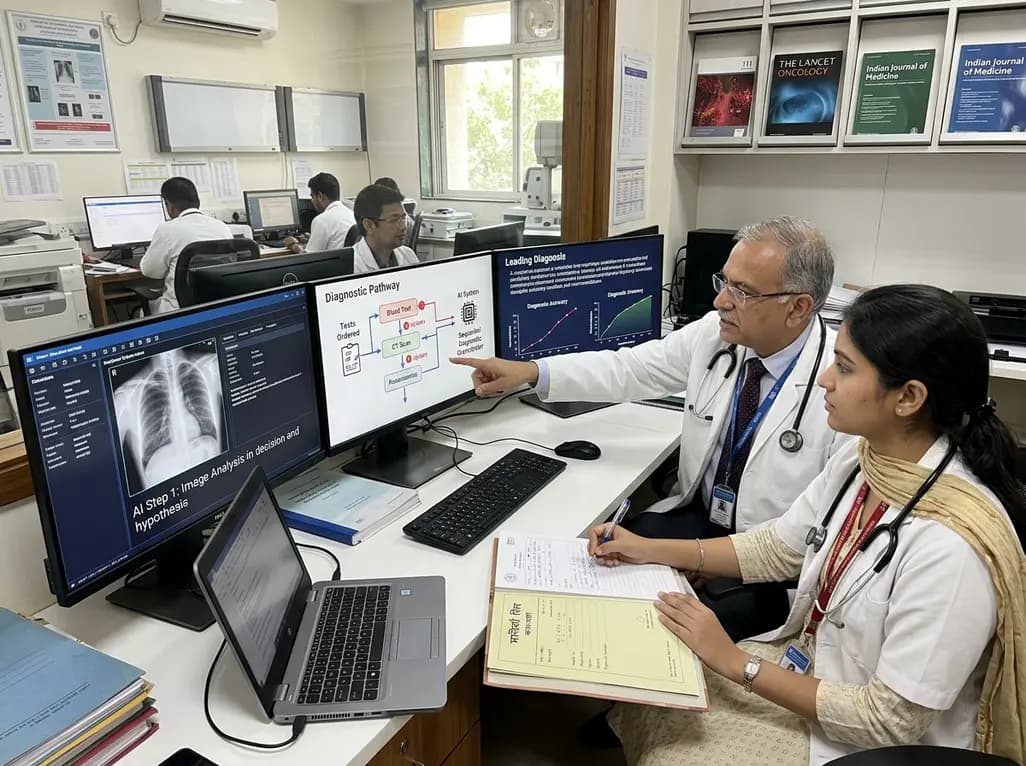
A breakthrough peer-reviewed study demonstrates that a sequential AI diagnosis system can mirror real-world clinical reasoning. By ordering stepwise tests and updating hypotheses dynamically, this multi-agent orchestrator achieved superior diagnostic accuracy while reducing investigative costs.
Today

A prenatal case highlights severe glutaric acidemia type II presenting as bilateral hyperechoic cystic kidneys at 18 weeks. Whole-exome sequencing revealed a novel homozygous ETFDH frameshift variant, demonstrating the power of rapid genetic testing in fetal renal anomalies.
Today

Review how tailored exercise programs benefit frail older patients with heart failure. Explore pathophysiological mechanisms, individualized training prescriptions, and strategies to overcome adherence barriers in clinical practice.
Yesterday

This comparative study evaluates posterior labral tears with and without glenohumeral instability, highlighting distinct demographic patterns, MRI underestimation in stable shoulders, and successful arthroscopic repair outcomes.
Yesterday

A clinical study demonstrates that early intervention with tocilizumab, either as monotherapy or bridged with corticosteroids, achieves significant proptosis reduction and resolves active inflammation in treatment-naive thyroid eye disease.
Yesterday
