

Loading, please wait...
Loading, please wait...

Public health agencies worldwide prioritize preventing human papillomavirus infections to curb cervical and other anogenital cancers. Recently, health officials implemented an extensive initiative offering an HPV vaccination catch-up opportunity for young adults aged 18 to 27 years. In the Netherlands, this campaign achieved a 24% completion rate among invited young adults. However, public responses on social networks highlighted significant informational gaps, vaccine hesitancy, and logistical obstacles. For Indian healthcare professionals leading cervical cancer elimination drives, understanding these online dynamics is vital. Analyzing digital dialogue helps clinicians address patient misgivings, dispel misinformation, and advocate prophylactic immunisation effectively.
Modern young adults routinely seek medical advice across digital channels like Instagram, Facebook, and X. Consequently, public health teams initiated manual social listening during the Dutch catch-up rollout to monitor online reactions. Investigators analyzed over 800 posts and 5,100 public comments to map dominant public themes. Interestingly, true malicious misinformation did not overwhelm the online discourse. Instead, open inquiry and authentic confusion represented the primary drivers of community discussion. Many users expressed uncertainty regarding the biological role of HPV in causing oncogenic lesions. Furthermore, comment sections frequently cited conflicting external sources, alternating between accredited health agencies and speculative commentary. Because online discourse directly shapes personal health choices, public health teams recognized an urgent need for proactive communication. Therefore, clinicians must realize that patient hesitancy frequently stems from educational voids rather than entrenched hostility toward vaccines. By proactively identifying these questions in daily practice, doctors can demystify viral transmission and foster therapeutic trust during adolescent and young adult clinical encounters.
The social listening investigation classified information deficits regarding vaccine effectiveness as a prominent high-risk theme. Specifically, many netizens questioned whether undergoing an HPV vaccination catch-up provides clinical utility once an individual has already initiated sexual activity. Individuals frequently assumed that prior viral exposure completely invalidates subsequent immunisation benefits. In response, physicians must articulate clear immunologic realities. First, nonavalent and quadrivalent vaccines safeguard against multiple oncogenic genotypes simultaneously. Even if a patient previously acquired one viral subtype, the vaccine prevents initial infection by remaining covered strains. Furthermore, the vaccine stimulates potent neutralising antibody titres that surpass natural infection immunity. Healthcare providers should also communicate that immunisation lowers recurrent dysplasia risks. However, clinicians must explain that prophylactic vaccines cannot treat or clear pre-existing cellular dysplasia. By addressing these nuances during consultation, clinicians empower young adults to make informed decisions. Consequently, timely counseling converts perceived ambivalence into proactive clinical uptake across hospitals, university clinics, and private practices.
Public commentary revealed significant apprehension concerning adverse event transparency and lingering post-pandemic vaccine skepticism. Many users demanded unfiltered disclosures regarding potential adverse reactions before receiving injections. Furthermore, societal fallout from the COVID-19 pandemic visibly eroded general vaccine confidence among young demographics. As a result, individuals frequently linked routine prophylactic vaccines with broader socio-political controversies. To combat this challenge, medical practitioners must avoid dismissive language when patients voice trepidation. Instead, clinicians should validate patient emotions while offering clear, evidence-based safety data. Providers should explain that transient local reactions like injection site soreness, low-grade fever, and mild dizziness remain typical, self-limiting manifestations of immune activation. Conversely, severe systemic adverse events remain exceptionally rare across hundreds of millions of recipients worldwide. Transparency regarding expected transient symptoms bolsters institutional credibility. Therefore, clinicians who candidly discuss expected mild reactions build stronger rapport. Ultimately, transparent clinical dialogue disarms pervasive skepticism and encourages young adults to accept vital oncologic protection without fear.
Beyond scientific skepticism, practical delivery barriers significantly influenced vaccine completion rates during the Dutch campaign. Specifically, social listening identified persistent complaints regarding restrictive service hours and distant vaccination centres. Many young working adults and university students encountered scheduling conflicts when attempting to attend regional sites. In addition, ambiguous communications regarding eligibility cut-offs and appointment booking systems fostered public frustration. These operational hurdles produced measurable attrition between first and subsequent booster doses. Public health experts therefore recommended diversifying administration avenues, expanding walk-in capacity, and lengthening evening operating schedules. For health administrators, eliminating logistical friction proves just as crucial as debunking medical misinformation. When healthcare systems simplify booking pathways and offer adaptable walk-in options, immunisation compliance escalates predictably. Moreover, digital mobile reminders and decentralized campus-based outreach drastically reduce missed appointments. Consequently, healthcare delivery systems must align clinical availability with the busy lifestyles of emerging adults to achieve optimal population coverage and sustain public health gains.
These European findings offer invaluable insights for Indian clinicians, gynaecologists, and public health authorities. Cervical cancer represents the second most frequent malignancy among Indian females, causing substantial annual mortality. While national initiatives actively expand adolescent vaccination through programs utilizing Cervavac and Gardasil, catch-up recommendations remain essential. The Federation of Obstetric and Gynaecological Societies of India specifically recommends catch-up vaccination for young adult women up to age twenty-six. However, Indian clinicians frequently encounter similar cultural hesitancy, parental taboos regarding sexually transmitted infections, and safety misconceptions. By adopting structured social listening techniques, Indian medical institutions can identify prevailing digital narratives across regional languages. Furthermore, primary care physicians should proactively initiate compassionate, non-stigmatizing conversations with young adult patients during routine visits. Practitioners must clearly decouple cancer prophylaxis from sexual activity taboos. Simultaneously, providers must remind patients that vaccination complements regular Pap smears and cervical screening rather than replacing them. Through sustained education and accessible community initiatives, India can accelerate progress toward eliminating cervical cancer nationwide.
Although health authorities prioritize HPV vaccination for adolescents aged nine to fourteen before sexual debut, catch-up programs offer vital defense for young adults. Even if individuals have encountered one HPV strain, vaccination protects against other oncogenic types included in polyvalent formulas. Furthermore, clinical trials confirm persistent immunogenicity in older age brackets. Therefore, offering catch-up immunisation significantly curtails persistent oncogenic infections, anogenital precancers, and cervical dysplasia across eligible young adults.
Clinicians must maintain transparency by discussing common, self-limiting reactions before administration. Specifically, practitioners should explain that transient injection-site discomfort, mild erythema, low-grade pyrexia, and minor headaches reflect normal immune activation. In addition, providers should reassure patients by contrasting these temporary events against extensive global safety data from hundreds of millions of distributed doses. Consequently, open dialogue dispels alarming online myths and builds confidence during adult catch-up consultations.
No, vaccination does not replace routine cervical screening. Although current nonavalent and quadrivalent vaccines shield against the highest-risk strains responsible for most malignancies, they do not prevent every oncogenic variant. Furthermore, older recipients might harbor pre-existing infections from past exposures. Therefore, professional medical societies, including FOGSI, advise that vaccinated women must strictly continue standard cervical cytology and HPV DNA screening protocols according to age-appropriate national guidelines.
Disclaimer: This content is for informational and educational purposes only and does not constitute medical advice. Healthcare professionals should exercise their independent clinical judgment, while patients should consult a qualified physician for individual healthcare needs. Refer to the latest local and national guidelines for clinical practice.
References
1. van der Werf EEMW et al. Social Media Insights Into the Human Papillomavirus Vaccination Catch-Up Campaign for Young Adults in the Netherlands, 2023-2024: Qualitative Study. JMIR Infodemiology. 2026 Nov 17. doi: 10.2196/73803. PMID: 43044099.
2. Federation of Obstetric and Gynecological Societies of India (FOGSI). Good Clinical Practice Recommendations for Screening and Management of Preinvasive Lesions of Cervix and HPV Vaccination. Mumbai: FOGSI; 2023.
3. World Health Organization. Human papillomavirus vaccines: WHO position paper (2022 update). Wkly Epidemiol Rec. 2022;97(50):645-672.

Read summarized clinical updates, watch expert medical content, and earn CME certifications right from your smartphone.
Open your smartphone camera to scan and install.





A qualitative study on the Dutch HPV vaccination catch-up campaign reveals that young adult hesitancy stems from information gaps and accessibility barriers rather than rampant misinformation. Clinicians can leverage these social listening insights to improve vaccine communication and address patient concerns.
Today
The FocUS-R study highlights the role of structural factors in stress management effectiveness. Findings reveal that while psychological flexibility supports coping, socioeconomic barriers significantly diminish its protective benefits, highlighting the need for equity-focused clinical and public health approaches.
Today
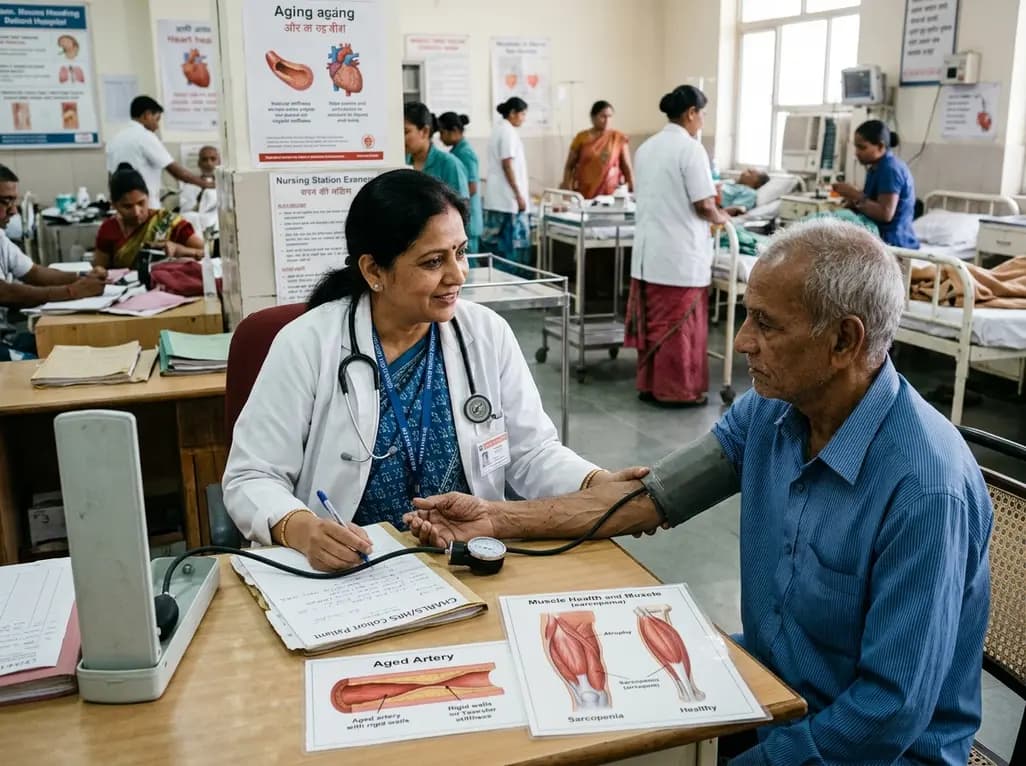
A multicenter longitudinal study of the CHARLS and HRS cohorts demonstrates that elevated cumulative pulse pressure and high-stable trajectories significantly increase incident sarcopenia risk in older adults, particularly in those with heart disease, linking arterial stiffness directly to progressive muscle loss.
Today

A 491-patient cohort study in Sudan reveals critical insights into war trauma reconstructive surgery, analyzing injury patterns, soft-tissue procedures, and a 25.5% complication rate in resource-limited conflict zones.
Today
A descriptive qualitative study reveals that dietary and exercise relapses in mHealth apps stem from stress, cultural misalignment, and emotional disengagement. Clinicians must champion flexible, relapse-responsive digital therapeutics that foster gentle reentry and sustained glycemic control.
Today
