.webp&w=384&q=75)

Loading, please wait...
Loading, please wait...

The rapid integration of digital tools in medicine has transformed how clinical systems operate. However, it has also increased the risk of medical misinformation. To address this challenge, Dr. Viduthalai Virumbi Balagurusamy has developed a state-of-the-art clinical platform. This system delivers verified healthcare intelligence by combining advanced artificial intelligence with rigorous clinical expertise. Consequently, it aims to strengthen preventive healthcare across India. Ultimately, this innovation bridges the critical gap between raw medical data and actionable clinical insights.
Historically, medical professionals have relied on standalone clinical databases and traditional textbooks for decision-making. However, the rise of generic online search tools and generative AI has complicated this landscape. Many patients now self-diagnose using unverified digital platforms. As a result, clinicians often face patients who possess misleading or dangerously inaccurate health information. Dr. Balagurusamy, an experienced Chennai-based epidemiologist, recognized this growing crisis. Therefore, he established the Honeybee Population Healthcare Foundation to create a safer clinical solution. This vision culminated in the development of the Healthcare Intelligence and Verification Engine, known as HIVE. Specifically, this platform functions as an advanced decision intelligence engine rather than a simple conversational chatbot. Unlike standard systems that merely scrape raw text from the internet, HIVE processes structured medical literature alongside localized clinical guidelines. Consequently, the tool provides structured, context-rich recommendations to clinicians and frontline staff. By doing so, the foundation hopes to establish a reliable digital registry that prioritizes absolute clinical accuracy. Ultimately, this approach safeguards the patient-provider relationship by ensuring that technology serves as a reliable ally rather than an unregulated source of medical advice.
Standard artificial intelligence tools typically generate conversational responses based on probabilistic text associations. On the other hand, the HIVE platform relies on a sophisticated verification framework that values clinical precision over speed. Specifically, the system integrates the treating physician's unique clinical judgment with real-time patient electronic health records. Furthermore, it validates every clinical suggestion against current national guidelines and published peer-reviewed medical literature. Consequently, the platform delivers verified healthcare intelligence that remains completely transparent, traceable, and tailored to the unique clinical realities of each patient. This clinical transparency helps eliminate the black-box effect commonly associated with consumer-facing AI applications. Moreover, it actively reduces the risk of delayed diagnoses and inappropriate self-medication by keeping doctors at the center of the therapeutic process. Clinicians can easily trace each recommendation back to its original scientific source or public health guideline. Accordingly, this feature builds a strong foundation of trust between patients and providers. By anchoring all automated insights in hard clinical evidence rather than generic assumptions, HIVE sets a new benchmark for clinical safety. Ultimately, it elevates the quality of digital health delivery across diverse clinical environments.
In many developing regions, access to specialized medical care remains highly limited due to geographical and financial barriers. Therefore, community health workers and frontline staff often serve as the primary point of contact for vulnerable populations. HIVE aims to support these dedicated individuals by putting sophisticated decision-support tools directly into their hands. For instance, the platform translates complex medical protocols into simple, actionable workflows for community health tasks. Consequently, these workers can easily identify high-risk patients who require immediate referral to tertiary centers. This immediate identification is especially critical in managing maternal health and severe pediatric conditions. Additionally, the tool provides specific guidance for identifying and tracking patients with persistent clinical symptoms like chronic anemia. By equipping community health workers with validated decision trees, the platform prevents unnecessary diagnostic delays in remote villages. Furthermore, this decentralized approach helps optimize scarce local healthcare resources. Frontline workers can confidently manage minor issues while escalating complex cases to doctors. Subsequently, this streamlined workflow reduces the patient burden on overcrowded public hospitals. Ultimately, technology acts as a force multiplier, improving community health outcomes where specialist doctors are scarce.
A core objective of the Honeybee Population Healthcare Foundation is to shift the medical focus from reactive treatment to proactive prevention. To achieve this, HIVE facilitates early disease detection by systematically analyzing population risk factors. For example, it tracks clinical parameters related to non-communicable diseases, perimenopause, and mental health. Consequently, clinicians can identify early warning signs of metabolic or psychiatric illnesses long before they reach a critical stage. Additionally, the system improves treatment compliance by sending personalized reminders tailored to individual patient behaviors. Patients adhere to their medical plans more consistently when they receive continuous, evidence-backed support. Furthermore, this preventive focus helps mitigate the severe economic burden that chronic illnesses impose on families. When doctors detect diseases early, treatment is often less invasive and far more affordable. As a result, vulnerable families avoid falling into medical debt. Moreover, public health authorities can utilize the aggregated data to design highly targeted intervention campaigns. Ultimately, this proactive model transforms community-wide health outcomes.
Technology should strengthen human clinical judgment rather than replace it. Dr. Balagurusamy firmly believes that the future of healthcare lies in augmenting clinical expertise with intelligent tools. Accordingly, HIVE serves as a reliable assistant that handles complex data processing, leaving final diagnostic decisions to the treating clinician. This division of labor ensures that human empathy and clinical experience remain central to medical care. Furthermore, the foundation is addressing healthcare disparity by offering HIVE free of cost to individuals. They also provide the platform at heavily subsidized rates for private clinics and public hospitals. Consequently, this pricing strategy ensures that smaller facilities in resource-constrained environments can access advanced decision-support software. Without such subsidies, rural clinics would struggle to adopt modern digital tools. Therefore, this initiative represents a major step toward achieving true healthcare equity across India. By making verified medical intelligence widely accessible, the foundation helps bridge the gap between urban centers and rural villages. Ultimately, this collaborative effort between technology and clinicians will improve quality of life for millions of citizens across the nation.
Q1: How does the HIVE platform verify the healthcare recommendations it generates?
Unlike conventional chatbots that rely strictly on raw internet data, HIVE validates its suggestions through multiple reliable channels. Specifically, it integrates patient clinical records, clinical reasoning, peer-reviewed medical literature, and current public health guidelines. Consequently, the platform ensures that every generated output is traceable and evidence-backed. This comprehensive verification process prevents misinformation, minimizes diagnostic errors, and provides clinicians with highly transparent and trustworthy decision support during consultations.
Q2: Who can access HIVE and what are the associated costs for users?
The Honeybee Population Healthcare Foundation offers HIVE free of cost to individual users seeking verified information. Additionally, the non-profit organization provides the platform at highly subsidized rates for doctors, clinics, and hospitals. This generous pricing structure specifically aims to promote medical equity across India. Consequently, healthcare providers in underserved or resource-constrained settings can easily adopt this advanced clinical decision-support system without experiencing financial strain.
Q3: Does HIVE aim to replace human doctors in the clinical decision-making process?
Absolutely not, as the platform is designed to augment rather than replace human clinical judgment. Indeed, the developers believe that technology should strengthen, not substitute, the expertise of trained medical professionals. Therefore, HIVE functions as an intelligent decision-support tool that compiles clinical evidence for the treating doctor. Ultimately, the clinician maintains full control and makes the final diagnostic and therapeutic decisions based on their professional experience.
Disclaimer: This content is for informational and educational purposes only. It does not constitute medical advice or replace professional judgment. Refer to the latest local and national guidelines for clinical practice.
References

Read summarized clinical updates, watch expert medical content, and earn CME certifications right from your smartphone.
Open your smartphone camera to scan and install.





The Honeybee Population Healthcare Foundation has introduced HIVE, a clinical decision-support engine. Built by Dr. Balagurusamy, this tool blends electronic records, medical literature, and local guidelines to provide verified clinical advice and support frontline workers in underserved Indian communities.
3 months ago
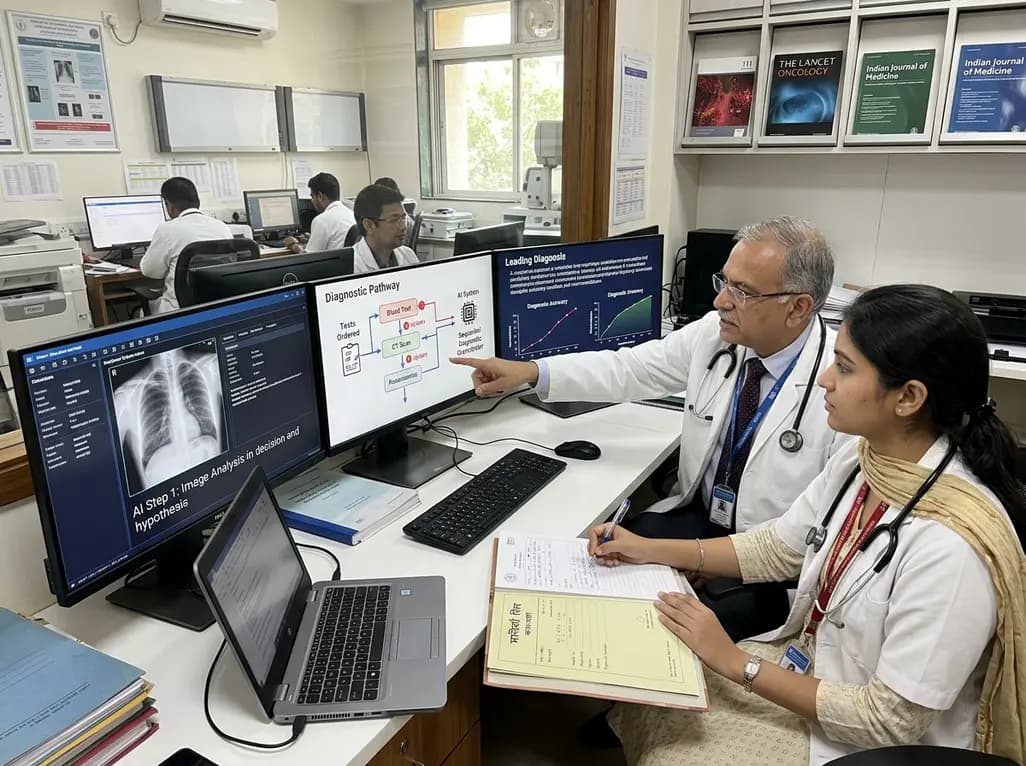
A breakthrough peer-reviewed study demonstrates that a sequential AI diagnosis system can mirror real-world clinical reasoning. By ordering stepwise tests and updating hypotheses dynamically, this multi-agent orchestrator achieved superior diagnostic accuracy while reducing investigative costs.
Today

A prenatal case highlights severe glutaric acidemia type II presenting as bilateral hyperechoic cystic kidneys at 18 weeks. Whole-exome sequencing revealed a novel homozygous ETFDH frameshift variant, demonstrating the power of rapid genetic testing in fetal renal anomalies.
Today

Review how tailored exercise programs benefit frail older patients with heart failure. Explore pathophysiological mechanisms, individualized training prescriptions, and strategies to overcome adherence barriers in clinical practice.
Yesterday

This comparative study evaluates posterior labral tears with and without glenohumeral instability, highlighting distinct demographic patterns, MRI underestimation in stable shoulders, and successful arthroscopic repair outcomes.
Yesterday

A clinical study demonstrates that early intervention with tocilizumab, either as monotherapy or bridged with corticosteroids, achieves significant proptosis reduction and resolves active inflammation in treatment-naive thyroid eye disease.
Yesterday
