.webp&w=384&q=75)

Loading, please wait...
Loading, please wait...

The implementation of HIS 2.0 digitalization at PGI Chandigarh faces a new review by the Health Ministry. This intervention follows a two-year stall in the institute's primary digital transition. Moreover, the project's delay significantly hinders critical tasks like data mining and clinical research. Consequently, the ministry seeks to resolve administrative bottlenecks that prevent the modernization of this premier medical facility. However, the reliance on outdated systems continues to affect daily operations.
Modernizing hospital information systems provides clinicians with integrated electronic medical records. Therefore, HIS 2.0 digitalization is vital for streamlining patient care across multiple departments. Furthermore, it introduces advanced queue management systems to reduce overcrowding in OPDs. This upgrade allows researchers to analyze trends across a massive patient database more efficiently. Additionally, it supports the integration with the Ayushman Bharat Digital Mission for better interoperability. Thus, a functional digital ecosystem is essential for institutional growth.
The original contract followed a single-tender process with C-DAC. However, the project's scope expanded to include 19 modules and mobile applications. This increased complexity led C-DAC to express concerns over meeting the original timelines. In response, C-DAC submitted a revised proposal totaling Rs 60.50 crore. This new plan includes cloud infrastructure and disaster recovery management. Nevertheless, the ministry has tasked PGI with reworking the memorandum to ensure transparency and accountability. Meanwhile, patients must navigate manual, paper-based workflows during this transition period.
The lack of a modern framework severely affects clinical data mining. Without electronic medical records, faculty cannot efficiently analyze patient outcomes. Specifically, paper records slow down longitudinal studies and trend identification. Moreover, digital payment systems are necessary to prevent financial fraud within the hospital administration. Modernizing the system will eventually facilitate QR-code-based appointments and integrated billing. For now, the institute remains reliant on the outdated HIS 1.0 framework. Consequently, faculty and patients must wait for the modernization promised years ago.
Q1: Why is the Health Ministry reviewing the PGI and C-DAC agreement?
The ministry is reviewing the MoU due to a two-year project stall and concerns regarding the original single-tender allocation. They aim to address the expanded scope and the revised cost of Rs 60.50 crore.
Q2: What clinical features does HIS 2.0 offer for doctors?
HIS 2.0 provides 19 modules, including integrated electronic medical records (EMR) and data mining tools. It also features a Queue Management System (QMS) and mobile apps to streamline patient flow.
Q3: How does the delay affect clinical research at PGI Chandigarh?
The delay prevents researchers from accessing streamlined digital data. Without EMRs, analyzing trends across the institute's massive patient database becomes manual and time-consuming, slowing down medical publications and outcomes research.
Disclaimer: This content is for informational and educational purposes only. It does not constitute medical advice or replace professional judgment. Refer to the latest local and national guidelines for clinical practice.
References

Read summarized clinical updates, watch expert medical content, and earn CME certifications right from your smartphone.
Open your smartphone camera to scan and install.





The Union Health Ministry directs PGI Chandigarh to review the HIS 2.0 MoU with C-DAC due to two-year delays, impacting research and modern patient care....
6 months ago
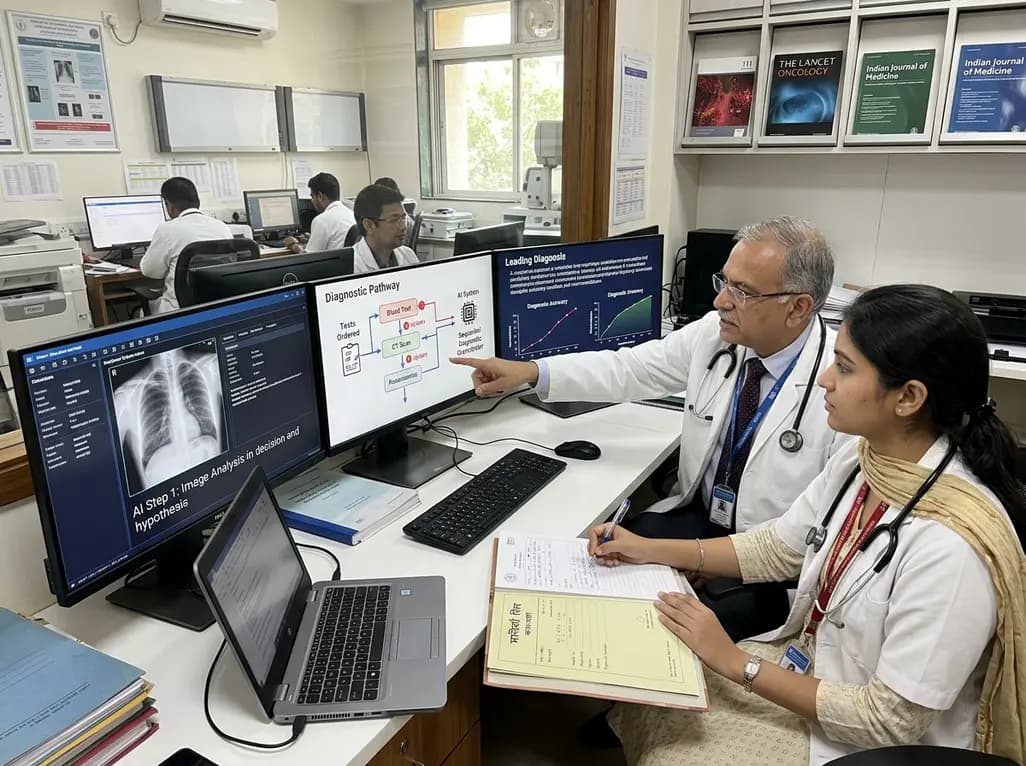
A breakthrough peer-reviewed study demonstrates that a sequential AI diagnosis system can mirror real-world clinical reasoning. By ordering stepwise tests and updating hypotheses dynamically, this multi-agent orchestrator achieved superior diagnostic accuracy while reducing investigative costs.
Today

A prenatal case highlights severe glutaric acidemia type II presenting as bilateral hyperechoic cystic kidneys at 18 weeks. Whole-exome sequencing revealed a novel homozygous ETFDH frameshift variant, demonstrating the power of rapid genetic testing in fetal renal anomalies.
Today

Review how tailored exercise programs benefit frail older patients with heart failure. Explore pathophysiological mechanisms, individualized training prescriptions, and strategies to overcome adherence barriers in clinical practice.
Yesterday

This comparative study evaluates posterior labral tears with and without glenohumeral instability, highlighting distinct demographic patterns, MRI underestimation in stable shoulders, and successful arthroscopic repair outcomes.
Yesterday

A clinical study demonstrates that early intervention with tocilizumab, either as monotherapy or bridged with corticosteroids, achieves significant proptosis reduction and resolves active inflammation in treatment-naive thyroid eye disease.
Yesterday
