.webp&w=384&q=75)

Loading, please wait...
Loading, please wait...

Scientists recently identified how specific nanoconstruct targeting features improve the efficacy of cancer-targeted therapies. Small-molecule ligands like folic acid offer excellent chemical stability and controlled synthesis. However, they face significant hurdles once they enter the human body. Specifically, a “protein corona” forms and blocks these ligands from reaching their intended targets. This nonspecific protein coating physically obstructs targeting because the proteins are much larger than the small-molecule ligands.
Consequently, the nanoparticle's shape plays a critical role in overcoming this biological barrier. In a recent study, researchers compared smooth nanoparticles to those with spiky cores. They utilized dot blot assays and single-particle analysis to track how these shapes interact with cancer cell membranes. Furthermore, the results indicated that high-curvature features, such as spiky tips, significantly improve ligand binding. These sharp features allow the ligands to remain accessible even when the nanoparticle is coated with blood proteins.
Therefore, designing nanoparticles with high-curvature surfaces may be a game-changer for precision drug delivery. Because the spiky tips protrude through the protein corona, the folic acid ligands can successfully find and bind to folate receptors on cancer cells. This discovery suggests that morphology is just as important as chemistry in nanomedicine design. In addition, this approach could reduce the dosage required for treatment. This reduction eventually minimizes side effects for oncology patients.
The protein corona is a layer of various proteins that stick to the surface of a nanoparticle once it enters the bloodstream. This layer acts as a physical shield, preventing the small targeting ligands on the nanoparticle from recognizing and binding to the receptors on cancer cells.
High-curvature shapes, like spikes or nanostars, provide sharp points that extend beyond the thickness of the protein corona. This structure ensures that the targeting molecules located at the tips remain exposed and functional, allowing for more precise interaction with cellular targets.
Disclaimer: This content is for informational and educational purposes only. It does not constitute medical advice or a professional recommendation. Refer to the latest local and national guidelines for clinical practice.
References
Chiu J et al. High-Curvature Features Improve Targeting of Nanoconstructs with Small-Molecule Ligands. Nano Lett. 2026 Mar 24. doi: 10.1021/acs.nanolett.5c06554. PMID: 41875423.
Walkey CD, et al. Nanoparticle Size and Surface Chemistry Determine Serum Protein Adsorption and Macrophage Uptake. ACS Nano. 2024;6(3):2486-2500.
Monopoli MP, et al. Physical-chemical aspects of protein corona: relevance to quaternary structure and biological interactions. Journal of the American Chemical Society. 2025;134(26):10738-10741.

Read summarized clinical updates, watch expert medical content, and earn CME certifications right from your smartphone.
Open your smartphone camera to scan and install.





High-curvature nanoparticle features improve cancer targeting by mitigating the obstructive effects of the protein corona on small-molecule ligands....
6 months ago
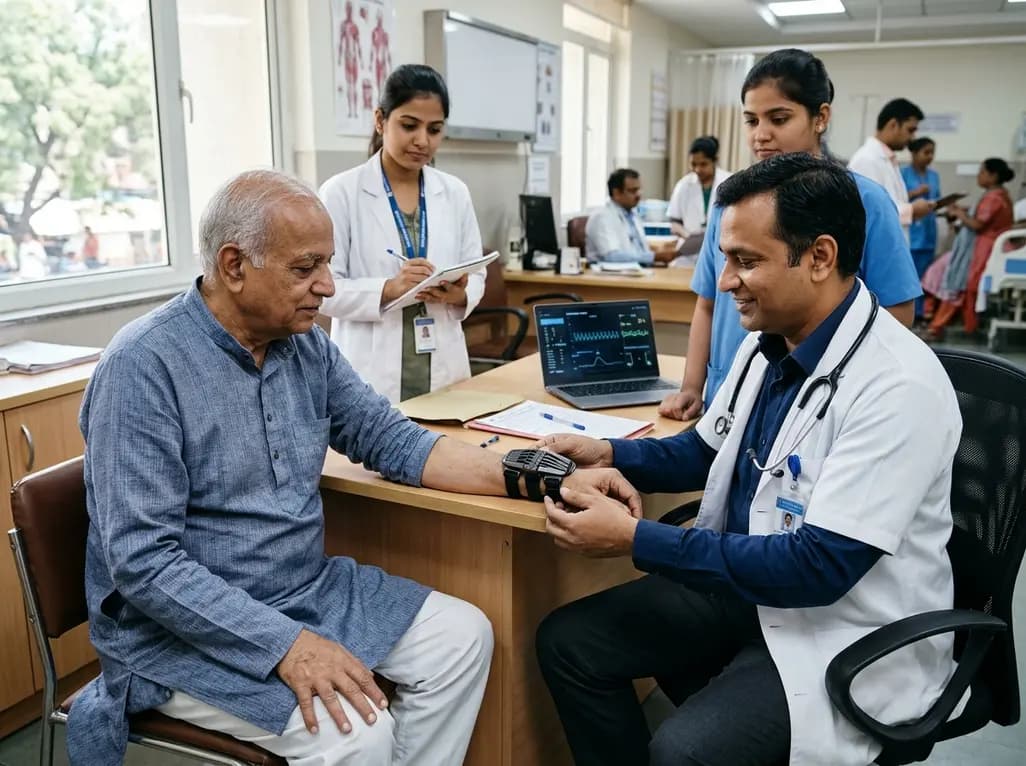
The TREM-AB open-label pilot study evaluated a wearable passive nonlinear vibration absorber for essential tremor. The Nonlinear Energy Sink bracelet reduced clinical Fahn-Tolosa-Marin tremor scores by 32.1% and electrophysiological tremor power by 49.2% with no adverse effects reported.
Today

A study in JAMIA Open shows lightweight open-source reasoning LLMs achieve up to 95% sensitivity and accelerate evidence synthesis screening by nearly twentyfold, presenting a cost-effective, scalable AI solution for biomedical research and systematic reviews.
Today

A landmark study details how an enterprise pediatric remote patient management model expanded from a single cardiology pilot to 16 diverse specialty programs by combining centralized digital operations with specialty clinical leadership.
Today

A comparative review of tension band wiring and intramedullary screw fixation in thumb metacarpophalangeal arthrodesis, evaluating union rates, hardware complications, and clinical outcomes.
Today

A breakthrough ultrathin multimodal sensor decouples physical hemodynamic monitoring from disposable electrochemical calibration, achieving long-term wearable glucose prediction with 81.36% accuracy and a 9.12% MARD. This offers a robust, drift-free solution for outpatient metabolic surveillance.
Today
