.webp&w=384&q=75)

Loading, please wait...
Loading, please wait...
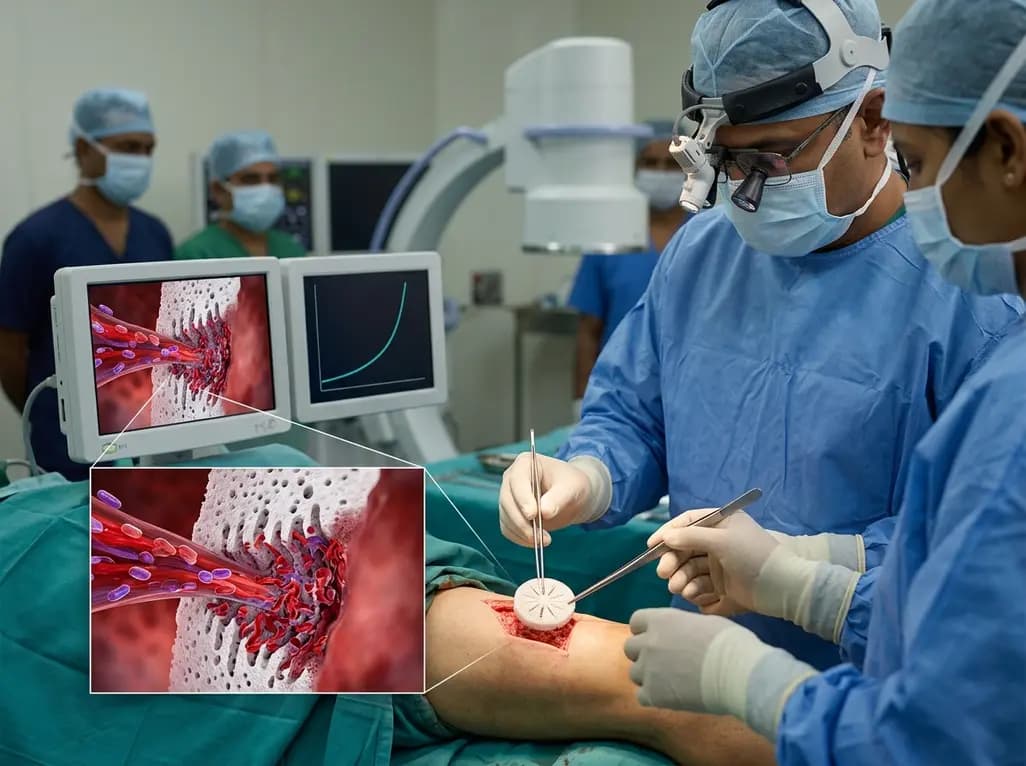
Uncontrollable bleeding in non-compressible bone defects remains a significant challenge in modern surgical practice. To address this, researchers developed a novel hemostatic sponge for bone defects using silk fibroin. This material features a unique architecture of radially aligned microchannels that overcomes the typical trade-off between fluid absorption and structural stability.
The sponge utilizes an elastic network crosslinked with ethylene glycol diglycidyl ether. This structure increases mechanical robustness significantly. Specifically, the radial architecture creates a powerful Laplace pressure gradient. Consequently, the material achieves a 16-fold increase in fluid absorption compared to standard random sponges. This rapid transport effectively sieves and concentrates blood cells at the injury site.
Surface modification with chitosan provides a positive charge to the scaffold. This charge enables strong electrostatic adhesion to blood cells. Furthermore, the integration of thrombin protein corona particles triggers activated biological coagulation. Molecular dynamics simulations reveal a highly favorable binding energy of -107.93 kcal/mol for this process. In rat calvarial models, this synergistic approach achieved hemostasis in only 64 seconds. However, standard random sponges required 185 seconds to reach the same result.
This innovative design offers a promising paradigm for surgical materials. By integrating structural design with biochemical cues, clinicians can manage bleeding more effectively in complex bone injuries. Thus, this technology may improve outcomes in orthopedic and dental procedures where traditional compression is difficult.
Radially aligned microchannels are structured pores that point toward a central axis. This specific geometry creates a pressure gradient that pulls fluids inward much faster than randomly oriented pores. In this sponge, it enables ultra-fast blood absorption and cell sieving.
Chitosan confers a positive surface charge to the silk fibroin structure. Because blood cell membranes are typically negatively charged, the chitosan creates a strong electrostatic bond. This adhesion helps trap cells within the microchannels to form a stable clot quickly.
Yes, the inclusion of thrombin provides a critical biological trigger. While the microchannels physically concentrate cells, the thrombin particles activate the natural coagulation cascade. This dual action ensures both rapid physical blockage and stable biological sealing.
Disclaimer: This content is for informational and educational purposes only. It does not constitute medical advice or a professional recommendation. The clinical performance described is based on experimental models. Refer to the latest local and national guidelines for clinical practice.
References
Zhang S et al. Radially Aligned Microchannels in a Hemostatic Sponge: Orchestrating Directional Transport, Active Sieving, and Coagulation. Adv Healthc Mater. 2026 May 31. doi: 10.1002/adhm.71312. PMID: 42218729.

Read summarized clinical updates, watch expert medical content, and earn CME certifications right from your smartphone.
Open your smartphone camera to scan and install.





A new silk fibroin sponge with radially aligned microchannels offers ultra-fast hemostasis in bone defects by integrating physical and biological mechanisms...
4 months ago

Novel diimide and hydrazone scaffolds, particularly compound #C4, synergistically reactivate latent HIV-1 when combined with JQ1 or PKC activators. Demonstrating donor-matched proviral transcription ex vivo and non-canonical signaling, these findings advance shock and kill strategies toward reservoir eradication.
Today

A comparative cohort study evaluates vNOTES vs TLH hysterectomy for benign conditions, demonstrating shorter operative duration, faster return to daily activities, and equivalent female sexual function scores without increased dyspareunia.
Today

Review how tailored exercise programs benefit frail older patients with heart failure. Explore pathophysiological mechanisms, individualized training prescriptions, and strategies to overcome adherence barriers in clinical practice.
Yesterday

This comparative study evaluates posterior labral tears with and without glenohumeral instability, highlighting distinct demographic patterns, MRI underestimation in stable shoulders, and successful arthroscopic repair outcomes.
Yesterday

A clinical study demonstrates that early intervention with tocilizumab, either as monotherapy or bridged with corticosteroids, achieves significant proptosis reduction and resolves active inflammation in treatment-naive thyroid eye disease.
Today
