.webp&w=384&q=75)

Loading, please wait...
Loading, please wait...

The Union Health Ministry recently unveiled advanced healthcare fraud detection AI tools to safeguard the Ayushman Bharat PM-JAY scheme. These innovative systems aim to identify forged medical documents and fraudulent hospital bills during the claim settlement process. Consequently, the government hopes to enhance transparency and ensure that benefits reach genuine patients across India.
During the AB PM-JAY Auto-Adjudication Hackathon Showcase 2026, officials presented technologies capable of analyzing diverse medical records. For instance, multilingual OCR systems can now scan low-quality documents to verify compliance with standard treatment guidelines. Furthermore, these AI models can detect manipulated discharge summaries and ghost beneficiaries. This technological leap is essential because the scheme processes nearly 40,000 claims every single day.
Moreover, the National Health Authority (NHA) introduced a benchmarking platform called BODH. Developed in collaboration with IIT Kanpur, this platform uses India-specific datasets to validate AI models. Since clinical patterns in India differ from global datasets, this localized approach ensures higher accuracy. Therefore, doctors and administrators can expect a more reliable claims adjudication process that minimizes manual errors.
The integration of AI has already significantly reduced processing timelines. Specifically, average claim settlement times have dropped from twenty days to just four hours in many cases. Additionally, the NHA reported that existing anti-fraud measures have prevented fraudulent claims worth over ₹630 crore. By identifying deepfake-generated documents and altered radiological images, these tools protect public funds effectively. Hospitals must now ensure high-quality documentation to align with these automated verification standards.
Q1: How does AI detect fraudulent medical claims in PM-JAY?
AI systems use multilingual OCR and machine learning to analyze scanned documents, X-rays, and MRIs. They identify inconsistencies in treatment patterns, manipulated images, and forged signatures that manual reviews might miss.
Q2: What is the BODH platform mentioned by the NHA?
BODH is an open benchmarking and data platform for health AI. It allows developers to test their models against diverse Indian datasets to ensure they are safe and effective for the local population.
Disclaimer: This content is for informational and educational purposes only. It does not constitute medical advice or replace professional judgment. Refer to the latest local and national guidelines for clinical practice.
References

Read summarized clinical updates, watch expert medical content, and earn CME certifications right from your smartphone.
Open your smartphone camera to scan and install.





The Centre unveiled advanced AI tools at the AB PM-JAY Hackathon 2026 to detect fake medical claims and speed up billing under the Ayushman Bharat scheme....
5 months ago
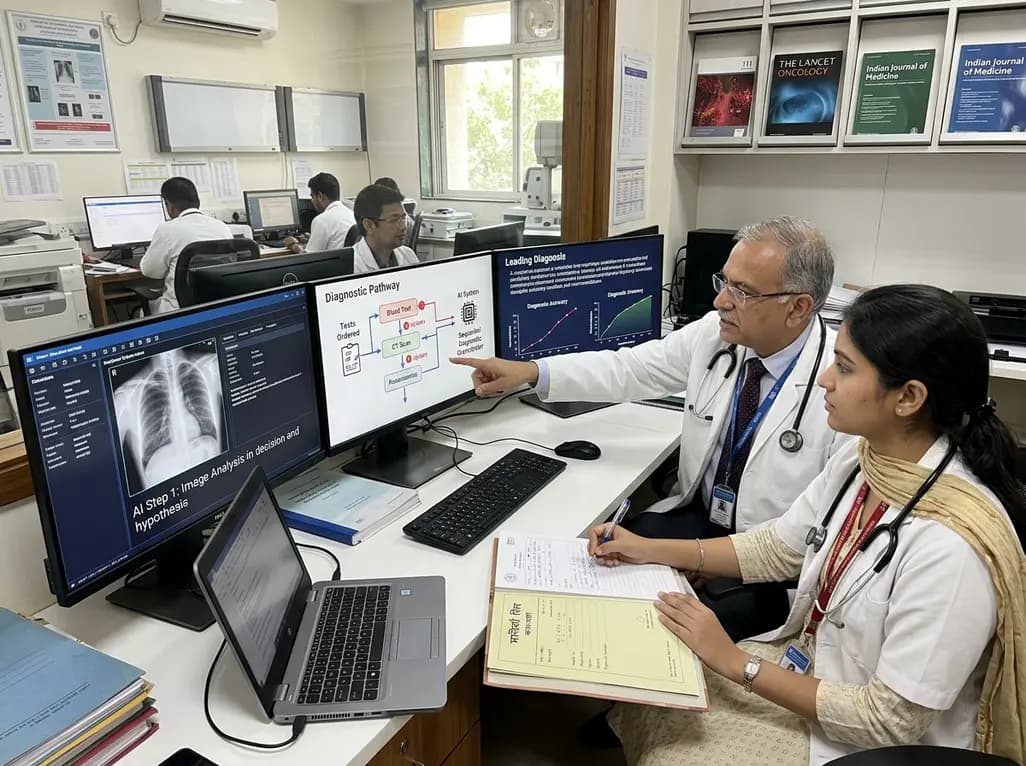
A breakthrough peer-reviewed study demonstrates that a sequential AI diagnosis system can mirror real-world clinical reasoning. By ordering stepwise tests and updating hypotheses dynamically, this multi-agent orchestrator achieved superior diagnostic accuracy while reducing investigative costs.
Today

A prenatal case highlights severe glutaric acidemia type II presenting as bilateral hyperechoic cystic kidneys at 18 weeks. Whole-exome sequencing revealed a novel homozygous ETFDH frameshift variant, demonstrating the power of rapid genetic testing in fetal renal anomalies.
Today

Review how tailored exercise programs benefit frail older patients with heart failure. Explore pathophysiological mechanisms, individualized training prescriptions, and strategies to overcome adherence barriers in clinical practice.
Yesterday

This comparative study evaluates posterior labral tears with and without glenohumeral instability, highlighting distinct demographic patterns, MRI underestimation in stable shoulders, and successful arthroscopic repair outcomes.
Yesterday

A clinical study demonstrates that early intervention with tocilizumab, either as monotherapy or bridged with corticosteroids, achieves significant proptosis reduction and resolves active inflammation in treatment-naive thyroid eye disease.
Yesterday
